
Takkyubin in Japan: Forwarding Luggage to Hotels and Airports
Takkyubin lets you send suitcases between hotels, airports and homes in Japan. Learn drop-off points, size limits, costs and how to fill in the shipping form.
Affiliate link — we may earn a commission at no extra cost to you. Affiliate disclosure
What takkyubin is and when to use it
Takkyubin (宅急便) is Japan's domestic luggage delivery service. You can send a suitcase from one hotel to another, to an airport, or to a home address. It is most useful when you want to travel by Shinkansen or local trains without hauling bags.
Operators include Yamato Transport, Sagawa Express, JAL ABC, Luggage-Free Travel, QL Liner and Airporter (JNTO luggage-free guide). Yamato Transport, with its black cat logo, is the one most travellers see at hotels and convenience stores.
Prices depend on size, weight, distance and operator. Check the operator's website or ask at the counter for current rates and cutoff times.
How to send a bag: step by step
- Pack and close your bag. Keep valuables, fragile items, fresh products, liquids and dangerous goods out of forwarded luggage; operators do not accept them (JNTO Luggage & Storage).
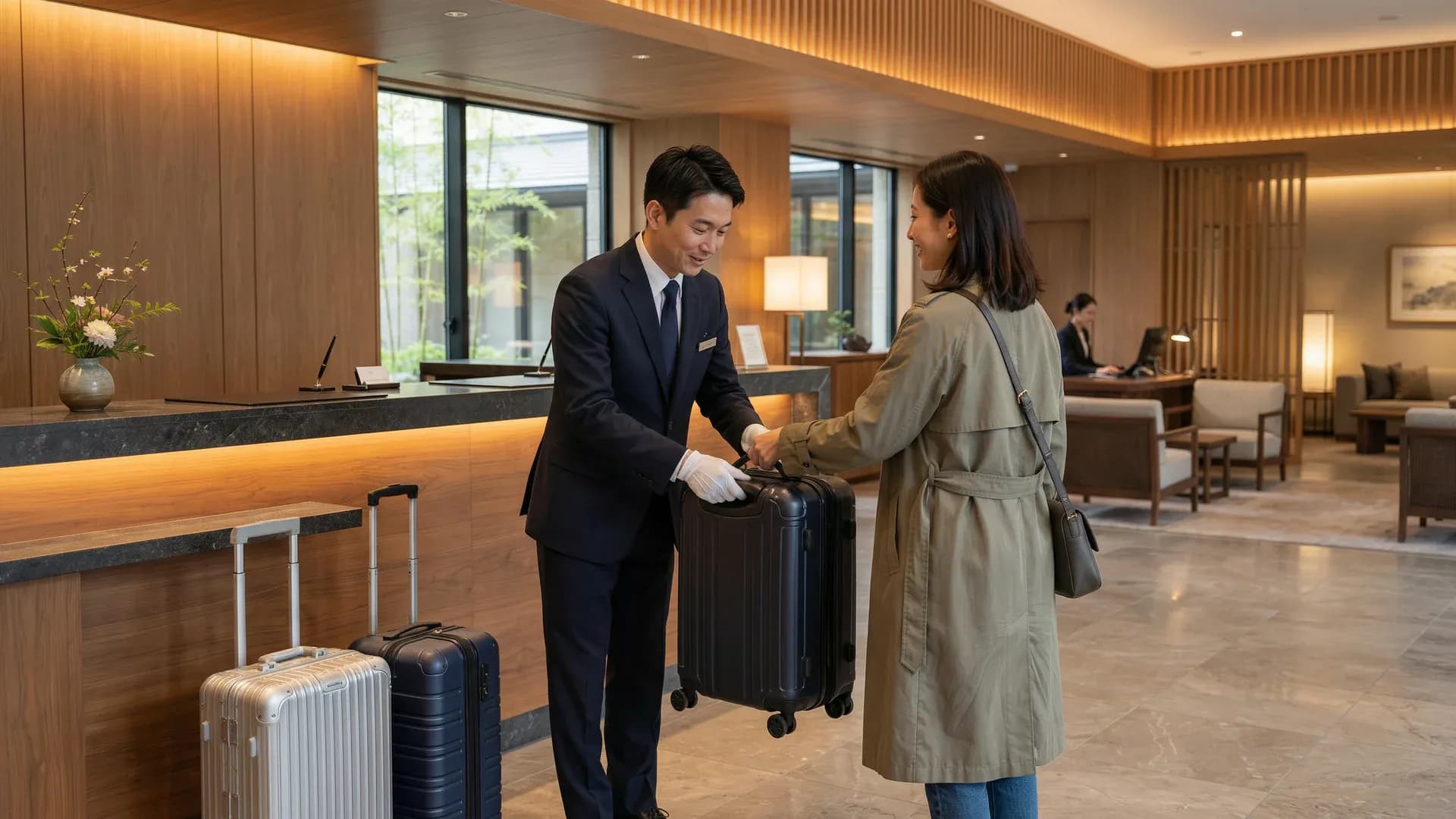
- Ask your hotel front desk for a takkyubin shipping form (送り状, okurijō). Many hotels can help guests send bags to their next destination; it is usually as simple as filling in a delivery slip and leaving the bag at the front desk (JNTO Traveling Comfortably).
- Write the destination hotel name, address, phone number, your name and the arrival date. For an airport, write the airport and terminal or counter if you know it.
- Choose a delivery date if the service offers one. If you need the bag on a specific day, write that date and allow a buffer.
- Pay at the hotel or drop-off point. Ask whether any handling fee applies.
- Keep the receipt and tracking number. You can check the bag's status with the tracking number (JNTO Hands-Free Travel guide).
Where to drop off
Drop-off point | How it works | Notes |
|---|---|---|
Hotel front desk | Most major hotels can arrange delivery to your next hotel; ask staff to help with the form (JNTO Luggage & Storage). | Convenient if your hotel offers the service. |
Convenience store | Some convenience stores accept takkyubin parcels, but space for large bags is limited and some stores may suspend the service or restrict size and quantity (JNTO Traveling Comfortably). | Check with the store before bringing a large suitcase. |
Yamato or Sagawa counter | Yamato has service counters nationwide; Sagawa has drop-off counters at train stations and tourist centres in Tokyo, including Asakusa and Tokyo Skytree (JNTO luggage-free guide). | Useful if you are not staying at a hotel. |
Airport counter | Yamato lists reception and sending counters at major airports including Narita, Haneda and Kansai (Yamato airport counter list). | Use the counter to send bags to your hotel or home, or to collect bags sent ahead. |
Typical costs and size limits
Yamato accepts parcels up to 200 cm (length + width + height) and 30 kg, with no single side longer than 170 cm; a typical large suitcase fits the 160 size, which allows up to 160 cm and 25 kg (Yamato size FAQ). JNTO notes that many services set limits such as 160 cm and 25–30 kg, with contents valued under ¥300,000 (JNTO Luggage & Storage).
Fares rise with size and distance. In Yamato's cash fare table applying from 1 October 2025, a 160-size parcel sent within the Kanto area costs ¥3,020, and the same size sent from Kanto to Okinawa costs ¥4,680; check the live price before booking (Yamato fare table).
For trip budgeting, see the Japan budget breakdown.
Hotel-to-hotel forwarding
Ask your hotel to send your suitcase to your next hotel. Depending on distance, some companies offer same-day delivery if you drop off before 11am; otherwise allow at least a day (JNTO luggage-free guide). Travel with a daypack and collect the bag at your next hotel's reception. If you arrive before the bag, ask the hotel to store it until it arrives.
For example, on a Tokyo-to-Kyoto trip, send your bag from your Tokyo hotel before you take the Shinkansen. Check in at your Kyoto hotel and collect the bag when it arrives. If you're booking a hotel in Kyoto, check Booking.com for Kyoto hotels. Some links on this page are affiliate links; see the affiliate disclosure.
If you're planning a lot of train travel, see the JR Pass guide and Japanese hotel types.
Airport forwarding
Arriving: at Narita, Haneda and Kansai, you can send bags from the airport to your hotel. Look for the designated delivery counter; Yamato lists its reception and sending counters at these airports (Yamato airport counter list). Some services offer same-day delivery if you send before 11am; otherwise allow until the next day (JNTO luggage-free guide). Pack essentials in a carry-on.
Departing: Yamato's airport takkyubin asks you to send bags by two days before departure (three days in some areas). Your bag is delivered to the departure airport by the day before, and you collect it at the partner counter on departure day. Sending to an airport costs an extra ¥660 airport fee (2025) (Yamato airport takkyubin). Confirm the counter location and opening hours with your hotel and the airport.
For airport-specific transfer advice, see airport guides, Narita to Tokyo, Haneda to Tokyo, and Kansai to Osaka. If you'd rather not handle bags on arrival, compare private airport transfers with Kiwitaxi.
What not to ship
Do not put valuables such as passports, tickets, credit cards or money in forwarded luggage; operators also do not accept fragile items, fresh products, liquids or dangerous goods (JNTO Hands-Free Travel guide; JNTO Luggage & Storage). Keep these with you.
Luggage forwarding is not a substitute for travel insurance. JNTO strongly recommends travel insurance for visitors (JNTO travel insurance), and there is a separate Japan travel insurance guide.
Timing and planning tips
- For airport forwarding, send by Yamato's deadline: two days before departure (three days in some areas) (Yamato airport takkyubin).
- For hotel-to-hotel forwarding, allow at least a day unless the operator offers same-day delivery; some same-day services require drop-off before 11am (JNTO luggage-free guide).
- Yamato's same-day service, introduced on 10 November 2025, requires a morning drop-off at a participating Yamato office and costs the standard fare plus ¥550 (2025); the earliest delivery slot is after 14:00 (Yamato same-day service).
- Keep a daypack with essentials for a day or two.
- Confirm your next hotel accepts luggage before check-in.
- Take a photo of the label and keep the tracking number.
- Ask about handling fees.
- For maps and tracking, an Airalo eSIM can keep you online.
- See the Japan packing list for what to keep in your daypack.
When takkyubin is not the best choice
- Same-day delivery: Yamato's same-day service is limited to morning drop-off at participating offices and is not available for airport takkyubin or round-trip takkyubin; the fee is the standard fare plus ¥550 (2025) (Yamato same-day service). If you need same-day delivery outside that service, ask the operator directly or use a taxi or private transfer.
- Tight schedules: next-day delivery may not fit.
- Long-distance or remote destinations: delivery may take longer.
- Oversized or heavy items: Yamato's maximum is 200 cm and 30 kg, so larger or heavier bags may be refused or cost more (Yamato size FAQ).
- Valuables: don't ship them (JNTO Hands-Free Travel guide).
Sources
Ready to explore Japan?
Browse tours and activities, or tell us what you're looking for and we'll suggest the best options.
Stay Connected in Japan
Airalo eSIMs work on arrival — no physical SIM needed. Data plans from $5 for 7 days.
Travel Insurance for Japan
Medical, trip cancellation, and adventure sports covered. Plans from $1.5/day.