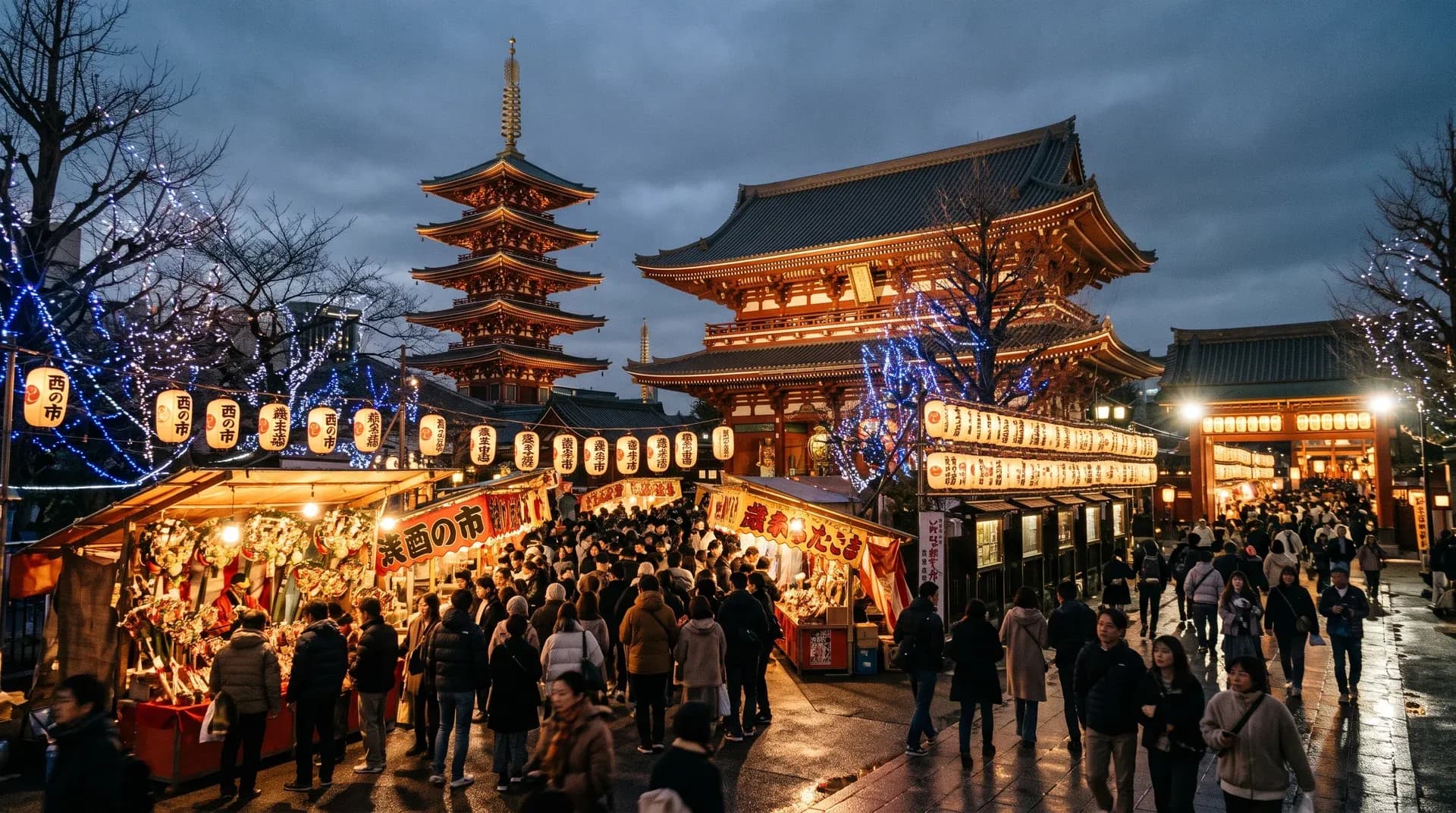
Tokyo in December: Light Displays, Year-End Markets &
This guide unlocks Tokyo's December 2026 calendar of light displays, traditional year-end markets, and cultural events before New Year. Expect ¥8,000-12,000 per day for mid-range stays, with the Tokyo Metro 24-hour pass at ¥1,000.
Affiliate link — we may earn a commission at no extra cost to you. Affiliate disclosure
Stepping off the train at Tokyo Station in December 2026, you'll immediately notice the scent of roasted chestnuts and the glow of thousands of LED lights strung overhead like festive garlands. The city transforms into a winter wonderland of illumination, with every major district unveiling its signature light displays by mid-November. This is your guide to navigating Tokyo's December 2026 calendar of light displays, traditional year-end markets, and cultural events that build momentum toward Oshogatsu, the New Year celebrations.
For first-time visitors, December offers a unique blend of holiday magic and cultural immersion without the overwhelming crowds of cherry blossom season. Budget travelers should expect daily costs between ¥8,000-12,000 for accommodation, food, and transport, with the Tokyo Metro 24-hour pass at ¥1,000 providing excellent value for the extensive light display circuit.
Essential Highlights & Local Itinerary
The core December experience in Tokyo revolves around major illumination displays and traditional markets. Tokyo Midtown in Minato Ward kicks off the season with its Roppongi Hills Mori Tower light display, running from November 25 through January 15, 2027. The complex features over 2 million LED lights creating dynamic patterns across the tower's facade. Take the Toei Mita Line to Roppongi Station and exit through Exit 3, then walk approximately five minutes south along Roppongi-dori toward the Mori Tower entrance. Plan to spend 90 minutes here between 6-8 PM when the full display activates each evening. The surrounding garden area also hosts a seasonal ice-skating rink that operates on a first-come, first-served basis; opening hours vary from 10 AM to 9 PM depending on weather conditions, so check the Tokyo Midtown website before you go. Admission to the light display is free, though the ice rink charges ¥500-700 for skate rental if you wish to try the rink.
Shibuya Sky, the observation deck above Shibuya Scramble Square, presents a different perspective with its constellation-themed lighting running through January 14, 2027. Access via JR Yamanote Line to Shibuya Station, then follow the clear signage to the Shibuya Scramble Square elevator lobby on the second floor and ride the high-speed elevators to the 45th floor. Allocate 60 minutes for the visit, best experienced after sunset around 5:30 PM when both the observation deck lighting and the famous Shibuya crossing below become fully illuminated. The deck offers a 360° panorama of the illuminated Shibuya crossing and the distant Tokyo Tower; ticket prices vary by time slot ranging from ¥2,000-3,500, and advance online reservation is strongly recommended during peak weeks from December 15 through December 30. Morning slots from 9-11 AM offer fewer crowds and allow you to see the transition from daylight to the evening illumination setup.
Tokyo Station's Marunouchi side transforms into a winter wonderland with its Illuminations event, featuring over 3,000 lights and a large Christmas tree. Take the JR Yamanote, Sobu, or Chuo Lines to Tokyo Station, then walk to the Marunouchi side via the Yaesu Central Exit and head north toward Nihonbashi-dori. Plan 45 minutes between 5-7 PM when the display reaches peak brightness each evening. The nearby Marunouchi Building houses a seasonal pop-up shop selling limited-edition ornaments; opening hours are 10:30 AM to 8:30 PM Monday through Friday and 10 AM to 9 PM on weekends. The Tokyo Station brick warehouse area also features illuminated holiday markets with artisan vendors selling handmade gifts and regional specialties from various prefectures.
The Imperial Palace East Gardens host their annual illumination from December 1 through January 14, offering a more refined, traditional light display that highlights the historic stone walls and pine groves. Access via Tokyo Metro Chiyoda Line to Tokyo Station, then follow the signs to the East Gardens entrance near the Otemon Gate. Allocate 75 minutes between 5-7 PM, avoiding weekends when crowds gather for the nearby New Year's calligraphy workshops at Bunkyo Civic Center in Bunkyo Ward. The gardens close at sunset; exact closing time varies by season but typically ranges from 4:30 PM to 5:30 PM in December. Admission to the East Gardens is free, though guided tours are available for ¥500-800 with English audio guides.
Ueno Park's light displays extend through January 14, with installations throughout the 55-hectare park including the famous Shinobazu Pond reflection display that mirrors the illuminated pagoda. Take the JR Yamanote Line to Ueno Station, then walk 10 minutes north to the park entrance via the Park Exit (Koraku-guchi). Plan 90 minutes between 6-8 PM, allowing time to explore multiple installations such as the lantern-lined pathway near the Tokyo National Museum and the interactive light tunnel near the Ueno Zoo entrance. The park remains open 24 hours, but individual installations may have separate operating hours that vary by location and attraction. The nearby Ueno Winter Market operates from December 1 through January 15 near the park's south gate, featuring over 150 stalls selling local crafts, food, and holiday gifts.
The Sumida Aquarium area features a winter-themed light display from December 1 through February 28, accessible via Tokyo Metro Hibiya Line to Hibiya Station, then transfer to Toei Asakusa Line to Azabu-Juban Station. Allocate 60 minutes between 5-7 PM when the aquarium lighting complements the external displays. The aquarium itself offers a special "Winter Night" ticket that includes entry to the illuminated tanks; ticket prices vary from ¥2,200 for general admission to ¥3,500 for the premium winter experience with special programming.
Traditional Markets & Seasonal Shopping
For traditional markets, the Bunkyo Shopping Street in Bunkyo Ward offers year-round winter produce and seasonal items, with special New Year preparations visible from December 10 onwards. Take the Tokyo Metro Hibiya Line to Hibiya Station, then walk 15 minutes north along Kasuga-dori to the shopping street that stretches between Hibiya and Kanda districts. Spend 45-60 minutes browsing local specialties such as dried persimmons, sweet potato chips, and hand-crafted kadomatsu (gate pine decorations). Vendor hours vary; most stalls open around 10 AM and close by 7 PM, though New Year preparation vendors extend their hours until 8 PM beginning December 15. The street is particularly famous for its traditional sweet potato chips made fresh daily and sold in paper bags for ¥300-500 per bag.
The Nihonbashi area hosts its annual Komeibutsu (rice cake) festival from December 5 through December 25, featuring traditional wagashi and seasonal snacks. Access via Tokyo Metro Ginza Line to Nihonbashi Station, then walk 5 minutes north to the main street (Chuo-dori) where the festival tents are set up along the pedestrian section between Nihonbashi and Mitsukoshimae stations. Plan 30-45 minutes for sampling local specialties like kusa-mochi (herb-flavored rice cake) and yuzu-flavored manjū. Festival stalls typically operate from 11 AM to 8 PM; exact hours vary by vendor, with some specialty shops remaining open until 9 PM during peak weekend periods.
The Tokyo Skytree Town Solamachi complex in Sumida Ward features its annual Winter Illumination from December 1 through January 31, with over 10,000 lights decorating the shopping mall's interior and exterior spaces. Take the Tobu Skytree Line to Tokyo Skytree Station, then follow signs to the Solamachi entrance. Allocate 75-90 minutes to explore the various themed zones including the Christmas Tree Forest, the Light Tunnel, and the Sky Tree observation deck with its own special winter lighting. Admission to the observation deck is ¥2,100 for adults, with discounted rates of ¥1,500 for children between ages 4 and 11.
Practical Details & Dual-Currency Budget
December in Tokyo brings mild winter weather with daytime temperatures ranging from 8-14°C and nighttime lows around 3-8°C. Pack layers and a warm jacket for evening illumination viewing. Peak season runs from December 15 through December 30, with hotel rates increasing 20-30% compared to early December. Shoulder season dates are December 1-14 and December 31 through January 5. Budget travelers can expect daily costs of ¥8,000-10,000 ($55-70 USD, approx. €50-65) covering a hostel bed, convenience store meals, and metro passes. Mid-range travelers should budget ¥12,000-15,000 ($85-105 USD, approx. €80-100) for business hotel stays, restaurant meals, and occasional taxi rides. The Tokyo Metro 24-hour pass at ¥1,000 ($7 USD, approx. €6.5) provides excellent value for the illumination circuit, while the 48-hour pass at ¥1,500 ($10 USD, approx. €9) works well for multi-day exploration. For airport connections, the Narita Express remains the most reliable option at ¥3,070 ($22 USD, approx. €20) to Tokyo Station, while Haneda Airport's Tokyo Monorail costs ¥500-650 ($4-5 USD, approx. €3.5-4.5) to Hamamatsucho Station. Consider the Keikyu Line from Haneda for the most economical option at ¥410 ($3 USD, approx. €2.8) to Shinagawa Station, then transfer to the JR Yamanote Line. IC cards like Suica and Pasmo work seamlessly across all systems and are essential for convenient travel. Download the Tokyo Metro app for real-time train information and navigation assistance. Currency exchange counters at major stations offer competitive rates; rates vary, so compare before committing.
Where to Eat & Local Food Secrets
December in Tokyo brings seasonal delicacies that complement the illumination experience. Start your evening at Tokyo Station's Central Street, where traditional kissaten (coffee shops) serve roasted chestnuts and warm taiyaki from December 1 through January 15. A typical portion costs ¥300-500 ($2-4 USD, approx. €2-3.5). For a proper winter meal, visit Torikizoku in Shibuya for yakitori and ikkaaki (chicken intestine skewers), with each skewer priced at ¥150 ($1 USD, approx. €0.9) and set meals starting at ¥1,200 ($8 USD, approx. €7.5). The chain operates daily from 11:30 AM to 5 AM, making it perfect for late-night illumination viewing. In Ueno, try the traditional oden at Mishimaya, a 100-year-old establishment serving hearty winter stew from ¥1,000 ($7 USD, approx. €6.5) for a small bowl to ¥3,500 ($25 USD, approx. €23) for a large selection. They open at 11:30 AM and serve until closing, with the best experience between 5-7 PM when locals gather after work. For New Year preparation, visit Kagari in Ginza for traditional zoni mochi soup, served from December 1 through January 3, with prices from ¥1,800 ($13 USD, approx. €12) for the standard set. The restaurant requires reservations for groups of four or more, so book at least three days in advance.
Don't miss the seasonal yuzu kosho ramen at any of Tokyo's major stations during December, typically priced at ¥1,200-1,500 ($8-11 USD, approx. €7.5-10) and available from 11 AM to 9 PM. For dessert, visit any of Tokyo Station's character-themed cafes for seasonal parfaits featuring winter fruits and sakura-themed decorations, with prices ranging from ¥1,500-2,000 ($11-14 USD, approx. €10-13). Street-food stalls near the illumination sites also sell hot amazake (sweet fermented rice drink) for ¥200-300 ($1.5-2 USD, approx. €1.3-1.8); availability varies by location. The famous Tsukiji Outer Market offers numerous winter specialties including nabe (hot pot) restaurants and grilled seafood stalls that remain open until late evening, with most establishments operating from 10 AM to 10 PM.
Cultural Events & New Year Preparations
The New Year's calligraphy workshops at Bunkyo Civic Center in Bunkyo Ward run from December 20 through January 5, offering visitors the chance to learn shodo (calligraphy) techniques from experienced instructors. Access via Tokyo Metro Hibiya Line to Hibiya Station, then transfer to Tokyo Metro Chiyoda Line and ride to Kasuga Station, walking 8 minutes north to the civic center. Workshop sessions are held daily except Mondays, from 10 AM to 6 PM with breaks, and cost ¥1,500-2,000 per session. Registration is required in advance through the center's website, with limited spots available for each time slot. The workshops are particularly popular on weekends, so booking at least one week ahead is recommended.
The Tokyo Metropolitan Teien Art Museum in Meguro Ward hosts its annual December evening openings with special winter exhibitions and illuminated gardens. Take the Tokyo Metro Hibiya Line to Roppongi Station, then transfer to Toei Mita Line and ride to Meguro Station, walking 10 minutes east to the museum. Evening openings run from 5 PM to 9 PM on Fridays and Saturdays from December 1 through December 30, with admission priced at ¥1,800 for adults and ¥900 for students. The museum's moonlight garden illumination creates a magical setting particularly suited for evening photography.
Essential Traveler Checklist
- Pack a portable battery pack (¥3,000-5,000 / $21-35 USD, approx. €20-33) as evening illumination viewing drains phone batteries quickly.
- Purchase a Japan Travel SIM or eSIM at Narita/Haneda for ¥3,500-5,000 ($25-35 USD, approx. €23-32) for 7-10 days of data.
- Carry cash for small vendors and traditional markets; most illumination areas have limited card payment options, with ¥10,000-20,000 ($70-140 USD, approx. €65-130) recommended for daily spending.
- Dress in layers with a warm jacket for evening viewing; temperatures drop to 3-8°C after sunset and indoor heating is minimal at many illumination sites.
- Learn basic Japanese phrases like "Sumimasen" (excuse me), "Arigatou gozaimasu" (thank you), and "Okanjou onegaishimasu" (check, please) to smooth interactions at markets and restaurants.
- Bring a compact umbrella or rain-proof shell; December weather can bring sudden drizzle, and many outdoor displays continue in light rain.
- If you plan to visit multiple illumination sites in one night, map the route in advance using the Tokyo Metro app to minimize backtracking and maximize viewing time.
- Keep a small notebook or digital note for jotting down vendor names, special items, and any reservation numbers; Wi-Fi may be spotty in crowded areas.
- Respect local customs: avoid eating while walking in shrine precincts, dispose of trash in designated bins, and keep voices low near residential neighborhoods after 9 PM.
- Download offline maps of Tokyo Station, Ueno, and Shibuya areas as backup navigation when cellular service becomes unreliable in underground passages.
- Bring a reusable shopping bag for market purchases; many vendors charge ¥10-20 for plastic bags, and it's environmentally friendly practice in Japan.
- Check individual attraction websites for special New Year's Eve events and midnight viewing opportunities, as some locations host exclusive programs on December 31 that require separate tickets or advance reservations.
- Consider purchasing a prepaid IC card (Suica or Pasmo) at the airport upon arrival to avoid queuing at station ticket machines; initial cost is ¥2,000 including a ¥500 deposit that's refundable when returning the card.
Related reading
- [Tokyo Tokyo: Tokyo's New Short-Term Rental Laws for 2026](/blog/tokyo-short-term-rental-laws-2026)
- [Tokyo Forest Escape: From Imperial Palace Cafe to Ogasawara ](/blog/tokyo-forest-escape-imperial-palace-cafe-ogasawara)
- [Tokyo November Travel Guide: Weather, Costs & Festival Logis](/blog/tokyo-november-travel-guide-weather-costs-festivals)
- [Tokyo Autumn Festivals Itinerary: Halloween, Food, Godzilla ](/blog/tokyo-autumn-festivals-itinerary)
- [Tokyo Anime and City Guide: Logistics, Costs, and Events](/blog/tokyo-anime-city-logistics-costs)
Sources
- Windswept Whisky: Japan's Northernmost Distillery on Rishiri Island
- Shuri Castle’s main hall reopens after historical restoration
- Things To Do in Tokyo in December 2026
- Golden Ginkgoes and Sporting History: Tokyo’s Meiji Jingū Gaien Turns 100
- New Tokyo train station ticket gates let you walk through without tapping anything at all
Frequently Asked Questions
What is Tokyo December 2026?
This guide unlocks Tokyo's December 2026 calendar of light displays, traditional year-end markets, and cultural events before New Year. Expect ¥8,000-12,000 per day for mid-range stays, with the Tokyo Metro 24-hour pass at ¥1,000. Visit Tokyo Midtown and Roppongi Hills for the biggest illuminations, and check Bunkyo Civic Center for New Year's calligraphy workshops.
Who is Tokyo December 2026 best for?
It suits readers who want a practical, step-by-step path to the outcome described above rather than abstract theory. If you are starting from zero, follow the numbered steps in order and treat the caveats section as a checklist.
How long does Tokyo December 2026 take to work?
Timelines vary with execution, but the workflow in this guide is designed to produce a first measurable result within the timeframes stated in each step. Set expectations from the caveats section, not from hype.
Ready to explore Japan?
Browse tours and activities, or tell us what you're looking for and we'll suggest the best options.
Stay Connected in Japan
Airalo eSIMs work on arrival — no physical SIM needed. Data plans from $5 for 7 days.
Travel Insurance for Japan
Medical, trip cancellation, and adventure sports covered. Plans from $1.5/day.