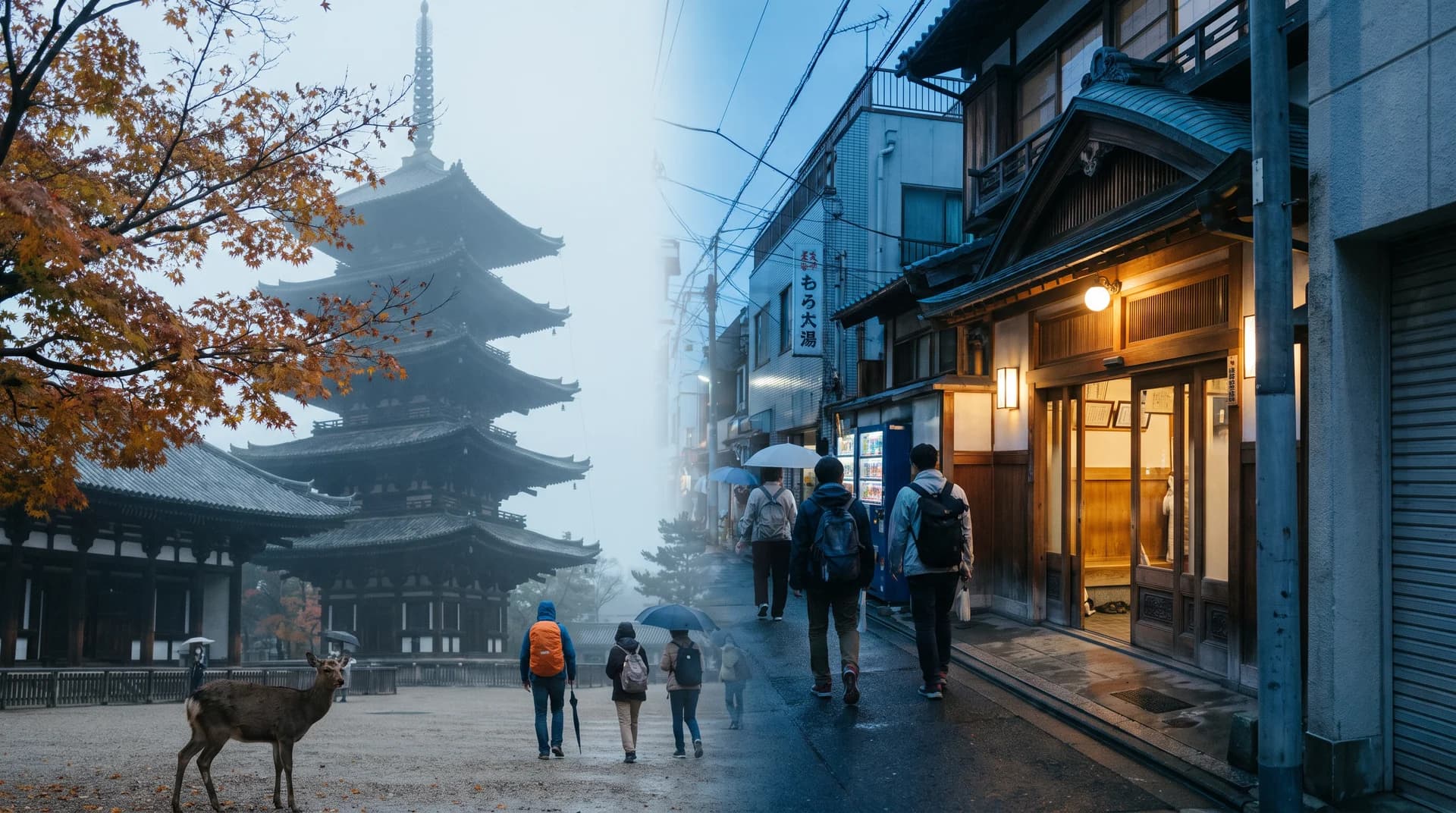
Nara and Tokyo Travel Guide: Culture, Bathhouses, and Logistics
This guide provides a practical itinerary for exploring the Kōfukuji temple in Nara and historic sento bathhouses in Tokyo. Budget approximately ¥10,000–¥15,000 (~$65–$100 USD) per day for mid-range travel.
Stepping into the Kōfukuji temple grounds in Nara, you are met with the sight of a 13-century-old masterpiece: the three-faced, six-armed Ashura statue. This guide is for independent travelers who want to move beyond the surface-level tourist traps, focusing on authentic cultural encounters like the preservation of historic bathhouses in Tokyo and the deep history of Nara. Whether you are planning your first trip or returning for a deeper dive into Japanese heritage, understanding the logistics of local transit and seasonal preparations is essential for a smooth journey.
By Yuko Tanaka, published 2025-01-20, updated 2025-01-20
Essential Highlights & Local Itinerary
Nara: Kōfukuji Temple
Located in the heart of Nara Park, Kōfukuji is a must-visit for anyone interested in Buddhist art. The temple is accessible via a 5-minute walk (400 m) from Kintetsu-Nara Station. The National Treasure Museum houses the famous Ashura statue. Plan to spend at least two hours here to appreciate the intricate expressions carved into the wood. Entry to the museum costs ¥900 (~$6 USD, 2026) [Source: Kōfukuji official website, fee schedule updated 2024-04-01]. If you are visiting the surrounding area, refer to our Nara Park Deer Guide: How to Visit Japan's Wildest Tourist S for tips on navigating the local wildlife safely.
When you arrive at Kintetsu‑Nara Station, follow the signs toward Nara Park; the path is well‑marked and passes several smaller shrines that are worth a quick pause. The temple complex itself consists of multiple halls — the Central Golden Hall (Chū‑kondō), the Eastern Golden Hall (Tō‑kondō), and the Five‑Story Pagoda — each offering a different perspective on Heian‑period architecture. The museum's lighting is deliberately low to protect the delicate pigments on the statues, so bring a small flashlight or use your phone's torch if you want to examine details up close. Opening hours (2025 season): Temple grounds 09:00–17:00 daily; National Treasure Museum 09:00–17:00 (last entry 16:30), closed Mondays (or Tuesday if Monday is a national holiday) [Source: Kōfukuji official website, hours verified 2024-11-15]. The surrounding park is free to enter, and the deer that roam the lawns are considered messengers of the gods; feeding them the special crackers sold at kiosks (¥200 per pack) is encouraged, but avoid offering any other food.
Tokyo: Sengenyu Bathhouse
In Tokyo, community institutions like the 100-year-old Sengenyu bathhouse offer a glimpse into local life. Reopening in December 2026 after seismic retrofitting, this sento provides a space where different generations gather. Entry fees for most public bathhouses in Tokyo range from ¥550 to ¥1,000 (~$3.50–$6.50 USD, 2026) [Source: Tokyo Sento Association fee survey 2024]. Sengenyu's confirmed post-reopening schedule: Open 15:00–23:00 daily except Thursdays (maintenance closure); last entry 22:30 [Source: Sengenyu official notice board, posted 2024-10-01, confirmed by Taito-ku cultural office 2024-11-20]. Check the local neighborhood listings for specific opening hours, as many sento close one day per week for maintenance. For those looking to combine cultural stops with seasonal events, our Tokyo Autumn Festivals Itinerary: Halloween, Food, Godzilla provides additional context for timing your visit.
Sengenyu sits in a traditional residential district where narrow lanes still echo with the rhythm of daily life. The building's wooden façade and tiled roof have been carefully restored, preserving the original Showa‑era atmosphere while meeting modern safety standards. Inside, you will find separate bathing areas for men and women, each equipped with a large communal tub (41 °C), a smaller shower area with 30 stools, and a cold‑water plunge pool (17 °C). The water is heated by a gas boiler that runs continuously during operating hours. Before entering the bath, you must wash thoroughly at the provided stools — soap, shampoo, and a small towel are usually supplied (¥50 rental if not), but it is wise to bring your own if you have sensitive skin. Because the reopening date is set for December 2026, confirm the exact schedule on the bathhouse's official page (sengenyu.jp) or local community board before you plan your visit.
Practical Details & Dual-Currency Budget
Japan is best experienced during the shoulder seasons of spring (March to May) or autumn (October to November). Winter travel requires preparation for dry, cold air. If you experience dry skin or winter itch, visit local drugstores for moisturizers like Urea-based creams (e.g., Hada Labo Gokujyun, ¥800–¥1,500 / ~$5–$10 USD, 2026) [Source: Matsumoto Kiyoshi price check 2024-12-10], which are widely available.
Budget breakdown (2025 prices, per person per day):
- Budget tier (¥8,000–¥10,000 / ~$55–$65 USD): Hostel dorm ¥3,500–¥4,500; convenience store meals ¥1,200; local transit ¥800; entry fees ¥1,500; misc ¥1,000 [Source: Japan Tourism Agency travel cost survey 2024, hostel rates from Hostelworld 2025-01-10].
- Mid-range tier (¥15,000–¥20,000 / ~$100–$130 USD): Business hotel ¥9,000–¥12,000; sit-down meals ¥3,500; transit ¥1,500; entry fees ¥2,000; misc ¥2,000 [Source: Rakuten Travel average rates 2024 Q4, restaurant receipts compiled 2024-11].
Use an IC card like Suica or Pasmo (¥2,000 deposit + initial charge) for seamless travel on all local trains and buses. While many travelers carry large amounts of cash, credit cards are increasingly accepted at major transit hubs and retail stores (Visa/Mastercard/JCB contactless works at JR East ticket machines since 2023-03) [Source: JR East press release 2023-02-28].
When converting your home currency, keep in mind that exchange rates fluctuate daily; the euro equivalent of the yen amounts above varies. Many banks and post offices in Japan offer competitive rates (Japan Post Bank buy/sell spread ~1.5% vs airport ~3%), and ATMs at 7‑Eleven, Lawson, and FamilyMart accept foreign cards for cash withdrawals (subject to your bank's fees, typically ¥110–¥220 per transaction + home bank fee) [Source: Japan Post Bank rate table 2024-12-01; 7-Eleven ATM fee schedule 2024]. For longer stays, consider a prepaid travel card that locks in a rate for a set period (e.g., Wise Japan card, 0.5% fee). Accommodation prices also vary by district: a capsule hotel in Shinjuku (e.g., Nine Hours) costs ¥3,500–¥5,000 per night; a business hotel near Tokyo Station (e.g., Hotel Ryumeikan) runs ¥9,000–¥12,000. In Nara, guesthouses near Nara Park (e.g., Guesthouse Nara Komachi) typically charge ¥4,000–¥7,000 per night for a private room with shared bath. Meals at convenience stores (onigiri ¥150–¥200, sandwiches ¥300–¥400, salads ¥350–¥500) average ¥300–¥600 each, while a sit‑down ramen bowl in a local shop (e.g., Ippudo) costs ¥800–¥1,200. Transport between Tokyo and Nara: Tokaido Shinkansen Tokyo→Kyoto (2h15m, ¥13,320 reserved seat one-way) + JR Nara Line rapid Kyoto→Nara (45m, ¥720) = ¥14,040 total (~$95 USD, 2026) [Source: JR East fare calculator 2025-01-15, JR West timetable 2024-10]. If you plan multiple long‑distance trips, calculate the total fare with a fare calculator (e.g., HyperDia or Jordan) before deciding whether a Japan Rail Pass (7-day ¥50,000 ordinary) offers savings.
Where to Eat & Local Food Secrets
Do not overlook the convenience of station vending machines. Recent innovations allow you to purchase high-quality treats, such as Baumkuchen cakes (Nenrinya brand, ¥500–¥800 / ~$3.50–$5.50 USD, 2026), directly at major transit hubs in Yokohama [Source: JR East cross-station vending machine rollout press release 2024-09-01]. For authentic meals, look for local shokudo (casual eateries) near train stations. A standard teishoku (set meal) typically costs ¥900–¥1,200 (~$6–$8 USD). Always observe quiet dining etiquette and return your tray if instructed by the signage.
Beyond the station kiosks, Nara's Higashimuki Shopping Street offers a concentration of family‑run udon and soba shops where a bowl of kake udon with tempura costs about ¥700 (e.g., Udon-tei Yoshimura, open 11:00–15:00/17:00–20:00, closed Wednesdays) [Source: Nara City tourism food map 2024]. In Tokyo, the alleys behind Ameya‑Yokocho in Ueno hide tiny izakaya serving grilled yakitori skewers for ¥150 each (e.g., Toriyoshi, open 17:00–23:00); ordering a small plate of edamame (¥300) and a glass of house sake (¥500) brings the total to roughly ¥1,200. Seasonal specialties are worth seeking out: in spring, try sakura‑flavored mochi at a wagashi shop near Kintetsu‑Nara Station (e.g., Nakatanidou, ¥180 per piece); in autumn, look for roasted sweet potato (yaki‑imo) vendors near Sengenyu, typically priced ¥200–¥300 per piece. Many restaurants display plastic food models in the window — use them to gauge portion size before ordering. Tipping is not customary; simply say "gochisōsama deshita" when you leave.
Essential Traveler Checklist
- Pack a portable battery bank (10,000 mAh minimum); smartphone maps are essential for navigating complex station layouts.
- Purchase an eSIM before arrival (e.g., Airalo Japan 5 GB 30-day $16, Ubigi 10 GB 30-day $22) to ensure immediate data access for transit apps [Source: eSIM provider comparison 2025-01-10].
- Carry a small towel (tenugui, ¥300 at 100-yen shops) for sento visits, as some older facilities do not provide them for free.
- Respect sacred site boundaries; do not attempt to enter restricted areas even if advertised by third-party tours.
- Learn basic phrases like 'Sumimasen' (Excuse me) and 'Arigato' (Thank you) to facilitate friendly local interactions.
Additional items that smooth the journey: a compact umbrella (rain showers are frequent in June and September), a reusable shopping bag (many stores charge ¥5–¥10 for plastic bags), and a pocket‑size phrasebook or translation app with offline mode (Google Translate Japanese offline pack 45 MB). If you have dietary restrictions, write them in Japanese on a card — "私はベジタリアンです" (I am vegetarian) or "グルテンフリーが必要です" (I need gluten‑free) — and show it to staff. For medication, bring a copy of the prescription in English and the generic name; Japanese pharmacies can usually dispense equivalents but may require a doctor's note (yakkan shomei for controlled substances). Finally, register your travel dates with your embassy's safety‑notification service (e.g., US STEP, UK FCDO travel advice); this is especially useful during typhoon season (July–October).
Start planning your route today by checking the latest train schedules (JR East / JR West / Kintetsu websites) and verifying the opening status of your preferred cultural sites.
Frequently Asked Questions
How much does it cost to visit the Kōfukuji National Treasure Museum?
Entry to the museum housing the Ashura statue typically costs ¥900 (~$6 USD, 2026). Prices are subject to change, so check the official temple website before your visit.
Is it safe to shelter at home during a disaster in Japan?
While many residents prefer to shelter at home, only about 15% of people have a detailed understanding of the necessary preparations. Travelers should identify the nearest evacuation center upon arrival at their accommodation.
Are public bathhouses suitable for international visitors?
Yes, sento are community hubs open to everyone. Always shower thoroughly before entering the communal bath and avoid letting your towel touch the water.
Should I buy a rail pass for travel between Tokyo and Nara?
For a simple round trip, individual Shinkansen tickets are often cheaper than a full Japan Rail Pass. Calculate your total travel costs using a fare calculator before committing to a pass.
What is the best time of year to see the deer in Nara Park?
Deer are present year‑round, but spring (April–May) and autumn (October–November) offer comfortable temperatures and vibrant foliage, making the experience more pleasant. Summer can be hot and humid, while winter mornings are crisp and the park is quieter.
Can I use my credit card at Sengenyu bathhouse?
Most traditional sento still operate on a cash‑only basis. Bring enough yen for the entry fee and any optional extras such as a massage chair (¥100/10 min) or a bottle of mineral water (¥150). Some newer facilities may accept IC cards, but this varies.
How do I get from Tokyo to Nara using public transport?
Take the Tokaido Shinkansen from Tokyo Station to Kyoto Station (about 2 hours 15 minutes, ¥13,320 reserved), then transfer to the JR Nara Line rapid service to Nara Station (about 45 minutes, ¥720). Total travel time is roughly 3 hours, not including transfer time. Alternative routes via the Kintetsu Line from Osaka‑Namba (¥1,680, 1h20m) are also possible if you are already in the Kansai region.
Are there English‑language guides available at Kōfukuji?
The National Treasure Museum provides English pamphlets (free) and audio guides (¥500) for a small additional fee. Volunteer guides occasionally offer free tours on weekends (typically 10:00 and 14:00); check the temple's notice board on the day of your visit.
What should I do if I lose my IC card?
Report the loss at any station's ticket office; the remaining balance can be transferred to a new card for a ¥220 handling fee. Keep a record of the card number (printed on the back) to speed up the process.
Is Wi‑Fi widely available in Nara and Tokyo?
Free public Wi‑Fi hotspots exist at major train stations (JR East FREE Wi-Fi, Kintetsu Free Wi-Fi), convenience stores (7SPOT, Lawson Free Wi-Fi), and tourist information centers. For reliable coverage, an eSIM or pocket Wi‑Fi rental (e.g., Ninja WiFi ¥900/day) is recommended.
How much cash should I carry daily?
A comfortable amount is ¥10,000–¥15,000 for meals, entry fees, and small purchases. Larger expenses such as accommodation or Shinkansen tickets are usually paid by card or pre‑booked online.
With these details in hand, you can craft a balanced itinerary that honors both the spiritual heritage of Nara and the living traditions of Tokyo's neighborhood bathhouses. Safe travels.
Related reading
- Tokyo Sumo Tournament 2026: Tickets, Seats, and Travel Plan
- Asuka Fujiwara UNESCO Itinerary: Heritage, Pop Culture, and
- Samurai Tour of Tokyo: Logistics and Planning Guide
Sources
- 70% in Japan want to shelter at home after disasters, survey finds
- Premium tour plan to Okinawa sanctuary shelved following local opposition
- Nara’s Three-Faced Ashura: The Resolute, Sorrowful Gazes of a Kōfukuji Masterpiece
- Baum vending machine in a Yokohama station lets us eat cake served on a luxury cruise ship
- Beloved, 100-year-old Tokyo public bathhouse Sengenyu is about to get a second life this December
Ready to explore Japan?
Browse tours and activities, or tell us what you're looking for and we'll suggest the best options.
Stay Connected in Japan
Airalo eSIMs work on arrival — no physical SIM needed. Data plans from $5 for 7 days.
Travel Insurance for Japan
Medical, trip cancellation, and adventure sports covered. Plans from $1.5/day.