
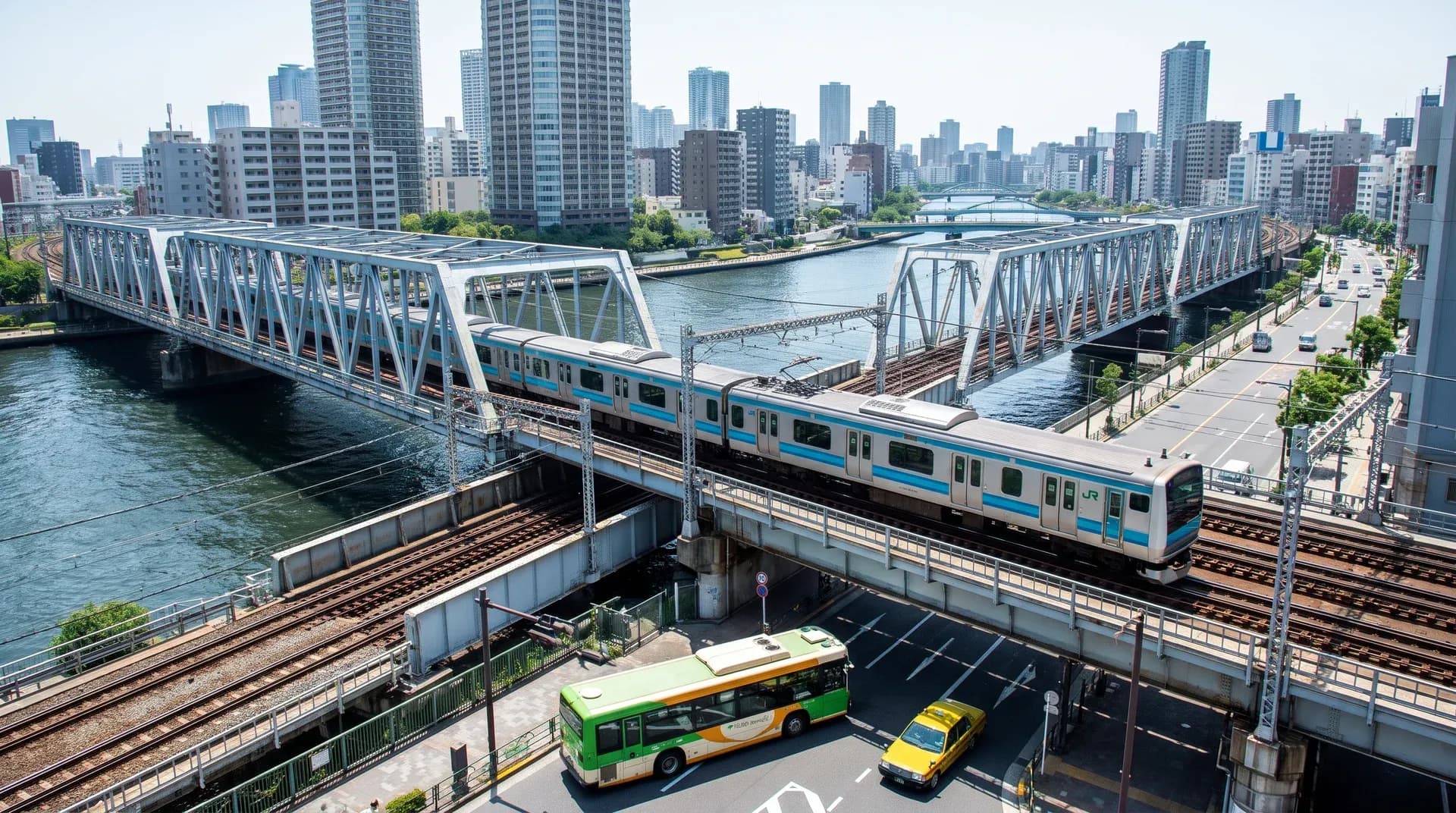
Japan transit: trains, metros, buses and passes explained
A reference guide to getting around Japan by Shinkansen, local trains, metro, bus, ferry, taxi and bicycle, plus Japan Rail Pass coverage and IC cards.
Affiliate link — we may earn a commission at no extra cost to you. Affiliate disclosure
Japan Transit Encyclopedia: Every Mode of Transport Explained
A reference for getting around Japan — trains, metros, buses, ferries and the passes that tie them together.
Quick Reference
Mode | Where you'll use it | Good to know |
|---|---|---|
Shinkansen | Between cities | Some services are excluded from the Japan Rail Pass (JR Pass) |
Local and limited express trains | Cities, suburbs, rural lines | Reserved seats can be booked with the pass at no extra charge |
Metro and private railways | City centres and airport links | Distance-based fares; IC cards accepted |
Bus | Local routes and long distance | Pass coverage differs between local and express buses |
Ferry | Islands | Pass coverage is limited to one route |
Taxi and bicycle | Short trips and the last mile | Fares and hire rates vary — confirm locally |
Trains
Shinkansen (Bullet Train)
Japan's high-speed lines are run by the JR group companies. On the Tokaido Shinkansen, N700-series trains run at up to 285 km/h (JR Central factsheet). The train name tells you how many stops it makes: between Tokyo and Shin-Osaka, Nozomi calls only at Shinagawa, Shin-Yokohama, Nagoya and Kyoto, Hikari serves those stations plus a few more, and Kodama stops at every station (JR Central factsheet).
Line | Main services | Japan Rail Pass |
|---|---|---|
Tokaido (Tokyo–Shin-Osaka) | Nozomi, Hikari, Kodama | Hikari and Kodama only |
Sanyo (Shin-Osaka–Hakata) | Nozomi, Mizuho, Hikari, Sakura, Kodama | Hikari, Sakura and Kodama only |
Kyushu (Hakata–Kagoshima-Chūō) | Mizuho, Sakura, Tsubame | Sakura and Tsubame only |
Nishi Kyushu | Kamome | Covered |
Hokkaido | Hayabusa, Hayate | Covered |
Tohoku | Hayabusa, Hayate, Yamabiko, Nasuno | Covered |
Joetsu | Toki, Tanigawa | Covered |
Hokuriku | Kagayaki, Hakutaka, Tsurugi, Asama | Covered |
Akita | Komachi | Covered |
Yamagata | Tsubasa | Covered |
Train names and pass validity per line are listed by the Japan Rail Pass Shinkansen guide.
JR Local Lines
JR East's network map shows the main lines around Tokyo. The Yamanote Line loops through the centre via Tokyo, Ueno, Shinjuku, Shibuya and Shinagawa; the Chūō Line runs west from Tokyo through Shinjuku towards Hachiōji and beyond; and the Keihin-Tōhoku Line links Ōmiya with Yokohama and Ōfuna (JR East route map).
Private Railways and Airport Lines
Greater Tokyo's private networks are extensive. The Greater Tokyo Pass route map lists the main operators — Tobu, Seibu, Keio, Odakyu, Tokyu, Keikyu, Keisei, Sotetsu and Minatomirai — and notes that JR lines are not covered by that pass. The same map shows Keikyu's Airport Line serving Haneda Airport Terminals 1·2 and 3.
Keisei connects Keisei-Ueno with Narita Airport Terminal 1 and Terminal 2·3 (Keisei route map). Tobu runs from Asakusa and Tokyo Skytree (Oshiage) to Tobu-nikko and Kinugawa-onsen (Tobu route map).
The Japan Rail Pass
The pass is issued to foreign nationals visiting Japan with Temporary Visitor entry status, and your passport details are registered to it — carry your passport while travelling (Conditions for use). It covers ordinary cars on all JR Shinkansen except Nozomi and Mizuho, limited express, express and local trains, the BRT, local JR Bus lines, the JR-West Miyajima ferry and the Tokyo Monorail. Reserved seats can be booked at no extra charge, but Green Car, Gran Class, private compartments and sleeping cars cost extra. To ride Nozomi or Mizuho you must buy a separate [ONLY WITH JAPAN RAIL PASS] NOZOMI MIZUHO ticket before boarding. Travel on private railways is not included, and coverage is subject to change.
A few private lines are covered only when you pass through without stopping: the Aoimori Railway between Hachinohe and Aomori, the IR Ishikawa Railway between Kanazawa and Tsubata, the Ainokaze Toyama Railway between Toyama and Takaoka, and Hapi-Line Fukui between Echizen-Hanandō and Fukui.
Metro and City Transport
Tokyo's urban rail is split between Tokyo Metro and Toei. Tokyo Metro operates the Ginza, Marunouchi, Hibiya, Tozai, Chiyoda, Yurakucho, Hanzomon, Namboku and Fukutoshin lines (Tokyo Metro fares and travel times).
The Namboku Line runs from Meguro to Akabane-iwabuchi, with interchanges onto JR at Meguro, Yotsuya, Ichigaya, Iidabashi, Komagome and Ōji, onto the Toei Mita Line at Shirokane-takanawa, onto the Toei Ōedo Line at Azabu-juban, and onto the Toei Mita and Ōedo lines at Kasuga, which connects with Korakuen (Namboku Line).
Tokyo Metro fares rise with distance and are sold in ¥180, ¥210, ¥260, ¥300 and ¥330 bands, with slightly cheaper IC card fares; when changing between lines, use the orange ticket gates and complete the transfer within 60 minutes (Regular Tickets). As an example, Ueno to Ginza on the Ginza Line costs ¥178 by IC card or ¥180 by paper ticket and takes about 16 minutes (2026 fares, Tokyo Metro fares and travel times). Check the current fare before you travel.
IC Cards
Suica and PASMO are the IC cards used across the Tokyo area, and JR East publishes a map marking the areas where they can be used (JR East route map). On Tokyo Metro, IC card fares are a little lower than paper ticket fares (Regular Tickets).
Buses
The JR Bus companies — JR Hokkaido Bus, JR Bus Tohoku, JR Bus Kanto, JR Tokai Bus, West Japan JR Bus, Chugoku JR Bus, JR Shikoku Bus and JR Kyushu Bus — run local lines that the Japan Rail Pass covers, but the pass is not valid on JR express bus routes (JR Pass scope of validity). For city buses and highway buses outside the JR network, confirm the fare and boarding rules locally before you ride.
Ferries
The Japan Rail Pass covers only one ferry: the JR-West Miyajima ferry. A Miyajima Visitor Tax of ¥100 is payable on top when you visit the island (JR Pass route map). The JR Kyushu Jet Ferry between Hakata and Busan is not covered (JR Pass scope of validity).
Taxis and Bicycles
Taxis are metered and can be hailed on the street or picked up at station ranks; fares vary by operator and area, so confirm the meter and any fixed fares before you set off. Bicycles can be hired in many cities and suit short hops, but rates, parking rules and where you may ride vary by operator — check locally.
Checking Routes and Delays
JR Central publishes basic Shinkansen timetables for the Tokaido and Sanyo lines, and notes that not every train is listed and that extra trains may run depending on the season, events and day of the week (JR Central timetable). For live disruption information, JR East's Train Status Information page reports anticipated and actual delays of more than 30 minutes on JR East lines, including the Tohoku, Joetsu, Hokuriku, Yamagata and Akita Shinkansen (JR East train status).
Ready to explore Japan?
Browse tours and activities, or tell us what you're looking for and we'll suggest the best options.
Stay Connected in Japan
Airalo eSIMs work on arrival — no physical SIM needed. Data plans from $5 for 7 days.
Travel Insurance for Japan
Medical, trip cancellation, and adventure sports covered. Plans from $1.5/day.