
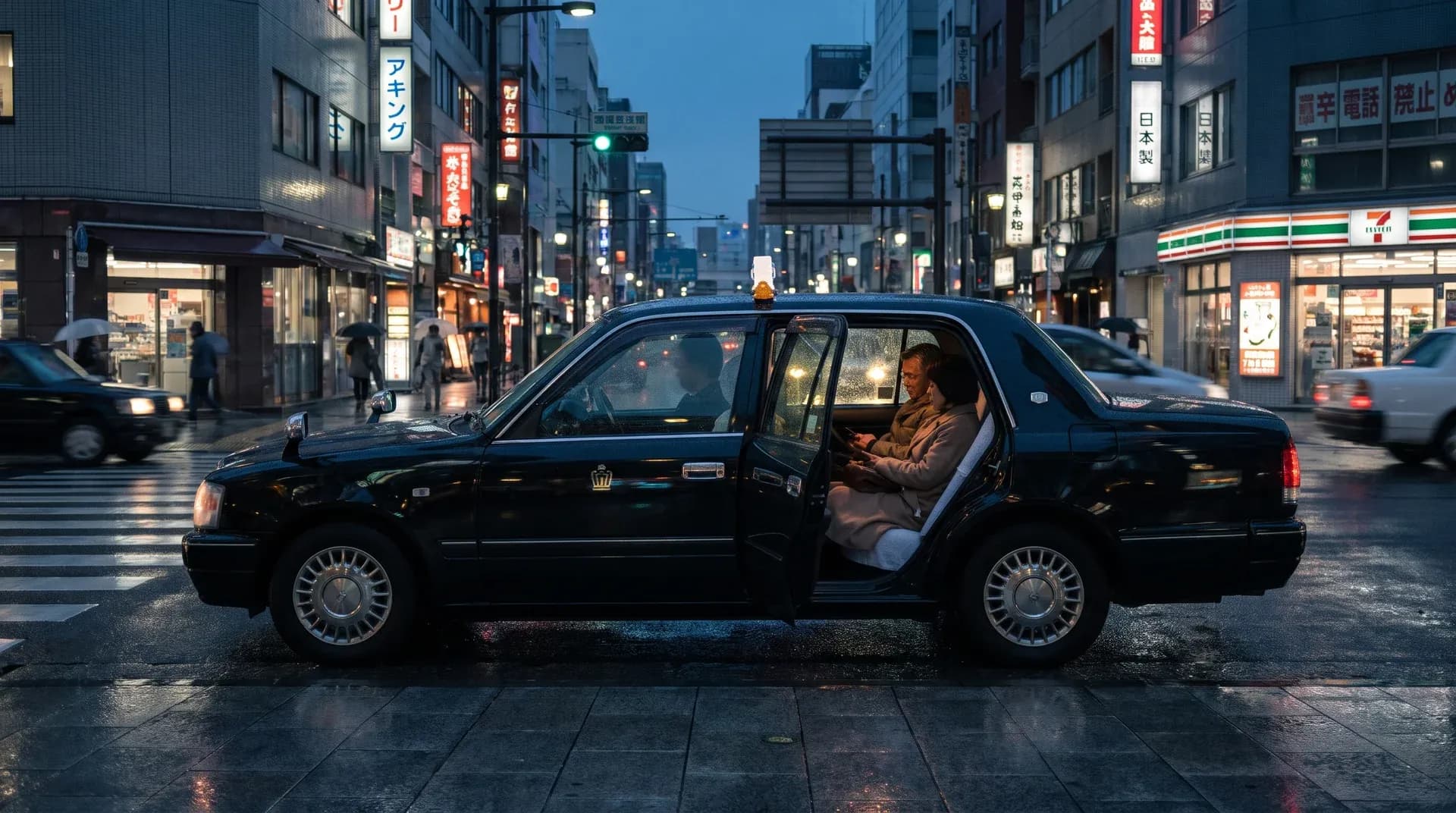
Japan taxis: when to ride, fares and apps
Japanese taxis suit groups, late nights and rural trips. Learn how to hail one, base fares and surcharges, payment options and airport fixed fares.
Affiliate link — we may earn a commission at no extra cost to you. Affiliate disclosure
Japan Taxicab Guide: How to Ride, Costs, and Apps
Japanese taxis are clean, well run and use automatic doors — and they cost more than trains and buses. Here is when they are worth it, what they cost and how to use them.
When Taxis Make Sense
Taxis are the most expensive way to get around, but they earn their fare in a few situations.
- Groups of three or four. A regular taxi seats four passengers, so splitting the fare can work out cheaper than four separate tickets (Traveling Comfortably).
- Late at night. Public transport in Tokyo does not run around the clock: the last trains and buses into the city end just after midnight (Haneda Airport).
- With heavy luggage. A taxi saves you hauling suitcases through stations, and wagon taxis have extra space for bags (Tokyo Taxi Center).
- In the countryside. Outside the big cities the number of cabs drops sharply and they are usually found in front of the train station; after public transport shuts down, a taxi may be your only option (JNTO).
How to Hail a Taxi
On the Street
Taxis show their status in the front window. The signs are in Japanese but colour-coded: red means the taxi can pick up passengers, green means it is occupied. Raise your hand to flag one down, and have your destination written in Japanese, especially if it is not a major sightseeing spot or hotel. The rear door opens and closes automatically, operated by the driver — do not touch it yourself (JNTO).
At a Taxi Stand
Taxis wait at train stations, hotels and major landmarks. In Tokyo, "Excellent Service" stands attended by certified drivers are found at Haneda Airport Terminal 3, in Ginza and at major stations, and the Haneda stands have multilingual signage and audio guidance. The windscreen display tells you what a taxi is doing: 空車 (vacant), 回送 (not in service), 割増 (increased fare, shown 10pm–5am), 迎車 and 予約車 (reserved). Note that in Ginza, taxis may only pick up passengers at designated stands between 10pm and 1am, except on Saturdays, Sundays and holidays (Tokyo Taxi Center).
By App
The main taxi apps in Japan are GO, S.RIDE and Uber. Coverage is reliable in major cities but drops off sharply in rural areas, so do not count on finding a ride far off the beaten track. Licensed taxis carry green number plates, while unlicensed cars carry white ones — book through official apps, websites or a hotel concierge to be sure you are getting a licensed vehicle (Chartered Taxis in Japan).
Pricing
Base Fares
City | Base fare | Then | Slow traffic (10 km/h or less) | Figures |
|---|---|---|---|---|
Tokyo (23 wards, Musashino, Mitaka) | ¥500 for the first 1.0 km | ¥100 every 232 m | ¥100 per 1 min 25 s | 2026, upper limit of the approved range |
Osaka | ¥600 for the first 1.2 km | ¥100 every 231 m | ¥100 per 1 min 25 s | As of 5 November 2025 |
The Tokyo figures are the top of the approved fare range, so the meter in your taxi may be slightly lower (Tokyo fare table); the Osaka figures are published by the prefectural government (Osaka Prefecture). Fares are set region by region and revised from time to time, so check the current base fare at the taxi stand or in the cab before you ride.
Surcharges and Extras
Extra | Detail |
|---|---|
Late-night / early-morning surcharge (Tokyo) | +20% between 10pm and 5am |
Highway tolls | Added to the fare |
Pick-up (dispatch) fee | Set by the taxi company |
Long-distance discount (Tokyo) | 10% off fares over ¥9,000 |
Disability discount (Tokyo) | 10% off |
Foreign currency is not accepted, so pay in yen. Many taxis take credit cards, taxi tickets and electronic payments, but check before you ride (Tokyo Taxi Center). In major cities credit cards can generally be used, while in the countryside cash may be your only option (JNTO).
Example Fares
Tokyo's fares were revised in 2026, when the base fare was changed to cover 1.0 km instead of 1.096 km and the increment to 232 m instead of 255 m. After the revision, a ride of about 1 km (Tokyo Station to Nihonbashi) is around ¥500, a ride of about 4.6 km — close to Tokyo's average taxi trip, such as Tokyo Station to Senso-ji — is around ¥2,100, and a ride of about 10 km, such as Tokyo Station to Odaiba, is around ¥4,400 (Cabinet Office paper). Treat these as distance-based estimates and watch the meter.
Taxi or Train?
For longer trips, trains and subways remain far cheaper. A taxi makes most sense for short hops, for groups of three or four splitting the fare, or when convenience matters more than cost.
Airport Transfers
Japan's major airports are covered by fixed-fare taxi services. At Narita, central Tokyo is divided into zones with a set price for each — ask your driver for the fixed rate when you get in, and check the price beforehand, since this is not a short ride. Haneda offers a similar flat-rate service to most areas of Tokyo, and a shared taxi shuttle serves Kansai International and Itami airports (JNTO).
At Haneda, late-night services and expressway surcharges cost extra (Haneda Airport), and fixed fares differ slightly between taxi companies (Tokyo Taxi Center). Flat-rate transfers are also available from Kansai International, Chubu Centrair, New Chitose, Fukuoka and Okinawa (Chartered Taxis in Japan).
Sightseeing and Chartered Taxis
In the Tokyo area, many taxi companies offer sightseeing tours by taxi that can be tailored to you and your group, and companies elsewhere in the country offer similar services (JNTO). Taxis can also be chartered by the hour for sightseeing or business, and larger vehicles such as minivans are available for groups with luggage. Book through official websites, apps, hotel concierge desks or travel agencies; most companies accept bookings up to a day in advance, and some take same-day reservations by phone or messaging app (Chartered Taxis in Japan).
Tips
- Leave the door to the driver. Japanese taxis use automatic doors operated by the driver, and in Tokyo traffic keeps to the left, so get out on the left.
- No tipping. Drivers do not expect or accept tips (JNTO).
- Wear your seatbelt. It is required by law, and almost all Tokyo taxis are non-smoking (Tokyo Taxi Center).
- Keep your receipt. If you leave something behind, contact the taxi company directly using your receipt or driver details.
- Show the address in Japanese. A map pin or a written address avoids confusion.
Ready to explore Japan?
Browse tours and activities, or tell us what you're looking for and we'll suggest the best options.
Stay Connected in Japan
Airalo eSIMs work on arrival — no physical SIM needed. Data plans from $5 for 7 days.
Travel Insurance for Japan
Medical, trip cancellation, and adventure sports covered. Plans from $1.5/day.