Tokyo subway guide: lines, fares and passes
Tokyo Metro and Toei are separate operators sharing stations and ticketing; this guide covers key lines, fares, transfer discounts, passes and navigation.
Affiliate link — we may earn a commission at no extra cost to you. Affiliate disclosure
Complete Tokyo Subway Guide 2026
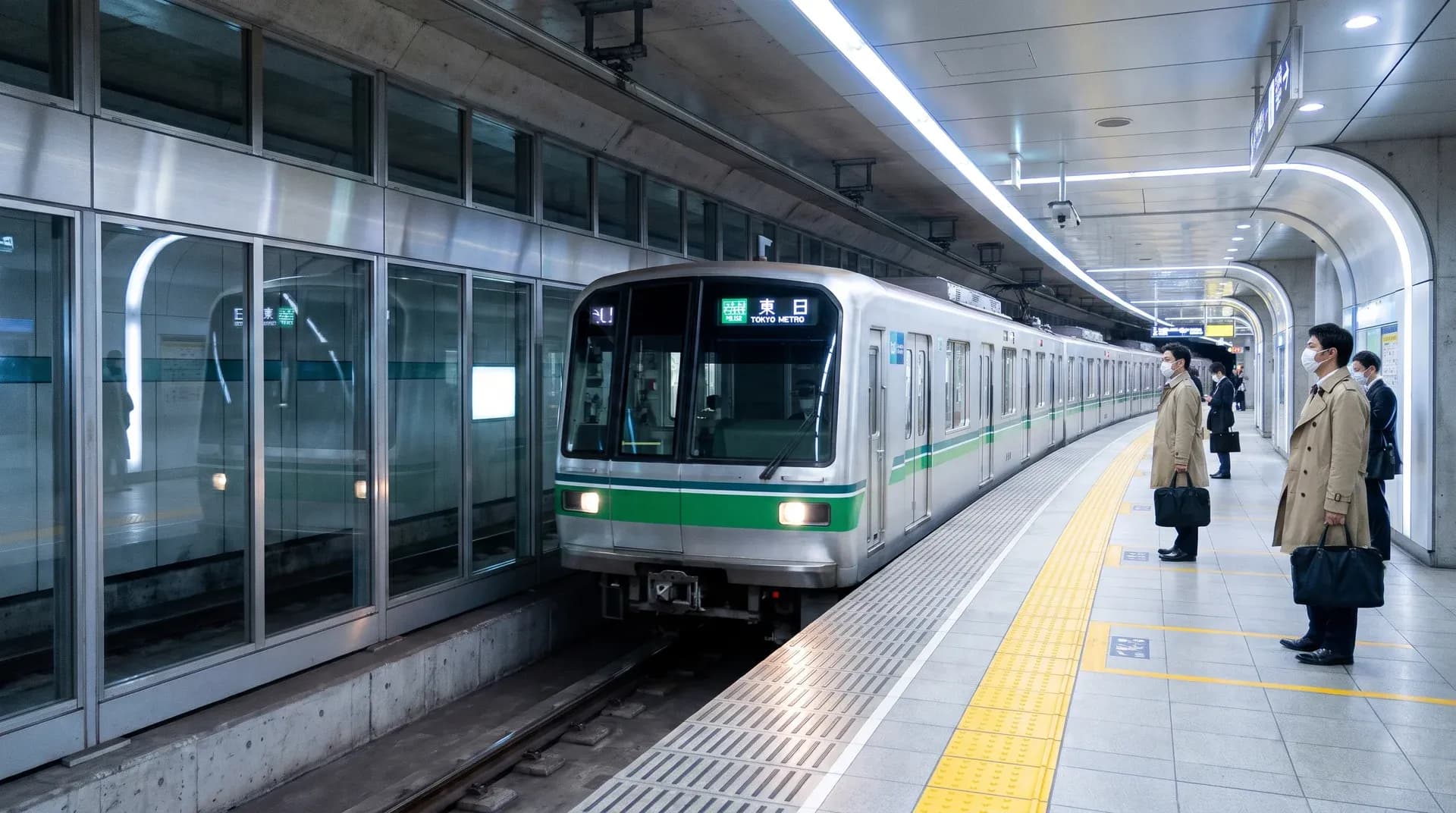
Tokyo has two subway systems — Tokyo Metro and Toei — with around 280 stations between them. This guide covers the lines you'll actually use, how to navigate them, and which passes are worth the money.
Tokyo's Rail Systems
System | Lines | What it covers |
|---|---|---|
Tokyo Metro | 9 | Ginza, Marunouchi, Hibiya, Tozai, Chiyoda, Yurakucho, Hanzomon, Namboku and Fukutoshin lines (Tokyo Metro route list) |
Toei Subway | 4 | Asakusa, Mita, Shinjuku and Oedo lines — 109 km and 106 stations in total (Toei Transportation Guide 2025) |
JR East | — | Above-ground commuter lines with their own fares and passes |
Private railways | — | Separate operators; some run through services onto the subway lines |
Tokyo Metro and Toei are separate companies with separate fare tables, but they share stations and ticketing, and a single through ticket can cover both.
Lines Tourists Use Most
Line | Operator | Key stations |
|---|---|---|
Ginza | Tokyo Metro | Shibuya, Omote-sando, Ginza, Ueno, Asakusa (19 stations) |
Marunouchi | Tokyo Metro | Ogikubo to Ikebukuro via Shinjuku, Tokyo and Otemachi (28 stations) |
Hibiya | Tokyo Metro | Naka-meguro to Kita-senju via Roppongi, Ginza, Ueno and Akihabara (22 stations) |
Hanzomon | Tokyo Metro | Shibuya to Oshiage via Otemachi and Kinshicho (14 stations) |
Tozai | Tokyo Metro | Nakano to Nishi-funabashi (23 stations) |
Chiyoda | Tokyo Metro | Yoyogi-uehara to Kita-ayase via Otemachi (20 stations) |
Oedo | Toei | Shinjuku, Roppongi, Tsukiji Market, Ryogoku and Daimon |
Asakusa | Toei | Asakusa, Nihombashi, Shimbashi, Daimon and Gotanda, with through services onto the Keikyu and Keisei lines |
Station counts and termini are as listed on the operators' route pages linked in the table above. Toei also labels its lines by colour: Asakusa is rose, Mita is blue, Shinjuku is leaf and Oedo is magenta.
Fares
Tokyo Metro fares are distance-based. The table below is from Tokyo Metro's fare guide dated 14 March 2026, and the prices include the railway station barrier-free fee (¥10 for adults). Child fares are half the adult fare.
Distance | Ticket (adult) | IC card (adult) |
|---|---|---|
1–6 km | ¥180 | ¥178 |
7–11 km | ¥210 | ¥209 |
12–19 km | ¥260 | ¥252 |
20–27 km | ¥300 | ¥293 |
28–40 km | ¥330 | ¥324 |
Source: Tokyo Metro fare guide, 2026. Fares are revised from time to time, so check the current fare at the station or on the operator's site before you travel.
Toei sets its own distance-based fares; the 2025 Toei guide's table runs from ¥180 for journeys up to 4 km to ¥430 for journeys up to 46 km (Toei Transportation Guide 2025).
Transfer discount: if you travel from a Tokyo Metro station to a Toei station on a single through ticket, ¥70 is deducted from the combined fare (Tokyo Metro transfer tickets). Tokyo Metro also applies smaller transfer discounts with JR lines (up to ¥20 for adults) and private railways (up to ¥30), and these are applied automatically when you use an IC card (Tokyo Metro FAQ).
Passes
Pass | Price (2026) | Covers | Worth it if… |
|---|---|---|---|
Tokyo Subway 24-hour Ticket | ¥1,000 adult / ¥500 child | All Tokyo Metro and Toei lines, 24 hours from first gate use | you ride six or more times in 24 hours |
Tokyo Subway 48-hour Ticket | ¥1,500 / ¥750 | Same coverage, 48 hours | you ride five or more times per 24 hours |
Tokyo Subway 72-hour Ticket | ¥2,000 / ¥1,000 | Same coverage, 72 hours | you ride four or more times per 24 hours |
Tokyo Metro 24-hour Ticket | ¥700 / ¥350 | Tokyo Metro lines only, 24 hours from first use | you are travelling only on Tokyo Metro lines |
Tokyo Metropolitan District Pass | ¥870 / ¥430 | JR ordinary and rapid trains within the 23 wards, one day | you are basing the day around JR stations |
Prices and validity for the Tokyo Subway Tickets come from Tokyo Metro's Tokyo Subway Ticket page; the Tokyo Metro 24-hour Ticket price is from the 2026 fare guide; the JR pass price is from JR East. Check the live price before you buy — fares and pass prices are revised periodically.
Two things to know before you rely on the Tokyo Subway Ticket. It is sold to people living outside Tokyo and the seven surrounding prefectures (Kanagawa, Saitama, Chiba, Ibaraki, Tochigi, Gunma and Yamanashi) and to overseas visitors, who need to show a passport proving short-term stay status (Tokyo Metro ticket information for travellers). It also does not cover travel to Narita or Haneda airports — you pay separately for the airport leg.
For a plain stored-value card, TOURIST PASMO is sold at Haneda and Narita airport stations in denominations from ¥1,000 to ¥10,000, with no deposit and no refunds, and is valid for 28 days from purchase (TOURIST PASMO). Ordinary Suica and PASMO cards are prepaid and give no fare discount, so they are for convenience rather than savings.
Navigation Tips
- Learn the station numbers. Every station has a letter for its line plus a number, circled in that line's colour, so you can count the stops to your destination and check you are heading the right way (Tokyo Metro subway map).
- Follow the colour and letter on signs. Line names appear alongside the station numbers, so you can match what is on the platform sign to what is on your map.
- Check your exit before the ticket gates. Concourse and platform signage points to the exit nearest each sight or interchange; picking the right one saves a long walk at street level.
- Use an IC card for transfers. Touch in and out and the transfer discounts are applied automatically; top up at the ticket machines if the balance runs low.
- Use a journey planner. A maps app will tell you the line, platform and exit for each leg — useful when a journey mixes Metro, Toei and JR.
- Allow time for interchanges. Metro and Toei are separate networks, so some transfers mean a walk between gatelines even when the stations share a name.
Useful Phrases
English | Japanese |
|---|---|
Which platform? | 何番線ですか? |
Does this train go to ○○? | この電車は○○に行きますか? |
Where is the exit? | 出口はどこですか? |
Excuse me | すみません |
Ready to explore Japan?
Browse tours and activities, or tell us what you're looking for and we'll suggest the best options.
Stay Connected in Japan
Airalo eSIMs work on arrival — no physical SIM needed. Data plans from $5 for 7 days.
Travel Insurance for Japan
Medical, trip cancellation, and adventure sports covered. Plans from $1.5/day.