Scuba Diving in Okinawa: Sites, Seasons and Planning
A guide to Okinawa's dive sites, from the Blue Cave and Kerama Islands to Ishigaki and Yonaguni, with seasonal advice and travel planning.
Affiliate link — we may earn a commission at no extra cost to you. Affiliate disclosure
Scuba Diving in Okinawa: Best Sites, Seasons and Planning Your Dives
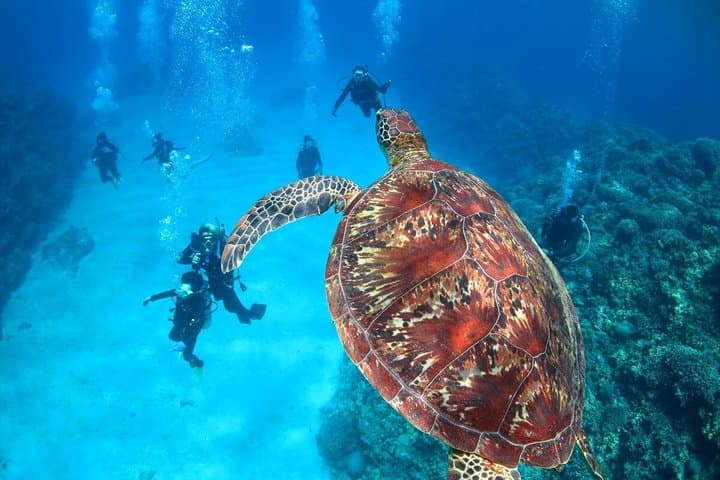
Okinawa has some of the world's best scuba diving, with clear water year-round, coral reefs and a wide variety of marine life (JNTO).
Why Dive in Okinawa?
- Clear water and coral — the ocean is clear year-round, and the nutrient-rich Kuroshio current flowing in from the south supports coral reefs and tropical reef fish.
- Large marine life — manta rays, whales and whale sharks are all possibilities, depending on the island and the season.
- Variety — Okinawa is a chain of 160 islands, each with its own dive sites and character.
- Access — Naha Airport on the main island is under four hours from Haneda, Narita and Kansai airports, and acts as the gateway to the other islands (JNTO diving guide).
Best Dive Sites
Okinawa Main Island
Blue Cave, Cape Maeda (Onna) — the main island's best-known dive and snorkel site. It is a partially submerged cave where sunlight enters through the underwater entrance, giving the water inside a blue glow. Tours are available for novices and even non-swimmers. You can dive or snorkel here all year, but the best time is between May and October; it gets busy in summer, so book ahead. The cave is about an hour's drive north of Naha, or roughly an hour and a half from Naha Bus Terminal by bus (bus 28 to Yomitan Bus Terminal, then bus 48) (JNTO Blue Cave).
Manza Dream Hole — for more advanced divers, a boat dive with a descent of about 10 metres to the cave entrance and then to around 30 metres, where you can see sweeperfish, garden eels and fan coral. The nearby Mini Dream Hole is half as deep (JNTO Blue Cave).
Busena Marine Park — about a 30-minute drive north on Route 58, with an underwater observatory and a glass-bottomed boat trip of around 20 minutes (JNTO Blue Cave).
Motobu Peninsula — Gorilla Chop is a shallow beach-entry site suited to fish watching and underwater photography. Minna Island is a 15-minute boat ride away, with white sand and reef patches, while Sesoko Island is reached by dive boat and has drop-offs, caves, channels and coral (JNTO where to dive).
Chibishi Islands — about 10 km west of Naha, a 30-minute boat ride, made up of three small islands: Kamiyama, Kuefu and Nagannu. Boats heading to the Kerama Islands often stop here for a dive (JNTO where to dive).
Aguni Island — a day-trip diving destination from Naha, with large schools of bigeye trevally from spring to early summer (JNTO where to dive).
Kerama Islands
The Kerama Islands lie 32 km southwest of Okinawa Island. Four are inhabited — Tokashiki, Zamami, Aka and Geruma — and the group has close to 100 dive sites, all reached by boat. The water is exceptionally clear and typically calm, which makes the area especially good for beginners. Kerama is a Ramsar Site, and Zamami has received two stars in the Michelin Green Guide. Humpback whale watching is popular here in winter (JNTO where to dive). Ferries from Tomari Port in Naha take between 20 minutes and an hour, and high-speed ferries reach the islands in under an hour (Japan Times).
Ishigaki Island
Ishigaki is the manta ray destination of the Yaeyama Islands. The four most notable sites are Kabira Ishizaki Manta Scramble, Manta City Point, Yonara Channel and Panari Big Corner, and there are more sites reachable by boat from Kabira Bay (JNTO diving guide). At the Manta Scramble, rays congregate in Kabira Bay in summer and early autumn to feed on plankton; the best months for diving overall are March to October, and the water can be rough in winter. Kabira Bay is about a 30-minute drive from Ishigaki City, and buses run from Painushima Ishigaki Airport to the bay. There are direct flights from Haneda and Kansai International airports (JNTO Ishigaki).
Miyako Islands
The Miyako Islands are known for cavern sites formed by erosion. At Tori-ike you cross from the ocean into a freshwater pond through an underwater tunnel; at Antoni Gaudi you enter a cavern said to resemble the architect's designs. The islands also have Yabiji, a reef group of more than 100 coral reefs (JNTO diving guide). Miyako lies roughly 300 km southwest of Okinawa Island, and the diving areas are affected by the wind: in summer you can dive the Irabu Island area to the north, while in winter conditions restrict diving to the Shimoji Island area (JNTO where to dive).
Iriomote Island
Iriomote is the second-largest island in Okinawa Prefecture and is mostly covered in jungle and mangrove swamp. Around nearby Nakano-ogan Island there are about 50 dive sites, with a good chance of large schools of dogtooth tuna, bluefin trevally and rainbow runner, as well as whale sharks (JNTO diving guide).
Yonaguni Island
Yonaguni is the westernmost inhabited island of Japan. It is known for schools of hammerhead sharks at Irizaki from winter to spring, and for the large underwater formation popularly called the Underwater Ruins. Most Okinawan islands are best from summer to autumn, but Yonaguni is the opposite: the best conditions for both the ruins and the sharks come from winter through spring (JNTO diving guide).
Kume Island
Kume lies about 100 km west of Naha and is famous for Hate-no-hama, said to be Japan's longest sandbank. At Manta Station there is a chance of seeing rare black manta rays; Tombara and Imazuni have large schools of dogtooth tuna and bigeye trevally; Ahra Oyakoiwa is a cavern site (JNTO diving guide). A manta cleaning station was found here in 2017, so mantas can now be seen year-round (JNTO where to dive).
Seasons
Okinawa's average annual temperature is 22.7°C, and even in the coldest months of December and January lows are around 15°C. January to March is whale-watching season, and the sea is notably clearer in December than in summer (Okinawa cruise FAQ).
Season | Conditions and highlights |
|---|---|
January–March | Humpback whale watching around the Kerama Islands (JNTO) |
Spring to early summer | Large schools of bigeye trevally at Aguni Island (JNTO) |
May–October | Best period for the Blue Cave (JNTO) |
March–October | Best months for diving off Ishigaki (JNTO) |
Summer to early autumn | Mantas gather in Kabira Bay (JNTO) |
Winter to spring | Hammerhead sharks and the Underwater Ruins at Yonaguni (JNTO) |
Booking a Dive
Dive shops operate in Naha, along the Onna coast and on the main dive islands, and boats to the Kerama Islands leave from Tomari Port in Naha. Booking ahead is recommended so that you have enough time on the water, and the DIVE IN OKINAWA brochure lists activities available around the prefecture (Okinawa cruise FAQ). Prices, group sizes and what is included vary by shop and season, so confirm the current price and conditions directly with the operator before you book.
What You'll Need
Item | Notes |
|---|---|
Dive certification | Check which level the sites you want require |
Log book | Useful for showing your experience |
Medical clearance | Ask the shop in advance if you have any concerns |
Swimwear | Worn under the wetsuit |
Mask | A personal fit is more comfortable |
Camera | Optional, but the reef photography is excellent |
Tips
- Book in advance — the Blue Cave is busy in summer, and boat diving needs planning.
- Check the certification level — some sites, such as Manza Dream Hole, suit more advanced divers.
- Dive in the morning — many divers prefer earlier slots for calmer conditions.
- Bring reef-safe sunscreen — sun protection matters, and coral is fragile.
- Don't touch marine life — observe only.
- Check the weather — rough seas can mean cancelled boats, especially around Ishigaki in winter.
- Rent gear locally — it saves luggage space.
- Take photos — underwater photography is one of the joys of diving here.
Ready to explore Japan?
Browse tours and activities, or tell us what you're looking for and we'll suggest the best options.
Stay Connected in Japan
Airalo eSIMs work on arrival — no physical SIM needed. Data plans from $5 for 7 days.
Travel Insurance for Japan
Medical, trip cancellation, and adventure sports covered. Plans from $1.5/day.