
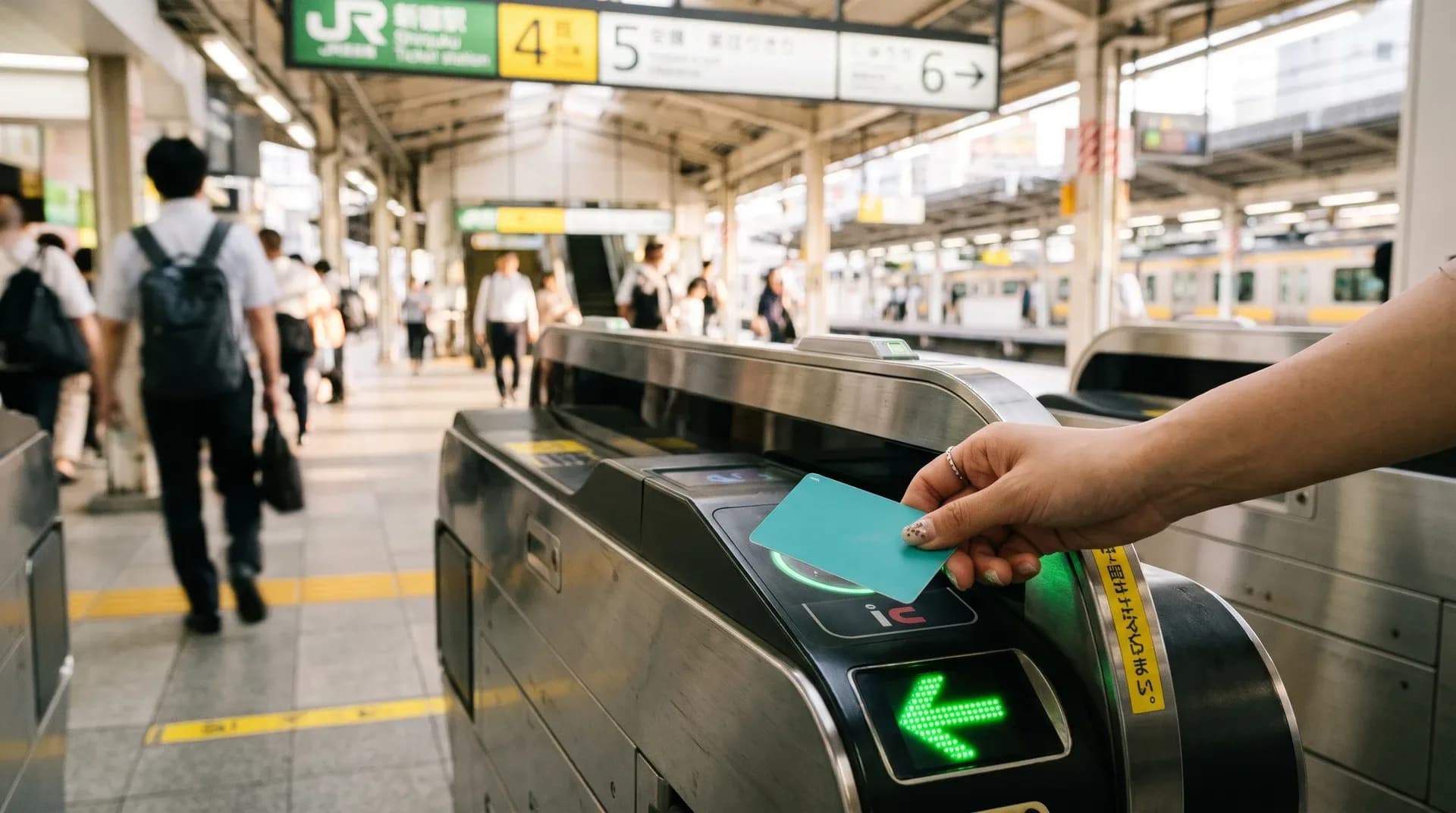
Using IC cards in Japan: Suica, PASMO and ICOCA
A guide to buying, topping up and tapping Suica, PASMO and ICOCA cards on trains, buses and in shops, with coverage and compatibility caveats.
Affiliate link — we may earn a commission at no extra cost to you. Affiliate disclosure
An IC card is a rechargeable transit card you tap on train gates, bus readers and convenience-store tills. It works on many trains, subways, buses and monorails, and for small purchases, but coverage varies by area and transport type. Suica and PASMO are common in the Kanto area, while ICOCA and TOICA are used in other areas; most IC cards can be used across services and cities where the IC logo is displayed, but you cannot travel continuously between different IC areas on one card (JNTO; JR East).
What an IC card is
The major IC cards include:
Card | What to know |
|---|---|
Suica | Prepaid IC card accepted in Suica areas and on participating transport |
PASMO | Major IC card in the Kanto area |
ICOCA | One of the IC cards used depending on the area |
TOICA | One of the IC cards used depending on the area |
Kitaca, SUGOCA, nimoca | Listed among cards accepted where the IC logo is displayed |
Where the IC logo is displayed, the cards are generally accepted on local trains, subways, buses and at convenience stores. Some rural lines and some transport, such as certain highway buses, do not accept them (JNTO; JR East).
Where to buy an IC card
Physical Suica and PASMO
Physical IC cards are sold at station ticket counters and automatic ticket vending machines at most railway stations; only cash is accepted at ticket machines, and a deposit is usually required (JNTO).
Standard Suica and PASMO sales were suspended during a card supply shortage. Non-personalized Suica, Rinkai Suica and PASMO cards went back on sale from 1 March 2025 (JR East). Availability can still change, so check JR East before you rely on a specific card.
Suica carries a refundable deposit; JR East's Suica page lists a ¥500 deposit and a ¥220 refund handling fee, so check the current figures before you buy (JR East).
Welcome Suica is a tourist card with no deposit, but leftover balance is not refunded. It is valid for 28 days from purchase. From 27 March 2025 it is sold at JR East Travel Service Centers including those at Narita Airport Terminal 1, Narita Airport Terminal 2・3, Haneda Airport Terminal 3, Tokyo, Shibuya, Shinjuku, Ikebukuro, Ueno, Yokohama and Sendai, and at Welcome Suica ticket vending machines at the three airport stations (JR East).
The Welcome Suica Mobile app was announced for release on 6 March 2025 for iPhone and Apple Watch; it lets you issue and top up a Suica in the app and use it for trains, buses and shopping (JR East).
Mobile IC cards
Mobile Suica and Mobile PASMO are smartphone apps. Mobile PASMO requires an Android phone with Android 6.0 or later and the latest Osaifu-Keitai app; check device compatibility before you rely on it (PASMO). Mobile Suica on Android also uses the Osaifu-Keitai app (JR East).
Welcome Suica Mobile uses Apple Pay. Its balance is valid for 180 days from the initial charge, and no refund can be made after that period (JR East).
If your phone is not compatible, buy a physical card.
How to load money
Top up at station ticket machines or in the mobile app. JR East lists Suica top-ups in increments of ¥500, ¥1,000, ¥2,000, ¥3,000, ¥5,000 or ¥10,000, with a maximum balance of ¥20,000; top-ups at ticket machines are cash only (JR East). Check the screen or ask staff because rules can vary by card and machine.
For a city stay, start with a few thousand yen and top up as needed. You can check your balance in the mobile app; Mobile PASMO lets you view balance and history on your phone (PASMO).
How to use an IC card
Tap in and out on trains, tap on bus readers when boarding and alighting, and tap at convenience-store tills. JR East explains that fares are calculated at the exit station and that limited-express, express and Green Car travel needs a separate ticket; JNTO explains bus tapping and notes that not all buses accept IC cards (JR East; JNTO).
Trains
Tap in at the ticket gate and tap out at your destination. The fare is deducted automatically. If you forget to tap out, ask station staff so the trip is closed correctly.
When using Suica on a limited express, express or Green Car, you need to buy a separate limited-express ticket.
Buses
On buses that accept IC cards, tap once when you get on and again when you get off. Not all buses accept IC cards, so check for the IC symbol at the bus stop or entrance; if there is no symbol, pay in cash.
Shops
Convenience stores commonly accept IC cards, and some vending machines, shops and lockers do too. Tap the reader and the amount is deducted from your balance.
IC card vs paper tickets
The main differences are convenience and where you can use the card (JNTO; JR East).
Factor | IC card | Paper ticket |
|---|---|---|
Convenience | Tap in and out; fare calculated at exit | Buy a ticket for each journey |
Transfers | Usually simpler; fare calculated at exit | May need separate tickets |
Shops | Accepted at convenience stores and some shops | Not accepted |
Deposit | Most IC cards: refundable deposit (JR East lists ¥500 for Suica; check current figures); Welcome Suica: no deposit | None |
Best for | Repeated local trips | One-off trips or limited-express/Shinkansen tickets |
For most city travel, an IC card is easier. Buy paper tickets when you only need one specific long-distance or limited-express ticket and will not use local transit again.
Refunds and leftover balance
When you return a Suica, JR East deducts a ¥220 handling fee from the remaining balance and refunds the ¥500 deposit; if the balance is less than ¥220, the remaining balance is used up and you still get the deposit back (JR East). Refund rules can change, so confirm at a JR East ticket office.
Welcome Suica has no deposit, but remaining balance is not refunded. Use it down before you leave (JR East).
Mobile Suica and PASMO are managed in the app, not at a station ticket window. Mobile PASMO lets you check balance and history on your phone (PASMO).
IC card vs JR Pass
Use an IC card for city trains, subways and buses. For long-distance Shinkansen travel, compare a JR Pass with point-to-point tickets. The nationwide Japan Rail Pass is due to rise in price on 1 October 2026 (JNTO). Check current prices on the official Japan Rail Pass site (Japan Rail Pass), and see the JR Pass guide and the JR Pass calculator.
Trip type | Better starting point |
|---|---|
Staying in Tokyo or Osaka | IC card |
Day trip on local trains | IC card |
Multiple long-distance Shinkansen trips | Compare JR Pass |
Rural lines | Check coverage; IC card may not work |
Practical tips
- If your balance is insufficient, top up at a station machine (JR East).
- Check your balance in the mobile app; Mobile PASMO lets you view balance and history on your phone (PASMO).
- Tap out every time. If you forget, ask station staff.
- If you arrive at Haneda or Narita, look for a Welcome Suica at the airport, but check availability (JR East).
- For airport transfers, see the airport guides for Narita, Haneda and Kansai.
- Choose accommodation near a station you will use.
Sources
- JR East: Suica
- JR East: Resumption of sales for non-personalized Suica and PASMO
- JR East: Welcome Suica
- JR East: Welcome Suica Mobile release
- JR East: Welcome Suica Mobile terms
- JR East: Mobile Suica on Android
- PASMO: Mobile PASMO service start
- JNTO: How to travel by train and bus in Japan
- JNTO: Cashless Payments in Japan
- JNTO: Price Increases are Coming to the Nationwide Japan Rail Pass (2026)
- Japan Rail Pass official site
Ready to explore Japan?
Browse tours and activities, or tell us what you're looking for and we'll suggest the best options.
Stay Connected in Japan
Airalo eSIMs work on arrival — no physical SIM needed. Data plans from $5 for 7 days.
Travel Insurance for Japan
Medical, trip cancellation, and adventure sports covered. Plans from $1.5/day.