Kyushu guide: volcanoes, hot springs and street food
A guide to Kyushu's volcanic landscapes, hot springs and street food, with highlights across Fukuoka, Nagasaki, Kumamoto, Oita, Miyazaki and Kagoshima.
Affiliate link — we may earn a commission at no extra cost to you. Affiliate disclosure
Kyushu Guide: Volcanoes, Hot Springs and Street Food
An island of active volcanoes, steaming hot springs and some of the country's best food.
Why Kyushu?
- Volcanic landscapes — Sakurajima, a world-famous composite active volcano, towers over Kagoshima and erupts repeatedly (JNTO).
- Hot springs — Beppu's seven jigoku ("hells") are boiling springs to look at rather than bathe in, and four of them are designated National Places of Scenic Beauty (JNTO).
- Street food and a slower pace — Fukuoka is known across Japan for good, cheap food, from tonkotsu ramen to street-side yatai stalls, and makes a more relaxed base than Tokyo, Kyoto or Osaka (JNTO).
The Seven Prefectures
Fukuoka
Known for: yatai stalls, tonkotsu ramen, Dazaifu's plum blossoms.
Fukuoka City is Japan's fifth-largest city, loosely divided into Hakata and Tenjin with the island of Nakasu between them. It is renowned across Japan for good, cheap food — tonkotsu ramen, goma saba (sesame mackerel) and street-side yatai stalls — and hosts the Hakata Dontaku festival in May during Golden Week and the Hakata Gion Yamakasa in July. The quiet town of Dazaifu, once Kyushu's administrative heart, is home to Dazaifu Tenmangu, the top shrine dedicated to scholars and scholarship, which enshrines Sugawara Michizane (845–903) (JNTO).
Highlight | Details |
|---|---|
Dazaifu Tenmangu plum season | About 6,000 plum trees; the 2026 plum season runs 20 January–15 March (Dazaifu Tourism Association) |
Plum Blossom Ceremony | Held every 25 February at Dazaifu Tenmangu, with prayers at the main sanctuary at 11:00 (Dazaifu Tenmangu) |
Uminonakamichi Seaside Park | Over 2,000 sakura trees plus flower gardens; open 9:30–17:00 November–February and 9:30–17:30 March–October (JNTO) |
Nagasaki
Known for: its trading history, European-style houses and harbour sights.
Nagasaki was Japan's early gateway to trade with the West, and that influence still shows in its districts of stately European-style homes. Sights include Dejima and Glover Garden, the night view from Mt Inasa, and Gunkanjima, the abandoned coal-mining island. Local dishes worth trying are Nagasaki chanpon and castella sponge cake (JNTO).
Highlight | Details |
|---|---|
Peace Park, Atomic Bomb Museum and Oura Cathedral | The museum covers the city's nuclear attack during the Second World War, with the Peace Park, Peace Statue and epicentre monument nearby; the tram also reaches Oura Cathedral, Japan's oldest Christian building built by Japanese (JNTO) |
Omura Park | Over 2,000 sakura trees, including more than 300 rare Omura Zakura; open 24 hours and free (JNTO) |
Kumamoto
Known for: Kumamoto Castle and Suizenji Jojuen Garden.
Kumamoto Castle remains the city's top attraction, with its imposing black exterior and steep ramparts. It was one of the worst-hit public buildings in the 2016 earthquakes, and restoration is estimated to take twenty years, so only limited parts of the castle are open to the public. A tram from JR Kumamoto Station reaches the Kumamotojo-mae stop in about 17 minutes (JNTO).
Highlight | Details |
|---|---|
Suizenji Jojuen Garden | Begun in 1632 by Hosokawa Tadatoshi and designated a national Historic Site in 1929; take the tram to Suizenji Park, then walk 4 minutes (JNTO) |
Suizenji in spring | Hundreds of sakura trees; open 7:30–18:00 March–October and 8:30–17:00 November–February (JNTO) |
Oita
Known for: Beppu's hot springs and the Jigoku Meguri.
Beppu Station can be reached by limited express train from Hakata, and from there buses 2, 5, 24 and 41 run to the Kannawa and Umi-Jigoku-mae stops in about 20 minutes. The seven hells — Umi, Oniishibozu, Kamado, Oniyama, Shiraike, Chinoike and Tatsumaki — are for viewing, not bathing, and four of them are designated National Places of Scenic Beauty (JNTO).
Highlight | Details |
|---|---|
Beppu Jigoku Meguri | Open 8:00–17:00 year-round; admission ¥2,400 for adults (high school and over) and ¥1,200 for children (2025 prices, in effect from 1 February 2025) — check the current price before you go (Beppu Tabi) |
Highlights | Umi Jigoku's cobalt-blue pond, around 80 crocodiles at Oniyama Jigoku, and the Tatsumaki geyser, which erupts every 30–40 minutes (Beppu Tabi) |
Miyazaki
Known for: spring blossom and jitokko chicken.
Miyazaki is worth timing for spring: Mochio Park has a 2 km road lined with 2,600 sakura trees, open 24 hours and free to enter. The prefecture is also known for jitokko chicken, grilled simply over charcoal (JNTO).
Kagoshima
Known for: Sakurajima, Sengan-en and shochu.
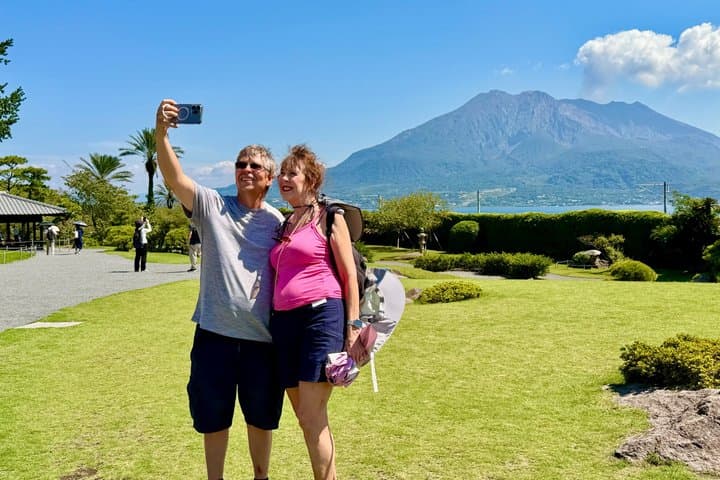
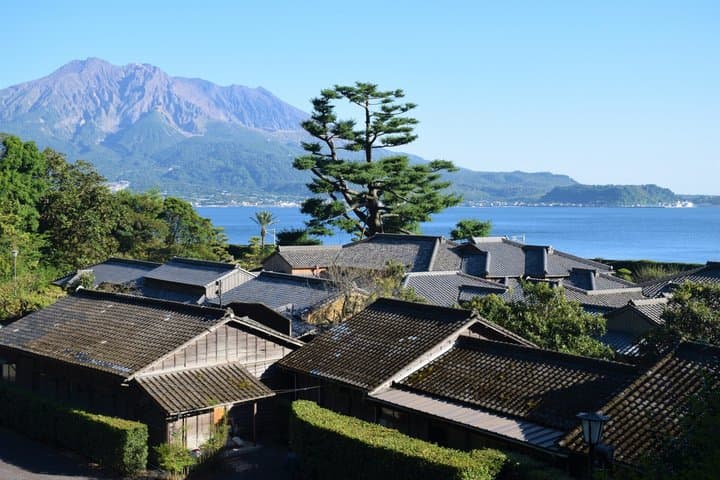
Sakurajima is a world-famous composite active volcano that towers over the city, emitting smoke constantly and erupting repeatedly; spots to see include Sakurajima Magma Onsen, the Sakurajima Nature Dinosaur Park and the Nagisa Lava Trail. Sengan-en, a former villa and garden, is a UNESCO World Heritage site, and Kagoshima is the place to sample local shochu (JNTO).
Highlight | Details |
|---|---|
Yoshino Park | About 800 sakura trees and over 40,000 azaleas; free entry, open 7:00–18:00 November–February and 6:00–19:00 April–June (JNTO) |
Saga
Known for: blossom and squid.
Ogi Park, near Saga City, has over 3,000 sakura trees that are lit up at night, and entry is free with the park open 24 hours. On the coast, Yobuko is known for ika no ikezukuri — live squid sashimi served moments after it leaves the tank (JNTO).
Getting There
From | To | Transport | Journey time |
|---|---|---|---|
Tokyo or Osaka | Fukuoka (Hakata) | Tokaido-Sanyo Shinkansen, or a flight to Fukuoka Airport | About 5 hours from Tokyo Station to Hakata; about 2 hours 20 minutes from Shin-Osaka to Hakata; about 1 hour 45 minutes from Haneda to Fukuoka Airport. The airport is about six minutes from Hakata Station by subway (JNTO) |
Hakata | Nagasaki | Nishi Kyushu Shinkansen "Kamome" | About 1 hour 30 minutes (JNTO) |
Hakata | Kumamoto | Kyushu Shinkansen | About 40 minutes (JNTO) |
Hakata | Kagoshima-chuo | Kyushu Shinkansen | Direct service (JNTO) |
Tips
- Eat at the yatai — Fukuoka's street-side stalls draw crowds from across Japan and Asia, and the city is renowned for good, cheap food (JNTO).
- Check the volcano first — Sakurajima emits smoke constantly and has repeated eruptions, so check conditions before planning a visit (JNTO).
- Know the shinkansen rules — Nozomi trains on the Tokaido-Sanyo line are not covered by the Japan Rail Pass unless you buy the additional Nozomi Mizuho ticket, and baggage with overall dimensions over 160 cm on the Tokaido, Sanyo, Kyushu and Nishi-Kyushu lines needs a seat with oversized baggage space, booked in advance at no extra charge (JNTO).
- Plan around spring — sakura season in Kyushu usually falls between March and April (JNTO).
- Check times and prices — opening hours and admission charges change, so confirm them on the official website before you travel.
Ready to explore Japan?
Browse tours and activities, or tell us what you're looking for and we'll suggest the best options.
Stay Connected in Japan
Airalo eSIMs work on arrival — no physical SIM needed. Data plans from $5 for 7 days.
Travel Insurance for Japan
Medical, trip cancellation, and adventure sports covered. Plans from $1.5/day.