
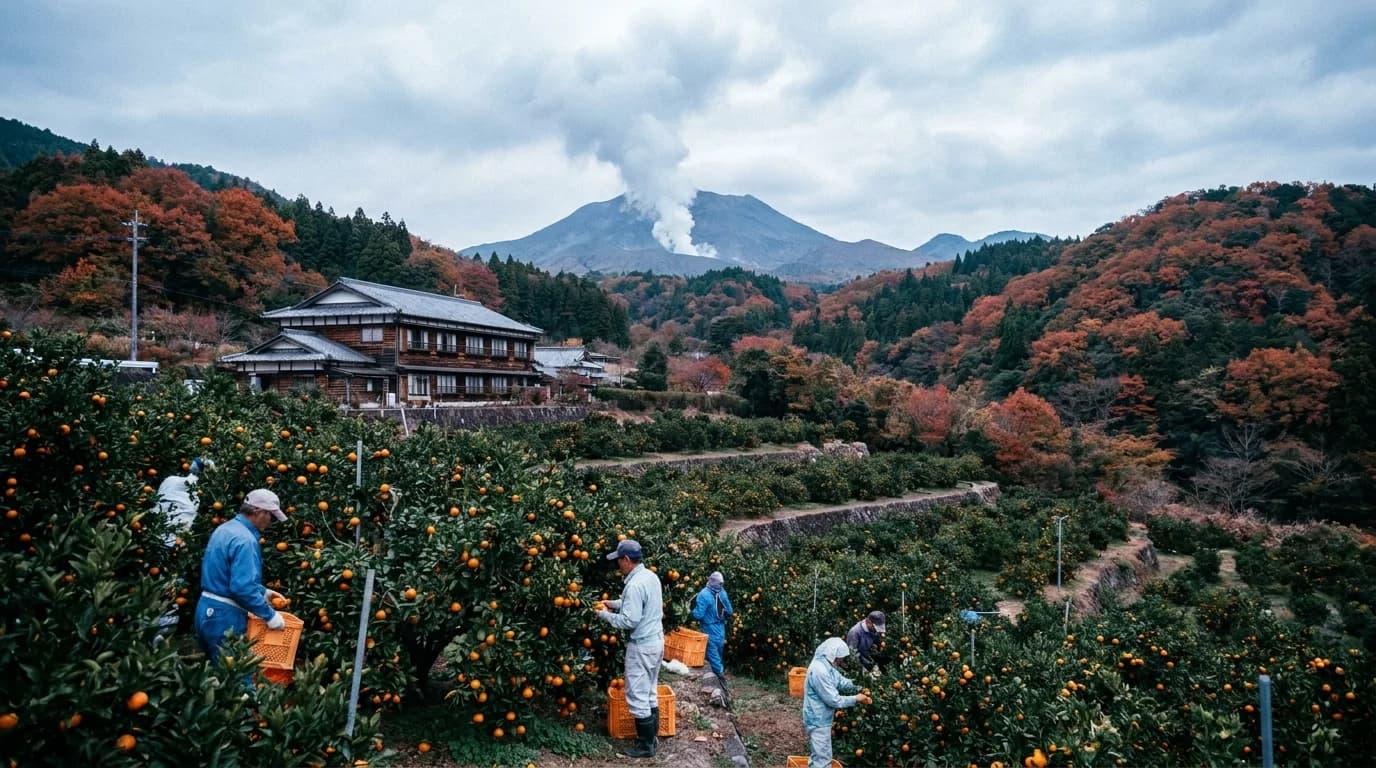
Kagoshima Rural Travel Guide: Living on an Active Volcano
By Tour in Japan editors · Updated
Trade Tokyo's crowds for mandarin harvesting and inn-keeping on an active volcano with this guide to rural Kagoshima.
The smell of sulfur hangs faintly in the air, mixing with the scent of damp earth and citrus. You are standing on the slopes of an active volcano in Kagoshima, far from the neon glare of Shinjuku. Here, the pace of life is dictated by the harvest cycle and the geothermal heat beneath your boots. This is not a curated tourist stroll; it is an invitation to step into the daily grind of Japanese countryside living. This Kagoshima rural travel guide is for the independent traveler who feels claustrophobic in the city and wants to trade their suitcase for a pair of work gloves.
For many, the dream of moving to the countryside remains a fantasy. However, Kagoshima offers a tangible way to test that dream. Whether you are harvesting mandarins in the autumn chill, digging your own footbath in volcanic sand, or learning the grueling logistics of running a traditional Japanese inn (ryokan), this region provides a raw look at rural survival. If you are a traveler who prefers dirt paths over paved sidewalks and genuine labor over guided tours, this itinerary unlocks the hidden, volcanic heart of Kyushu.
Essential Highlights & Local Itinerary
Exploring rural Kagoshima requires a shift in mindset. You aren't visiting landmarks; you are participating in a lifestyle. Most of these experiences are centered around the foothills of Sakurajima and the surrounding rural hamlets.
Day 1: The Volcanic Gateway (Sakurajima)
Start your journey at the Sakurajima Ferry Terminal. The ferry from Kagoshima City to the volcano is the primary artery for the island. The trip takes about 15 minutes and costs ¥200 / ~$1.30 USD for a one-way ticket. Ferries depart roughly every 15 to 20 minutes between 6:00 AM and 9:30 PM, with a reduced schedule after 6:00 PM. Once on the island, avoid the tour buses. Rent a bicycle (around ¥500 / ~$3.30 USD per hour from the rental shop near the ferry dock) or a small 50cc scooter (around ¥2,500 / ~$17 USD for a half-day) to reach the outer rim of the volcano.
Spend your first afternoon at the Nagisa Lava Trail. This is where you will find the natural footbaths. Instead of paying for a spa, you can find areas where the geothermal heat allows you to dig your own small pool in the sand. The experience is free, though you will want a towel and a change of shoes. The sand can reach temperatures of 60–80°C just below the surface, so dig carefully with a small hand shovel and test the temperature with your wrist before submerging your feet. Spend 3 to 4 hours here, observing how the local residents utilize the volcanic heat for daily chores—some elderly residents use the steam vents to steam sweet potatoes or dry laundry in winter. There are also two free public footbath facilities, the Yunohira Footbath and the Nagisa Footbath, if you prefer a more sanitized soak.
Day 2: Mandarin Harvesting and Agriculture
Move inland toward the rural orchards of the Kagoshima prefecture. Depending on the season, specifically late autumn and winter (October through January), the region is famous for its citrus, particularly the unshu mikan. You can arrange short-term stays with local farming cooperatives to help with the mandarin harvest. The two main harvesting regions are around Kanoya and Tarumizu on the Osumi Peninsula, and the foothills near Aira City, where terraced orchards climb the volcanic slopes.
This is physically demanding work. You will spend 6 to 8 hours in the fields, learning the specific clipping techniques used to prevent bruising the fruit. A typical harvester clips 30 to 50 kg of mandarins per day during peak season, earning roughly ¥700 to ¥1,000 / ~$4.70 to $6.70 USD per hour under the standard agricultural day-laborer rate. Volunteers typically work shorter days (4 to 5 hours) and receive free lodging and meals in exchange for their labor. If you are visiting as a tourist rather than a volunteer, a guided picking experience typically costs between ¥2,000 and ¥5,000 / ~$13 to $33 USD, depending on the volume of fruit you take home (usually 2 to 5 kg). Wear gloves—the citrus oils combined with rough branches will shred your hands within an hour.
Day 3: The Art of the Ryokan
Experience the operational side of Japanese hospitality. Rather than just staying as a guest, look for "work-stay" opportunities at smaller, family-run inns in the rural outskirts. You will learn that running an inn is less about aesthetics and more about logistics: scrubbing tatami mats (which must be aired and wiped every two weeks), preparing elaborate multi-course kaiseki meals, and managing the heating of onsen baths.
Spend the day shadowing the okami (manager). You will likely start at 5:00 AM to help with breakfast preparations. A typical kaiseki breakfast includes grilled fish, miso soup, rice, pickled vegetables, and a small egg dish—each requiring separate preparation stations and timing. The cost for these immersive stays is often lower than standard hotel rates, sometimes ranging from ¥5,000 to ¥8,000 / ~$33 to $53 USD per night including meals, provided you contribute a few hours of work. Most family-run ryokan in the Kagoshima countryside have only 4 to 8 rooms, meaning the staff-to-guest ratio is high and your help is genuinely needed. Common tasks include futon setup, yukata folding, and assisting with the onsen water temperature checks (which must be maintained at 42–44°C).
Day 4: Rural Village Exploration
Take a local bus from Kagoshima-Chuo Station toward the mountainous interior. The bus fares are distance-based, usually ranging from ¥500 to ¥1,200 / ~$3.30 to $8 USD. Visit the small shrines that dot the hillsides. These are not the crowded shrines of Kyoto; you will often be the only person there. Notable rural shrines include the Kirishima-Jingu shrine complex in the highlands (accessible via a 90-minute bus ride costing ¥1,400 / ~$9.30 USD one-way) and the smaller, unmarked Inari shrines tucked into citrus groves throughout the peninsula.
Visit a local "Michi-no-Eki" (Roadside Station). There are roughly 18 Michi-no-Eki stations in Kagoshima Prefecture, each acting as a hub of rural commerce. The most popular for travelers are Michi-no-Eki Sakurajima Hanoshima (for volcanic products) and Michi-no-Eki Kawanami (for citrus and sweet potatoes). Here, you can buy locally grown vegetables and handmade crafts directly from the farmers. A typical snack or a small bento box here costs around ¥600 to ¥1,100 / ~$4 to $7 USD. Spend the afternoon chatting with vendors—even with limited Japanese, the shared experience of the land often bridges the gap. Many Michi-no-Eki also offer free samples of regional specialties, including shochu (the local distilled spirit) in tiny 30 ml tasting cups.
Practical Details & Dual-Currency Budget
Best Season & Weather
The best time to visit rural Kagoshima is during the shoulder seasons: Spring (March to May) and Autumn (October to November). Spring brings the cherry blossoms to the volcanic slopes, while Autumn is the peak for citrus harvesting and offers the most comfortable temperatures for outdoor labor (daily highs of 18–22°C / 64–72°F).
Avoid the peak of summer (July to August) if you dislike extreme humidity and heat, which can make farm work unbearable. Temperatures regularly exceed 33°C / 91°F with humidity above 80%, creating dangerous conditions for outdoor labor. The rainy season (June) can also make rural roads muddy and difficult to navigate, especially if you are relying on a bicycle. Winter (December to February) is mild by Japanese standards (5–12°C / 41–54°F) but brings occasional ashfall from Sakurajima, which can coat surfaces and reduce visibility.
Budget Breakdown
Rural travel is generally cheaper than city travel, but transport costs can add up due to the reliance on buses and taxis.
Budget Traveler (Hostels, Local Eateries, Public Transit):
- Daily cost: ¥6,000 - ¥9,000 / ~$40 - $60 USD.
- Focus: Shared dorms (¥2,500–3,500 / ~$17–23 USD per night), convenience store meals (¥500–800 / ~$3.30–5.30 USD each), and free natural footbaths.
Mid-Range Traveler (Minshuku/Ryokans, Sit-down Meals, Scooter Rental):
- Daily cost: ¥15,000 - ¥22,000 / ~$100 - $145 USD.
- Focus: Private rooms in traditional inns (¥8,000–12,000 / ~$53–80 USD per night including two meals), rental vehicles for flexibility (¥3,000–5,000 / ~$20–33 USD per day for a scooter), and regional specialty dinners.
Premium Traveler (Private Ryokan, Guided Experiences, Taxi Transfers):
- Daily cost: ¥30,000 - ¥50,000 / ~$200 - $330 USD.
- Focus: High-end onsen ryokan (¥20,000–35,000 / ~$130–230 USD per night), private guided farm tours (¥8,000–15,000 / ~$53–100 USD per day), and chartered taxi services between rural villages.
Transit & Access
Getting to Kagoshima is best done via the Kyushu Shinkansen from Fukuoka (about 1 hour 20 minutes, ¥10,000 / ~$67 USD one-way) or Osaka (about 3 hours 50 minutes, ¥16,000 / ~$107 USD one-way). The bullet train is fast but expensive. For local transit, the Kagoshima City View Bus is excellent for getting to the ferry terminal. A one-day pass for the City View Bus costs ¥700 / ~$4.70 USD and covers all major tourist routes in Kagoshima City.
Once in the rural areas, Google Maps is generally reliable for bus schedules, but always carry cash. Many rural bus drivers and small shop owners do not accept credit cards or IC cards like Suica or Pasmo. For ride-hailing, Uber is limited; rely on local taxi companies or pre-arranged pickups from your host. Rural taxi fares start at ¥600 / ~$4 USD and add ¥80 / ~$0.50 USD per kilometer, making them expensive for long distances. If you plan to explore multiple rural sites, consider renting a car from Kagoshima Airport (Toyota Rent-a-Car and Times Car both have counters; compact cars start at ¥5,500 / ~$37 USD per day plus insurance of ¥1,000 / ~$6.70 USD per day). Note that an International Driving Permit is required for all foreign drivers.
Where to Eat & Local Food Secrets
Rural Kagoshima cuisine is defined by the land and the sea. You will find a heavy emphasis on pork and root vegetables.
Kurobuta Pork (Black Pork)
Kagoshima is world-famous for its Kurobuta pork. In the city, you will find expensive shabu-shabu restaurants, but in the rural areas, look for "Tonkatsu" (breaded pork cutlet) shops. A hearty set meal with rice, miso soup, and cabbage typically costs ¥1,200 to ¥1,800 / ~$8 to $12 USD. The meat is richer and more marbled than standard pork. Rural tonkatsu shops often source their pork from a single nearby farm, so the quality is consistently high. Try the locally famous shops in Kanoya and Tarumizu, where a thick 150g cutlet with unlimited rice refills costs around ¥1,500 / ~$10 USD.
Satsuma-age (Fried Fish Cakes)
These are the quintessential snack of the region. You will find them at almost every roadside station and local market. They are savory, chewy fish cakes fried to a golden brown, made from ground local fish (typically mackerel or sardine) mixed with yam and egg. A few pieces will cost you around ¥300 to ¥600 / ~$2 to $4 USD. They are best eaten hot, straight from the fryer. Many rural shops sell them in mixed packs of 5–10 pieces for around ¥800 / ~$5.30 USD, perfect for a hiking snack.
Volcanic Sweet Potatoes
In the rural villages, you will see sweet potatoes being steamed or roasted using geothermal heat. These are naturally sweet and incredibly filling. A single large potato usually costs ¥200 to ¥400 / ~$1.30 to $2.60 USD. The volcanic soil gives them a distinctive caramelized flavor. The most prized variety is the "Satsuma-imo" (also called beni-imo), which has a purple-red skin and creamy yellow interior.
Shochu Tasting
Kagoshima produces more shochu than any other prefecture in Japan. In rural areas, small distilleries offer tastings for ¥300 to ¥500 / ~$2 to $3.30 USD, usually including 3 to 5 varieties. The most common types are imo (sweet potato) and mugi (barley). A full bottle of premium local shochu costs between ¥1,500 and ¥3,000 / ~$10 to $20 USD at the distillery, significantly cheaper than in urban shops.
Dining Etiquette
When eating at a small rural eatery or a minshuku, it is polite to announce your arrival with "Ojamashimasu" (I am disturbing you) if entering a home-based business. Always remove your shoes at the entrance. In these small communities, a simple "Gochisousama-deshita" (Thank you for the feast) after your meal goes a long way in building rapport with the locals. At ryokan, you will typically eat your meals in your room or in a communal dining hall; arrive at the designated time (usually 6:00 PM for dinner and 7:30 AM for breakfast) and avoid wearing outdoor shoes inside.
Essential Traveler Checklist
- Pack sturdy footwear: Bring waterproof hiking boots or work boots; rural Kagoshima is muddy and volcanic ash is abrasive. A pair of tabi socks is also useful for ryokan stays.
- Cash is King: Carry plenty of ¥1,000 and ¥5,000 notes; rural vendors and buses rarely take cards. Most rural ATMs are located inside post offices or JA (Japan Agricultural) bank branches.
- Connectivity: Get a local eSIM (like Ubigi or Airalo) before arriving, as free Wi-Fi is non-existent in the farming districts. A 10 GB eSIM for 30 days costs around ¥3,000 / ~$20 USD.
- Dress Code: When visiting local shrines or working in fields, wear modest, durable clothing that you don't mind getting stained. Long sleeves protect against both sun and branches.
- Basic Phrases: Learn "Sumimasen" (Excuse me) and "Arigato" (Thank you) to navigate social interactions with elderly residents. Also useful: "Kore ikura desu ka?" (How much is this?) and "Totemo oishii desu" (This is very delicious).
- Health & Safety: Bring insect repellent (especially in summer), sunscreen, and any personal medications. Rural clinics are limited; the nearest major hospital is in Kagoshima City.
- Cultural Sensitivity: Avoid photographing residents without permission, especially elderly people working in fields. Always ask first, and be prepared for some refusals.
Final Tips for the Rural Traveler
Rural Kagoshima rewards those who slow down. Unlike the efficient bullet-train culture of Tokyo, time here moves with the sun and the seasons. If you arrive during a festival—such as the Sakurajima Fire Festival in February or the mandarin harvest celebrations in November—you will see the community at its most vibrant. These festivals often welcome visitors to participate in traditional dances or sample seasonal dishes for a small fee (¥500–1,000 / ~$3.30–6.70 USD).
For those who want to extend their stay, many farming cooperatives offer weekly homestay programs costing ¥20,000 to ¥30,000 / ~$130 to $200 USD per week, including lodging, meals, and farm work. These programs are listed on platforms like WWOOF Japan and HelpX, and they provide the deepest immersion into rural Kagoshima life.
If you are planning to visit Japan for more than just sightseeing, be aware of recent logistical changes. For those who combine rural escapes with urban hobbies, such as attending trading card game events (One Piece or Pokémon) hosted by Bandai, be advised that Japanese government ID checks are becoming more common. Ensure you have your passport ready, as some events are moving toward requiring government-issued identification for admission or purchases.
For weekly travel updates and hidden gem guides, sign up for our newsletter at /newsletter.
Stay Connected in Japan
Yesim eSIMs work on arrival — no physical SIM needed. Japan data plans from $5.