
Hokuriku Alpine Route Guide: Logistics, Costs, and Transit
By Tour in Japan editors · Updated
This itinerary unlocks the connected Tateyama Kurobe Alpen Route and Kurobe Gorge Railway in the Hokuriku region. Travelers can save on costs via free Shinkansen ticket promotions for internationals. Expect to spend ¥20,000–¥35,000 on regional transit and mountain passes.
The smell of damp cedar and the sight of a 20-meter snow wall define the journey through the Japanese Alps. For the independent traveler, navigating the Hokuriku region requires more than a standard rail pass; it requires a precise sequence of cable cars, trolley buses, and open-top vehicles. This guide unlocks a high-altitude itinerary connecting the Tateyama Kurobe Alpen Route and the Kurobe Gorge Railway, a connection that has recently been streamlined for fall travel. This is for the adventurous traveler who prefers rugged mountain landscapes over the neon lights of Shinjuku and wants a concrete plan to handle the complex transit transfers of the northern Honshu island.
Essential Highlights & Local Itinerary
Day 1: The Tateyama Kurobe Alpen Route
Start your journey in Toyama City. From Toyama Station, take the local train to Tateyama Station. From here, you enter the Alpen Route, a linear path that moves you across the mountains toward Omachi in Nagano Prefecture.
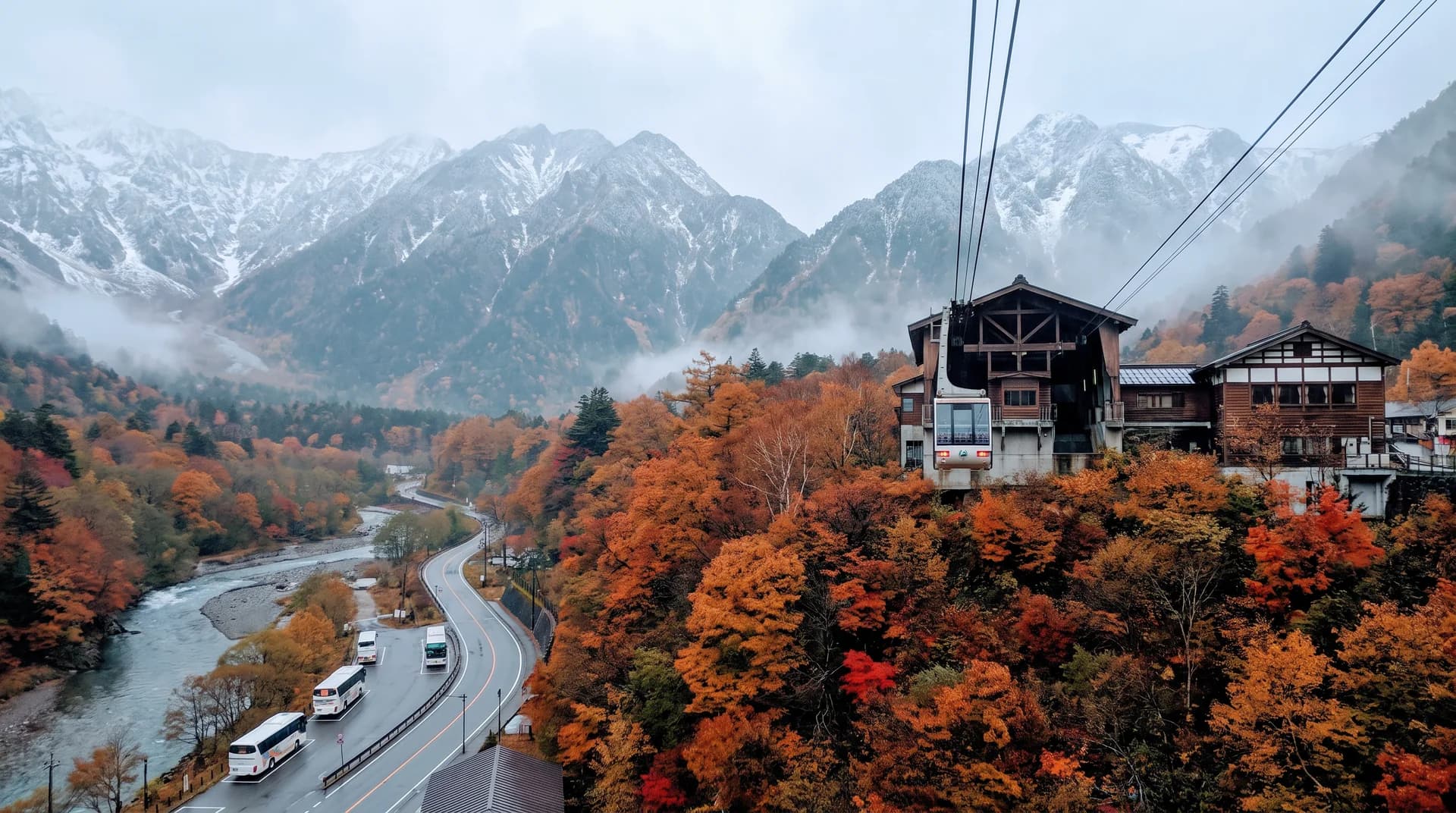
Logistics: You will use a combination of the Tateyama Cable Car, the Tateyama Highland Bus, and the Tateyama Ropeway. The most iconic stretch is the Yuki-no-Otani (Snow Wall), though this is primarily a spring experience (typically mid-April to June). In the fall, the focus shifts to the vibrant autumn colors of the Murodo plateau, where the foliage turns a deep crimson and gold from late September through October.
Timing: Allow a full 8 to 10 hours to traverse the entire route. If you start at 7:00 AM in Toyama, you can expect to reach the Omachi side by late afternoon, allowing for 1-2 hour stops at key vistas.
Costs: A full crossing ticket typically costs around ¥18,000 to ¥22,000 / ~$120 to $145 USD, depending on the season and starting point. This is a non-negotiable cost as the transit is operated by private entities.
Day 2: Kurobe Gorge Railway
With the new connectivity between the Alpen Route and the Gorge Railway, you can now transition more efficiently to the Kurobe Gorge. This is a narrow-gauge railway that winds through deep canyons and over massive bridges, offering a visceral sense of the region's geological power.
Location: Kurobe Gorge (Kurobe Kyokoku), accessed via the Kurobe Gorge Station.
Logistics: Access the railway via the Kurobe Gorge Station. The open-air carriages are the best way to experience the gorge, allowing you to feel the mountain air and hear the rushing river. You will board the "Torokko" train, which is designed specifically for sightseeing. Be aware that these trains are open to the elements; if it is raining, you will need a poncho.
Timing: A round trip to the end of the line (Keyaki Station) takes approximately 4 to 5 hours. This includes the train ride and short walking excursions at the various stops along the way.
Costs: A round-trip ticket is roughly ¥3,300 to ¥5,000 / ~$22 to $33 USD. If you opt for the "Special Car" (which has a roof and cushioned seats), expect to pay an additional ¥1,000 to ¥2,000.
Day 3: Toyama City and Kanazawa
Before heading back to the mainland hubs, spend time in Toyama and Kanazawa. These cities provide the urban infrastructure needed to reset before returning to Tokyo or Kyoto. If you are planning a wider trip, check the Tokyo Travel Guide: Logistics, Costs, and Local Districts to coordinate your return journey.
Location: Kanazawa (Ishikawa Prefecture).
Logistics: Use the Hokuriku Shinkansen from Toyama to Kanazawa. The ride is short, taking about 20 minutes. Once in Kanazawa, the "Kanazawa Loop Bus" is the most efficient way to reach the major sites. Visit the Kenrokuen Garden (one of Japan's three most beautiful gardens) and the Higashi Chaya district, where traditional wooden teahouses line the streets.
Timing: Spend 6 hours exploring the main districts. Allocate 2 hours for Kenrokuen and 2 hours for the Higashi Chaya district, with the remainder for the Omicho Market.
Costs: Entry to Kenrokuen is approximately ¥320 / ~$2 USD. A loop bus day pass is roughly ¥800 / ~$5 USD.
The Play: Step-by-Step Execution
To execute this itinerary without getting stranded or overwhelmed by the ticket kiosks, follow this exact sequence:
Step 1: The Logistics Pre-Game (2-4 Weeks Prior)
- Book your Alpen Route tickets online. During peak snow wall or autumn seasons, tickets sell out weeks ahead. Use the official Tateyama Kurobe Web Reservation system. Select a "Crossing Ticket" rather than a "Round Trip" if you plan to exit via Nagano.
- Arrange your Luggage Forwarding (Takkyubin). Do NOT bring a large suitcase on the Alpen Route; buses and cable cars strictly enforce carry-on limits. Drop your rolling bags with Yamato Transport at your Tokyo or Osaka hotel desk 24 hours prior—or use the sameday Dentetsu-Toyama Station bag transfer window before 09:00 AM—to send them straight to your Kanazawa hotel. Carry only a 25L daypack for the traverse.
- Check for Shinkansen Promotions. Look for the "Hokuriku Area Pass" or specific international visitor promotions that may offer discounted or free legs of the journey to Toyama.
Step 2: Day 1 Execution (The Ascent)
- 07:00: Arrive at Dentetsu-Toyama Station (located right next to the main JR Toyama Shinkansen gates). Purchase a high-quality Ekiben (station bento, specifically the local pressed trout sushi Masu-no-Sushi) for the trail.
- 08:00: Board the Toyama Chihou Railway local train to Tateyama Station (approx. 60 minutes).
- 09:00 - 13:00: Sequence of transit: Tateyama Cable Car $\rightarrow$ Highland Bus $\rightarrow$ Murodo. At Murodo (the highest point at 2,450m), spend at least 90 minutes hiking the perimeter loop around Mikurigaike pond.
- 13:00 - 17:00: Sequence of transit: Tateyama Ropeway $\rightarrow$ Kurobe Dam. Spend 45 minutes walking across the dam wall—the scale is immense, and the water release is a sight to behold.
- Evening: Stay overnight in a mountain lodge or proceed to Omachi/Toyama depending on your ticket type.
Step 3: Day 2 Execution (The Gorge)
- 09:00: Arrive at Kurobe Gorge Station in Unazuki Onsen.
- 10:00: Board the Torokko train. Ensure you are in the open-air carriage for the best photos of the red Shin-Yamabiko Bridge.
- 12:00: Disembark at Keyaki Station. This is the terminus. Walk the short trail down to the riverside footbaths at Sarutobi Gorge for a meditative break.
- 14:00: Board the return train. Use this time to buy local crafts, such as carved wooden animals, which are regional specialties.
Step 4: Day 3 Execution (The Cultural Reset)
- 10:00: Take the Hokuriku Shinkansen from Toyama Station to Kanazawa (20 minutes on the Tsurugi or Kagayaki train).
- 11:00: Head directly to Omicho Market. Eat a freshly sliced "Kaisen-don" (seafood bowl piled high with sweet shrimp and yellowtail) for lunch.
- 13:00: Visit Kenrokuen. If visiting in winter, look for the "yukitsuri" (conical rope arrays supporting pine branches against heavy snow).
- 15:00: Walk through Higashi Chaya. Purchase gold-leaf ice cream at Hakuichi, a local Kanazawa delicacy.
Real-World Example: A Mid-Range Budget Scenario
Let's look at a realistic cost breakdown for a solo traveler spending 3 days and 2 nights in the region, starting and ending in Toyama.
Fixed Transit Costs:
- Alpen Route Crossing Ticket: ¥21,000
- Kurobe Gorge Round Trip (Special Car): ¥6,000
- Toyama $\rightarrow$ Kanazawa Shinkansen (Round Trip): ¥5,000
- Kanazawa Loop Bus Pass: ¥800
- Total Transit: ¥32,800 (~$215 USD)
Accommodation:
- Night 1 (Toyama Business Hotel): ¥8,000
- Night 2 (Kanazawa Boutique Hotel): ¥12,000
- Total Lodging: ¥20,000 (~$130 USD)
Food & Activities:
- Day 1 (Ekiben + Murodo Snacks): ¥3,500
- Day 2 (Gorge Bento + Dinner): ¥4,000
- Day 3 (Seafood Bowl + Gold Leaf Ice Cream): ¥5,000
- Kenrokuen Entry: ¥320
- Total Food/Activity: ¥12,820 (~$85 USD)
Grand Total for 3 Days: ¥65,620 / ~$430 USD.
Note: This does not include the cost of getting to Toyama from Tokyo or Osaka, which can be offset by using a JR Pass or regional promotion.
Practical Details & Dual-Currency Budget
Best Season & Weather
Peak season for the Hokuriku region is split between mid-April to June (for the snow walls) and October to November (for autumn foliage). Avoid the region during the height of the typhoon season (August to September) if you are prone to travel delays, as heavy rains can cause landslides that shut down mountain roads. Winter (December to March) is beautiful but restricts access to many parts of the Alpen Route, with only specific "winter corridors" open for skiing and snowboarding. In my experience hiking Murodo in mid-October, temperatures drop by as much as 15°C (27°F) between Toyama's coastal plain and the 2,450-meter crest—a mild morning at the station can turn into freezing rain at the ridge before noon.
Budget Breakdown
For a 3-day excursion into the Alps from a base city like Tokyo or Osaka, expect the following daily costs:
- Budget Traveler: ¥12,000 / ~$80 USD per day. This includes hostel stays (dorm beds near Toyama or Kanazawa station), convenience store meals (konbini on-the-go), and basic transit. Budget travelers should stick to the standard open Torokko carriages and avoid expensive hotel dining.
- Mid-Range Traveler: ¥25,000 / ~$165 USD per day. This includes reliable business hotels (like Daiwa Roynet or Dormy Inn), sit-down meals (like Hida beef or high-end sushi), and full-route mountain passes.
- Luxury Traveler: ¥50,000+ / ~$330+ USD per day. This includes ryokan stays with multi-course kaiseki dinners in Unazuki Onsen and private guided tours of the Gorge.
Transit & Access
International visitors should look for specific promotions offering free Shinkansen tickets to promote travel to the mainland's outer regions. These are often limited-time offers (such as those run by the Japan National Tourism Organization) and require specific claim processes through official tourism portals.
For local movement, a Suica or Pasmo IC card is essential for Toyama and Kanazawa city buses, but these will not work on the specialized mountain transport of the Alpen Route. You must purchase separate tickets or a bundled pass for the mountain segments. If you are coordinating this with a visit to the ancient capital, see the Kyoto Travel Guide: Avoiding Crowds and Local Logistics to manage your rail pass timings.
Where to Eat & Local Food Secrets
Toyama Bay Seafood
Toyama is famous for its deep-sea shrimp (Shiro-ebi), often called the "jewels of Toyama Bay," and firefly squid (Hotaru-ika). Skip the tourist traps and head straight to Shiroebiya located inside the Ekitanto food hall inside Toyama Station. I always grab their fried glass-shrimp donburi immediately after getting off the Shinkansen.
Typical Price: A seafood donburi (bowl) costs between ¥1,500 and ¥3,000 / ~$10 to $20 USD. Try the raw Shiro-ebi sashimi for a creamy, sweet flavor profile.
Hida Beef in the Alps
While traveling through the mountain regions, look for Hida beef skewers or bento boxes. These are often sold at the transit hubs between the ropeway and the bus segments, particularly at the wooden food stands outside Daikyoji and Kurobe Dam station. Hida beef is a high-grade Wagyu from neighboring Gifu, characterized by intense marbling that melts into smoked savory juice when flash-grilled over charcoal.
Typical Price: A beef skewer is usually ¥800 to ¥1,200 / ~$5 to $8 USD. A full Hida beef bento is usually around ¥2,500 / ~$16 USD.
Dining Etiquette
In the mountain huts and small village eateries of the Hokuriku region, cash is still king. While hotels in Toyama and Kanazawa accept credit cards, the small vendors along the Kurobe Gorge often do not. Always carry at least ¥10,000 in physical cash for these mountain segments. When eating in small family-run shops, it is polite to say "Gochisousama-deshita" (Thank you for the meal) to the staff upon leaving. This is especially appreciated in rural areas where English is less common.
Essential Traveler Checklist
- Pack Layers: Even in summer, Murodo is significantly colder than the coast; bring a windproof jacket, a light fleece, and thermal base layers. Temperature drops can be as much as 15°C (27°F) between the city and the peak.
- Cash Reserves: Carry physical JPY for mountain transport and rural food stalls where IC cards and credit cards are not accepted. Small denominations (¥1,000 bills) are most useful.
- eSIM Setup: Use an eSIM with strong regional coverage (like Ubigi or Airalo) as signal can be spotty in the deep gorges. Download offline Google Maps for the Toyama and Kanazawa areas.
- Footwear: Wear waterproof hiking boots or sturdy sneakers; the Alpen Route involves significant walking on uneven terrain, and the snow wall paths can be slushy.
- Luggage Forwarding: Use Takkyubin (luggage forwarding) to send your large suitcases from your Tokyo/Kyoto hotel directly to your next destination, as mountain transit cannot accommodate large bags. Most hotels can arrange this for you at the front desk.
For more weekly travel updates and hidden gem guides, sign up for our updates at /newsletter.
Frequently Asked Questions
How much does the Tateyama Kurobe Alpen Route cost?
A full crossing typically costs between ¥18,000 and ¥22,000 (~$120 to $145 USD), depending on the season and the specific starting point of your journey. This covers all the cable cars, buses, and ropeways.
Can I use a JR Pass for the mountain segments?
The JR Pass covers the Shinkansen to Toyama and certain local trains, but it does not cover the private cable cars, ropeways, or buses that make up the core of the Alpen Route. You will need to pay for the mountain transit separately.
Is the Kurobe Gorge Railway accessible for beginners?
Yes, it is very accessible as it is a train-based experience. However, it requires a full day of commitment and is best visited during the autumn foliage peak in October and November. Be prepared for some walking at the terminal stations.
Related reading
Stay Connected in Japan
Yesim eSIMs work on arrival — no physical SIM needed. Japan data plans from $5.