Getting around Kyoto: buses, trains, bikes and walking
A practical guide to Kyoto’s buses, subway, private rail, cycling and walking, including passes, fares and crowded-season tips.
Affiliate link — we may earn a commission at no extra cost to you. Affiliate disclosure
Getting Around Kyoto: Buses, Trains, Bikes, and Walking
Kyoto's public transport can be confusing — temples aren't always near train stations, buses get crowded, and some of the best areas are best explored on foot. Here's how to navigate it all.
Kyoto Transport Overview
Kyoto's subway does not cover every temple district, so you will usually combine subway, bus, private rail and walking.
Area | Practical transport |
|---|---|
Kinkaku-ji and north-west Kyoto | Subway to Kitaoji, then city bus 25, 102, 204, 205 or M1 (Kyoto City Bus & Subway Information Guide) |
Ryoan-ji | Keifuku Kitano Line to Ryoan-ji Station and walk 10 minutes, or bus 59 from Sanjo Keihan to Ryoan-ji-mae (Travel Japan) |
Kiyomizu-dera and Gion | City bus to Kiyomizu-michi or Higashiyama Yasui, then walk (Hankyu Gion & Higashiyama map) |
Arashiyama | JR Sagano Line from Kyoto Station, about 15 minutes, then walk (JR Central) |
Nijo Castle | Karasuma Line to Karasuma-Oike, then Tozai Line to Nijojo-mae (Travel Japan) |
Fushimi Inari | Keihan Railway to Fushimi-inari (Keihan guide) |
Bus System
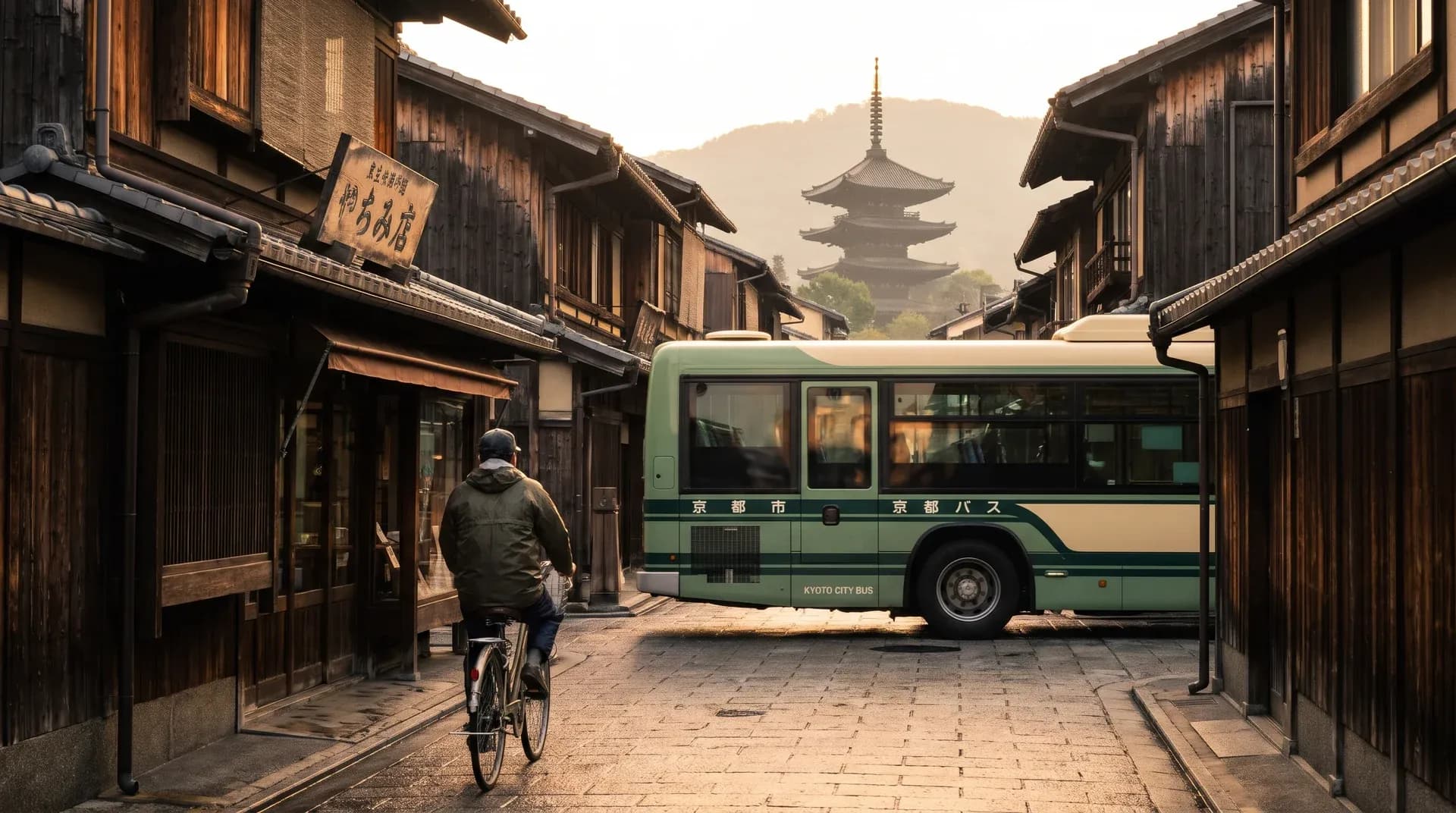
Kyoto City Bus
Kyoto City Bus is the main bus network for temple districts. The standalone city bus one-day pass is no longer sold: the city ended sales at the end of September 2023 and now points visitors to the Subway & Bus 1-Day Pass (Kyoto City notice). Check the current fare and pass price before you travel.
How to Ride
- Board through the rear door where indicated and pay when you get off. In the flat-fare zone the adult fare is ¥230 and child ¥120 (2026); on non-flat-fare buses you tap on and off. With a 1-Day Pass, insert it into the card slot the first time and the date is printed on the back (Kyoto City Bus & Subway Navi PDF).
- Pay by cash or IC card. Credit and debit cards are not accepted, and the JAPAN RAIL PASS is not accepted (Kyoto City Bus guide).
Bus Tips
During spring and autumn sightseeing seasons, expect crowds. Kyoto runs a tourist express bus between Kyoto Station and Higashiyama on weekends and holidays; the fare is ¥500 adult and ¥250 child (2026), and the Subway & Bus 1-Day Pass is accepted. The city also provides bus location and crowding information through "Pokeloke plus+" from 20 March 2026, and asks visitors with large luggage to avoid bringing it on buses (Kyoto City Bus & Subway Information Guide).
Train & Subway
Kyoto Subway
Kyoto has two subway lines. The Karasuma Line connects Kyoto Station with Karasuma-Oike, where you can change to the Tozai Line for Nijojo-mae (Nijo Castle) (Nijo Castle access). The Tozai Line also serves Higashiyama, and the Karasuma Line serves Kitaoji. The Subway 1-Day Pass costs ¥800 adult and ¥400 child (2026) (Kyoto City Bus & Subway Navi PDF).
The pass is valid on the day of activation, not for 24 hours, and does not cover transfers to the Kintetsu or Keihan Otsu lines (Subway 1-Day Pass). Check the live price before you buy.
JR Lines
The JR Sagano Line is useful for Arashiyama: it takes about 15 minutes from Kyoto Station (JR Central).
Private Railways
Railway | Useful for |
|---|---|
Keihan Railway / Eizan Railway | Keihan to Fushimi-inari, Gion-Shijo and Demachiyanagi; Eizan from Demachiyanagi towards Kurama and Kibune (Keihan guide) |
Hankyu Railway | Kyoto-Kawaramachi (Hankyu map) |
Biking
Cycling can be useful for short trips, but rental prices, opening hours and rules vary by shop, so confirm them directly before you rely on a bike. Use designated parking, follow local signs, and avoid blocking pavements or temple approaches.
Walking
Many of Kyoto's most rewarding areas are best on foot. In Higashiyama, the lanes of Ninenzaka and Sannenzaka lead down from Kiyomizu-dera, and the backstreets are quieter at dusk (JNTO). In Arashiyama, the bamboo groves and Togetsukyo Bridge are the main walking draws (JR Central). The Philosopher's Path, Nanzen-ji and Ginkaku-ji are marked in the same Higashiyama walking area (Hankyu map).
Day Passes Comparison
There is no current standalone city bus one-day pass; the city ended sales at the end of September 2023 (Kyoto City notice). The main options are:
Pass | Price (2026) | Covers | Useful for |
|---|---|---|---|
Subway & Bus 1-Day Pass | ¥1,100 adult / ¥550 child (PDF) | All subway lines, all city bus routes, selected Kyoto Bus, Keihan Bus and West Japan JR Bus routes; valid on the day of activation, not 24 hours (Kyoto City Bus & Subway Information Guide) | Mixed subway and bus sightseeing |
Subway 1-Day Pass | ¥800 adult / ¥400 child | All subway lines; valid on the day of activation, not 24 hours (Subway 1-Day Pass) | Subway-only days |
Check the current fare or pass price before you travel.
Practical Combinations
For common cross-city trips, the city recommends combining subway and bus: from Kyoto Station to Kinkaku-ji, take the subway to Kitaoji and then bus 25, 102, 204, 205 or M1; to Ginkaku-ji, take the subway to Imadegawa and then bus 102 or 203; to Higashiyama, take the subway to Kujo and then bus 202 or 207 (Kyoto City Bus & Subway Information Guide). For Fushimi Inari, Keihan Railway has a Fushimi-inari station (Keihan guide). Walking the Higashiyama lanes between Kiyomizu-dera and Gion is part of the experience (JNTO).
Ready to explore Japan?
Browse tours and activities, or tell us what you're looking for and we'll suggest the best options.
Stay Connected in Japan
Airalo eSIMs work on arrival — no physical SIM needed. Data plans from $5 for 7 days.
Travel Insurance for Japan
Medical, trip cancellation, and adventure sports covered. Plans from $1.5/day.