Weekend in Kyoto: A Two-Day Itinerary
A two-day plan covering eastern and north-western Kyoto, with transport notes, etiquette reminders and what you will miss.
Affiliate link — we may earn a commission at no extra cost to you. Affiliate disclosure
Weekend in Kyoto: A 2-Day Itinerary
Two days in Kyoto is enough for several of the headline sights, but not for everything. This plan gives you an eastern day and a north-western day, with transport notes and etiquette reminders.
Is a Weekend Enough?
Yes for the highlights, no for depth. Two days will get you to Fushimi Inari Taisha, the Higashiyama temples, Kinkaku-ji and Arashiyama. It will not stretch to day trips or slower cultural experiences.
What you can see in two days
- Fushimi Inari Taisha Shrine
- Kiyomizu-dera Temple and the Higashiyama lanes
- Gion
- Nishiki Market
- Kinkaku-ji (the Golden Pavilion)
- Ryoan-ji
- Arashiyama and its bamboo grove
- The Philosopher's Path
What you'll miss
- Day trips such as Nara or Osaka
- Tea ceremonies, craft workshops and temple stays
- Quiet neighbourhoods away from the main sightseeing routes
Day 1: Eastern Kyoto
Morning
Fushimi Inari Taisha Shrine
Take the JR Nara Line from Kyoto Station to JR Inari Station. The journey takes about nine minutes, and the shrine's main approach is directly in front of you when you leave the ticket gate (kyoto.travel). From the timetable revision of 14 March 2026, all rapid trains on the Nara Line also stop at Inari Station (JR West). Avoid City Bus South No. 5 for this leg: the same Kyoto Travel page warns that its journey times can vary by more than 24 minutes.
Start as early as you can. The lower gates fill up quickly, and an early start leaves the rest of the day free.
Higashiyama and Kiyomizu-dera Temple
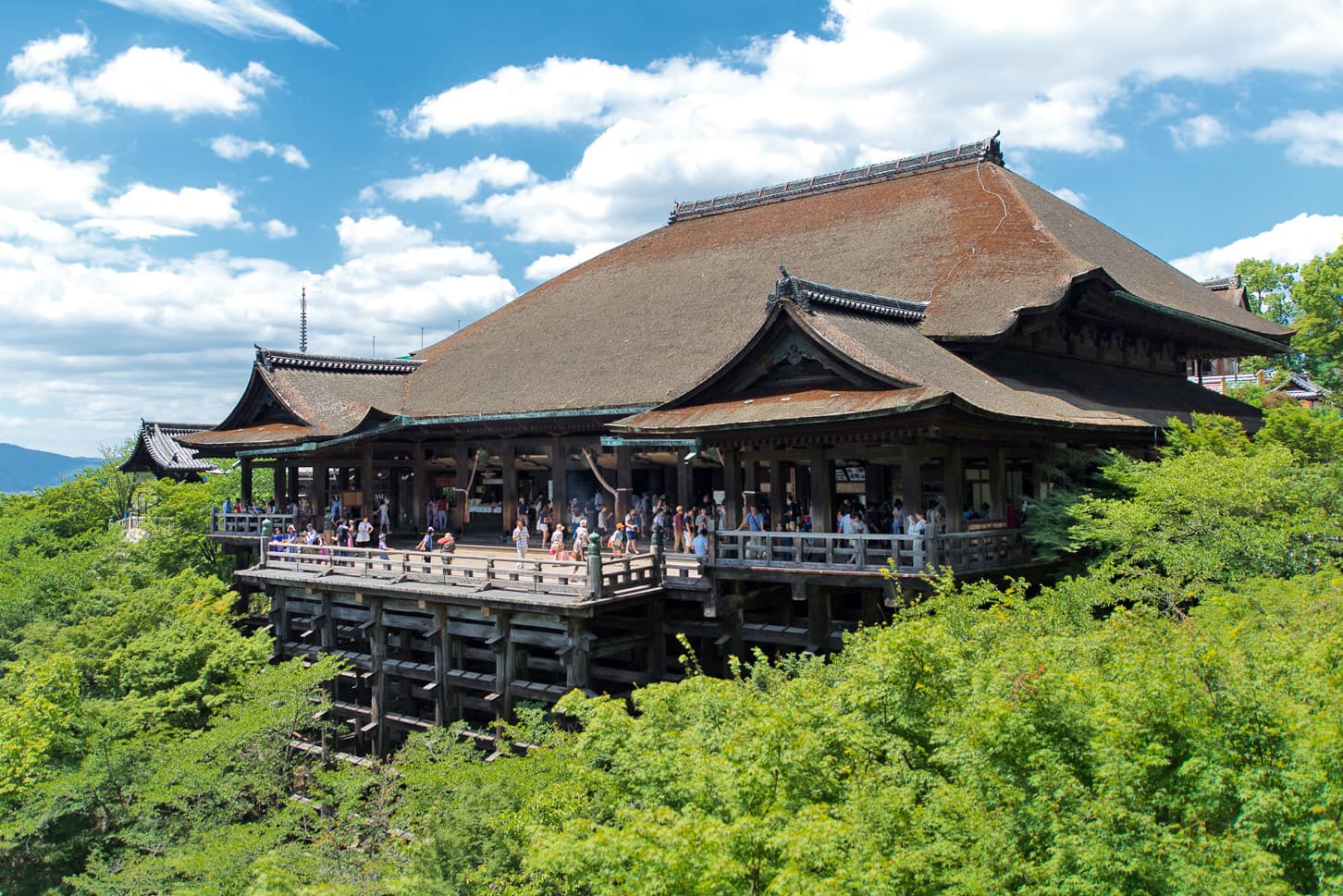
Many of Kyoto's temples and shrines open early, and Kiyomizu-dera Temple is one of them: it opens at 6:00 and closes at 18:00 (kyoto.travel). Reception at temples and shrines often closes around 4 p.m., so check the official website of any site you particularly want to see (Kyoto Online Tourist Information Center).
To reach Higashiyama from Kyoto Station, the most reliable route is train plus bus. Take the JR Nara Line to Tofukuji Station and change to the Keihan Line for Kiyomizu-Gojo Station, which is about a 25-minute walk from the temple. On weekends and holidays, express sightseeing buses EX100 and EX101 run between Kyoto Station and Gojo-zaka, the nearest bus stop to Kiyomizu-zaka; the fare is ¥500 for adults and the Subway & Bus 1-Day Pass is accepted (kyoto.travel). The City Bus route to Gojo-zaka is frequently congested, so allow extra time.
From Kiyomizu-dera, walk down through Sannenzaka and Ninenzaka towards Gion. The route passes Nene-no-michi and the Higashiyama lanes and takes in Kodai-ji Temple and Yasaka Shrine.
Lunch
Nishiki Market
Nishiki Market is one of Kyoto's busiest spots, so keep moving and avoid stopping in the middle of the street to talk or take photos (Responsible Travel). It is a good place to graze on Kyoto specialities; check prices as you go rather than budgeting a fixed amount.
Afternoon
Gion
Gion is a residential district, not a theme park. Do not stop, touch, follow or take unauthorised photos of geiko (Kyoto geisha) or maiko (apprentice geisha), and do not enter private property or restricted areas. If you would like to watch a Kyoto-style dance, performances are held daily at 6:00 p.m. or 7:00 p.m. at Gion Corner (kyoto.travel).
When you do spot a geiko or maiko, take a glimpse from a respectful distance rather than approaching (kyoto.travel).
Evening
Have dinner in the Kawaramachi–Ponto-chō area, then walk along the Kamo River. Both are a short walk from Gion.
Day 2: Northern & Western Kyoto
Morning
Kinkaku-ji and Ryoan-ji
From Kyoto Station, take City Bus No. 205 from Bus Terminal B to Kinkakuji-michi (about 45 minutes), then bus No. 59 for the short hop to Ryoanji-mae (Kyo-Navi). Ryoan-ji opens at 8:00 and closes at 17:00 from March to November, and at 8:30–16:30 from December to February (kyoto.travel).
Lunch
Arashiyama
There are plenty of places to eat around Saga-Arashiyama Station and the Togetsukyo Bridge. Menus and prices vary, so look before you commit.
Afternoon
Arashiyama Bamboo Grove and Tenryu-ji Temple
Saga/Arashiyama is about 25 minutes from Kyoto Station (Getting Around). The bamboo grove is free to walk through, but do not carve into the bamboo: damaged bamboo decays, and carving is treated as criminal property damage with fines of up to ¥300,000 (Responsible Travel). Tenryu-ji Temple opens at 8:30 and closes at 17:00 (kyoto.travel).
Finish at the Togetsukyo Bridge, which crosses the river at the southern edge of the district.
Evening
Return to Kyoto Station. Kyoto Station has several places where you can leave your baggage, and luggage delivery services are available if you want to travel hands-free (Getting Around).
Getting Around Kyoto
- City buses charge a flat fare of ¥230 for adults and ¥120 for children within the flat-fare zone. You cannot pay by QR code or by tapping a credit card on the bus; use cash, an IC card or a pass (Kyoto City Bus & Subway Navi).
- Subway & Bus 1-Day Pass: ¥1,100 for adults and ¥550 for children, valid on the day of activation only. It covers all subway lines, all City Bus routes, and certain Kyoto Bus, Keihan Bus and West Japan JR Bus routes (Kyoto City Bus & Subway Information Guide). Check the current price and conditions before you buy.
- IC cards such as ICOCA, PiTaPa and Suica work on city buses and the subway (Kyoto City Bus & Subway Information Guide: Tickets).
- Route planning and new services: the Arukumachi Kyoto Route Planner takes Kyoto's road congestion into account, which general map apps often do not. Kyoto City introduced a revised bus timetable on 1 June 2024, with more frequent loop and main-line buses and express sightseeing buses EX100 and EX101 serving major destinations. From 1 July 2026 a new "Kiyomizu-dera Line" runs on weekdays between Kyoto and Keihan Shichijo Stations and Kiyomizu-dera and Nishi Hongwan-ji Temples (Getting Around).
Costs to Plan For
Rather than a fixed budget, plan around the costs you can check in advance:
- Getting around: a single city bus ride is ¥230 for adults (2026), and the Subway & Bus 1-Day Pass is ¥1,100 for adults and ¥550 for children (2026). Check the live price before you buy (Kyoto City Bus & Subway Information Guide).
- Temple admission: Kyoto's Summer Special Openings in 2026 charged ¥800 for adults and ¥400 for ages 6–12 at most participating sites, with some exceptions (kyoto.travel).
- Autumn night viewings: in 2026, Kiyomizu-dera's night viewing ran from 21 to 30 November at ¥500 for adults and ¥200 for primary and junior high school students, and Kōdai-ji's ran from 23 October to 13 December at ¥800 for adults and ¥400 for junior and senior high school students (Kyoto YOI-YOI). Dates and prices change each year, so check before you go.
Seasonal Notes
- Spring (March–May): cherry blossom season and the busiest time of year.
- Summer (June–August): hot and humid. Kyoto's Summer Special Openings programme ran from 10 July to 30 September 2026, with special access to temples, shrines and historic buildings, plus limited-time night illuminations and heat-relief measures (kyoto.travel).
- Autumn (October–December): the main season for night illuminations and autumn foliage, with events at sites across the city in 2026 (Kyoto YOI-YOI).
- Winter (December–February): colder and quieter, and some temples shorten their hours. Ryoan-ji, for example, opens at 8:30 and closes at 16:30 from December to February (kyoto.travel).
Food to Try
Kyoto's signature dishes include kaiseki, yudofu (hot-pot tofu), yuba (tofu skin), obanzai (home-style small plates), Kyoto vegetables and matcha. Prices vary widely by restaurant, so check menus before you book.
Photo Spots
- Fushimi Inari — early morning for the torii tunnel
- Kinkaku-ji — morning light
- Arashiyama Bamboo Grove — early morning
- Kiyomizu-dera — late afternoon for the city view
- Gion — remember that photography is restricted in many areas (kyoto.travel)
Practical Tips
- Start early. Kyoto's famous sites are quietest in the early morning (kyoto.travel).
- Carry cash or an IC card. City buses do not accept QR code payment or credit card taps (Kyoto City Bus & Subway Navi).
- Follow local etiquette. Bring a reusable bottle, use only licensed taxis with green licence plates or an official ride-hailing app, don't litter, and note that smoking outside designated areas is banned on all Kyoto streets, with a ¥1,000 fine (Responsible Travel).
- Don't try to see everything. Two days is a taster, not a full tour.
Ready to explore Japan?
Browse tours and activities, or tell us what you're looking for and we'll suggest the best options.
Stay Connected in Japan
Airalo eSIMs work on arrival — no physical SIM needed. Data plans from $5 for 7 days.
Travel Insurance for Japan
Medical, trip cancellation, and adventure sports covered. Plans from $1.5/day.