
Shikoku Pilgrimage: Walking Japan's 88 Temple Trail
By Tour in Japan editors · Updated
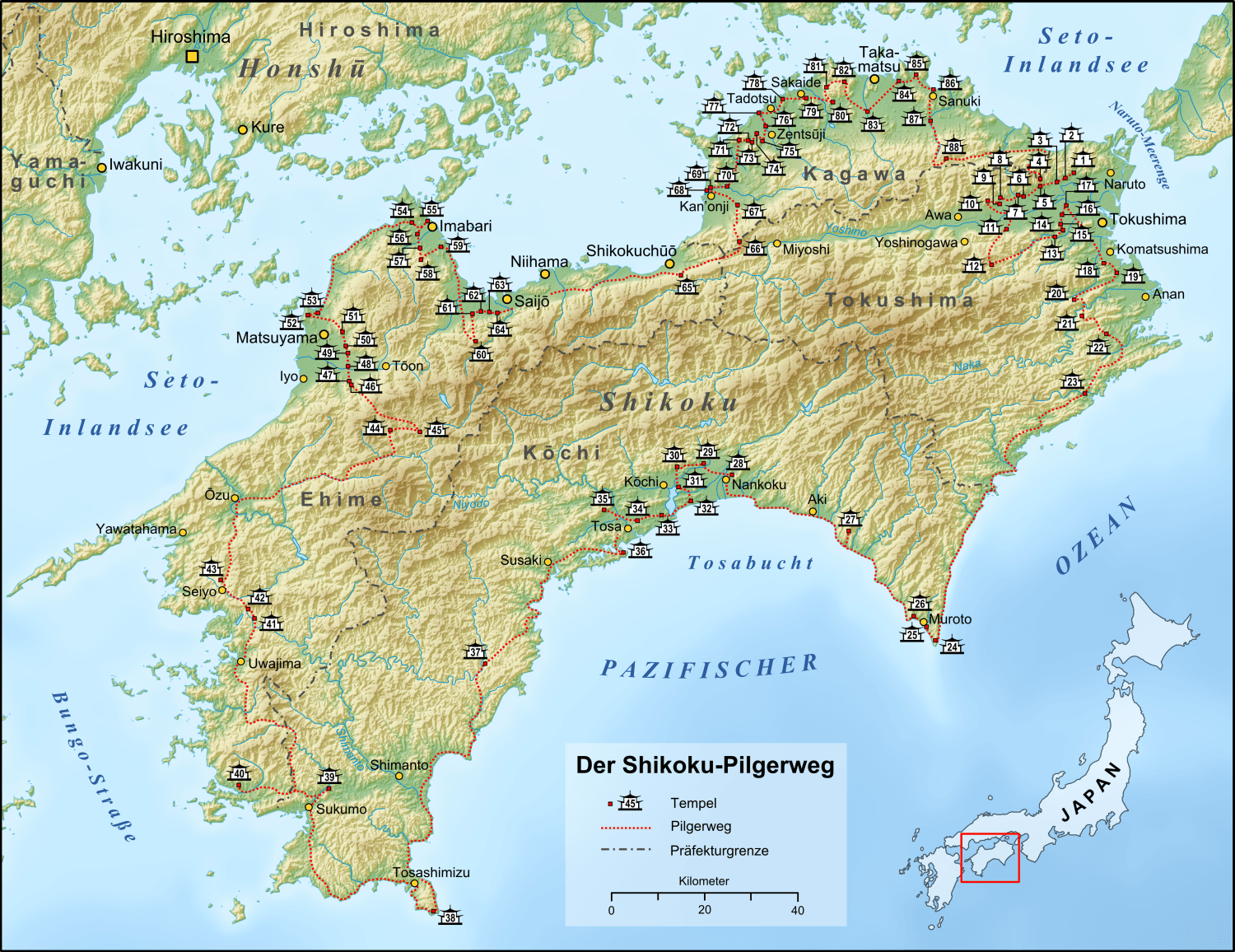
The Shikoku Pilgrimage (四国遍路 / Shikoku Henro) is one of the world's great long-distance walking routes. This 1,200-kilometer circuit around Japan's fourth-largest island visits 88 temples associated with the Buddhist monk Kūkai (Kōbō Daishi), founder of Shingon Buddhism. Each year, over 100,000 pilgrims walk, cycle, drive, or bus this sacred route.
What is the Shikoku Pilgrimage?
The Basics
- Total distance: ~1,200 km (745 miles)
- Number of temples: 88 (official) + many sub-temples
- Duration: 30–60 days walking, 10–14 days by car/bus
- Difficulty: Moderate (some mountain passes, mostly paved roads)
- Best season: March–May, September–November
- Cost: ¥100,000–¥300,000 total (walking), ¥200,000–¥500,000 (car/bus)
The Four Provinces
The pilgrimage is divided into four sections, each with its own spiritual theme:
| Province | Theme | Temples | Distance | Terrain |
|---|---|---|---|---|
| Tokushima (阿波) | Awakening (発心) | #1–#23 | 230 km | Mountainous, challenging |
| Kōchi (土佐) | Ascetic Practice (修行) | #24–#39 | 360 km | Coastal, flat, longest |
| Ehime (伊予) | Enlightenment (菩提) | #40–#65 | 330 km | Mixed, hilly |
| Kagawa (讃岐) | Nirvana (涅槃) | #66–#88 | 180 km | Flat, shortest |
How to Do the Pilgrimage
Option 1: Walking (遍路 / Henro)
The most traditional and rewarding way.
| Feature | Details |
|---|---|
| Duration | 30–60 days |
| Daily distance | 20–30 km |
| Daily cost | ¥5,000–¥10,000 |
| Accommodation | Minshuku, temples, campsites |
| Fitness required | Moderate (can be adapted) |
| Best for | Those with time, seeking spiritual experience |
Pros: Most authentic experience, slow travel, meet locals Cons: Time-consuming, physically demanding, weather-dependent
Option 2: Cycling (自転車遍路)
Faster than walking, still immersive.
| Feature | Details |
|---|---|
| Duration | 10–20 days |
| Daily distance | 60–100 km |
| Daily cost | ¥5,000–¥8,000 |
| Accommodation | Hotels, campsites, minshuku |
| Fitness required | Good (mountain passes) |
| Best for | Active travelers, cycling enthusiasts |
Pros: Cover more ground, flexible schedule, good exercise Cons: Some roads dangerous for cyclists, bike maintenance
Option 3: Driving (車遍路)
Fastest and most flexible.
| Feature | Details |
|---|---|
| Duration | 7–14 days |
| Daily distance | 100–200 km |
| Daily cost | ¥15,000–¥25,000 (car + fuel + tolls) |
| Accommodation | Hotels, ryokan |
| Fitness required | Minimal |
| Best for | Families, those with limited time |
Pros: Visit all 88 temples quickly, flexible schedule Cons: Expensive, miss the walking experience
Option 4: Bus Tour (遍路ツアー)
Guided bus tours that visit all temples.
| Feature | Details |
|---|---|
| Duration | 10–14 days |
| Daily cost | ¥20,000–¥30,000 |
| Accommodation | Hotels |
| Fitness required | Minimal |
| Best for | Seniors, those with mobility issues |
Pros: Hassle-free, expert guides, comfortable Cons: Fixed schedule, expensive, less authentic
Pilgrim Basics
What to Wear
Traditional pilgrim clothing (遍路装束 / henro shōzoku):
| Item | Japanese | Purpose | Where to Buy |
|---|---|---|---|
| White vest | 白のMutex | Purity, symbol of pilgrim | Temple #1 or shops |
| Conical hat | 菅笠 (sugegasa) | Protection, carries Kōbō Daishi's spirit | Temple #1 or shops |
| Walking stick | 金刚杖 (kongō-zue) | Walking aid, symbol of Kōbō Daishi | Temple #1 or shops |
| Stamps book | 納経帳 (nōkyō-chō) | Collect stamps at each temple | Temple #1 or shops |
Cost for full set: ¥5,000–¥8,000 at Temple #1
What to Bring (Walking)
Essential:
- Comfortable walking shoes (broken in)
- Rain gear (waterproof jacket + pants)
- Sunscreen and hat (summer)
- Headlamp (for early starts)
- First aid kit
- Water bottles (2L minimum)
- Snacks and energy bars
- Cash (ATMs are rare in rural areas)
Optional:
- Trekking poles
- Camera
- Portable charger
- Sleep mask and earplugs
- Book/Kindle for evenings
Temple Basics
Visiting a Temple
Each temple visit follows a similar pattern:
- Enter through the main gate (南門 / nanmon)
- Purify hands at the water basin (手水舎 / temizuya)
- Ring the bell (if available) by pulling the rope
- Place offerings — rice (5 go), incense (1 bun), candle (1 hon)
- Chant at the main hall — recite the Heart Sutra (般若心経)
- Get your stamp — the temple writes your stamp book (¥300–¥500)
- Buy charms (optional) — protection amulets, good luck items
Stamp Book (納経帳 / Nōkyō-chō)
| Item | Price | What It Is |
|---|---|---|
| Stamp (納経) | ¥300 | The temple's calligraphy stamp |
| Red stamp (朱印) | ¥500–¥1,000 | More detailed, often with art |
| Inkan (印鑑) | ¥1,000–¥3,000 | Personal stamp for your book |
Total for 88 temples: ¥30,000–¥50,000 for all stamps
Mantra for Each Temple
Each temple has its own mantra (真言 / shingon) to chant. The most common is:
"Namu Daishi Henjo Kōnichi" (南無大師遍照金剛) "Homage to the Great Teacher, Illuminating Vajra"
Key Temples to Know
Temple #1: Ryōzen-ji (霊山寺)
Starting point of the pilgrimage
- Location: Naruto, Tokushima
- Significance: Temple of Awakening
- What to see: Pilgrim supply shop, garden
- Time: 30 minutes
Temple #23: Yakuō-ji (八王子寺)
End of Tokushima section
- Location: Mima, Tokushima
- Significance: Highest temple on the route (927m)
- What to see: Mountain-top pagoda, sunset views
- Time: 1 hour
Temple #24: Hotsumisaki-ji (最御崎寺)
Start of Kōchi section
- Location: Muroto, Kōchi
- Significance: Where Kūkai attained enlightenment
- What to see: Clifftop views, cave where Kūkai meditated
- Time: 1 hour
Temple #36: Chikurin-ji (竹林寺)
Kōchi's most beautiful temple
- Location: Kōchi City
- Significance: Temple of Bamboo Forest
- What to see: Beautiful garden, pagoda
- Time: 45 minutes
Temple #40: Ishite-ji (石手寺)
Start of Ehime section
- Location: Matsuyama, Ehime
- Significance: One of the largest temples
- What to see: Massive gate, cave, garden
- Time: 1 hour
Temple #65: Iwaya-ji (岩屋寺)
Most dramatic temple setting
- Location: Shikokuchūō, Ehime
- Significance: Temple in a cave
- What to see: Cliff-side cave temple, stunning views
- Time: 1–2 hours
Temple #88: Ōkuboji (大窪寺)
Final temple
- Location: Zentsūji, Kagawa
- Significance: Completion of the pilgrimage
- What to see: Celebration atmosphere, pilgrims completing their journey
- Time: 30 minutes
Accommodation
Types
| Type | Cost | Comfort | Availability |
|---|---|---|---|
| Minshuku (民宿) | ¥5,000–¥8,000 | Basic | Good |
| Ryokan (旅館) | ¥8,000–¥15,000 | Good | Good |
| Temple stay (宿坊) | ¥8,000–¥12,000 | Basic | Limited |
| Hotel | ¥8,000–¥20,000 | Comfortable | Good |
| Camping | ¥500–¥2,000 | Basic | Available |
| Henro hut (遍路小屋) | Free | Very basic | Scattered |
Henro Huts (遍路小屋)
Free shelters for pilgrims scattered along the route. Basic but functional — usually just a room with futons. Ask locals or check guidebooks for locations.
Budget Summary
Walking Budget (40 days)
| Category | Cost |
|---|---|
| Accommodation | ¥200,000 (avg ¥5,000/night) |
| Food | ¥120,000 (avg ¥3,000/day) |
| Stamps/charms | ¥40,000 |
| Transport to/from Shikoku | ¥10,000 |
| Gear | ¥20,000 |
| Total | ¥390,000 (~$2,600) |
Car Budget (10 days)
| Category | Cost |
|---|---|
| Car rental | ¥50,000 |
| Fuel | ¥15,000 |
| Tolls | ¥20,000 |
| Accommodation | ¥100,000 (avg ¥10,000/night) |
| Food | ¥40,000 (avg ¥4,000/day) |
| Stamps | ¥40,000 |
| Total | ¥265,000 (~$1,760) |
Tips for First-Timers
- Start at Temple #1 — buy your gear and set your intention
- Walk at least a few days — even if you drive most of it
- Stay at a temple — the住宿坊 experience is unforgettable
- Eat local food — each province has specialties
- Learn the mantra — "Namu Daishi Henjo Kōnichi"
- Bring cash — ATMs are rare in rural areas
- Respect the tradition — dress appropriately, follow temple etiquette
- Don't rush — the pilgrimage is about the journey, not the destination
Japanese Phrases
| Japanese | Pronunciation | Meaning |
|---|---|---|
| お遍路さんです | O-henro-san desu | "I am a pilgrim" |
| お茶 please | O-cha kudasai | "Tea, please" (at homes) |
| 南無大師遍照金剛 | Namu Daishi Henjō Kōngō | Pilgrim's mantra |
| お接身体 | O-settai | "Pilgrim's gift" |
| お接身体ありがとうございます | O-settai arigatō gozaimasu | "Thank you for the gift" |
Related Articles
Stay Connected in Japan
Yesim eSIMs work on arrival — no physical SIM needed. Japan data plans from $5.