
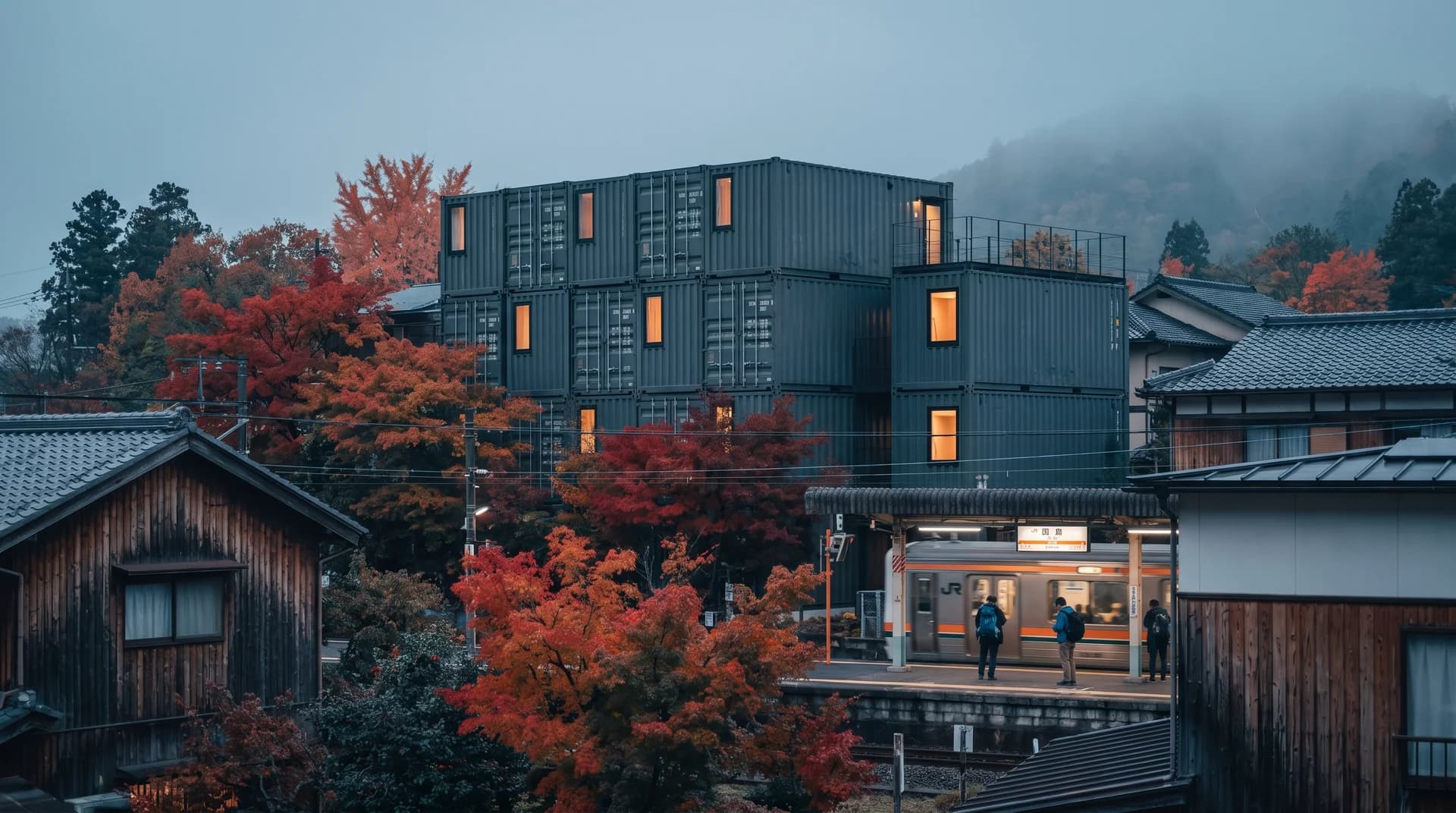
Japan's pod-style hotels: costs, booking and expectations
Pod-style lodgings sit between capsule and business hotel. Prices vary by city and season; check booking terms and licensing.
Japan's pod-style lodgings sit between a capsule bunk and a business hotel: you get a compact unit with a real mattress, a shelf, power outlets and a curtain or door for privacy, at prices closer to the capsule end. The catch is that the "container hotel" label is used loosely online, and much of what circulates about specific properties is unverifiable. What follows sticks to published price bands, booking mechanics and practical detail you can check yourself.
Capsule hotels are the closest established category. The world's first opened in 1979 in Osaka's Umeda district, aimed at salarymen who had missed the last train home; today they are an attraction in their own right, and a wave of newer openings has raised quality to the point where they are generally as clean, safe and pleasant as any other hotel. Most sit near train stations, which makes them convenient for short stays (JNTO, Capsule Hotels).
What a pod night costs in 2026
Published 2026 rates, per room per night, break down like this (Japan Hotel Prices 2026):
Tier | Tokyo | Kyoto | Osaka |
|---|---|---|---|
Budget (capsule, hostel, pod) | ¥4,000–5,500 | ¥4,500–6,000 | ¥2,800–4,500 |
Business hotel | ¥9,000–14,000 | ¥10,500–15,000 | ¥7,000–11,000 |
Mid-range | ¥18,000–30,000 | ¥20,000–35,000 | ¥13,000–22,000 |
In every city the budget band sits well below the business-hotel band, which is the band a container or cabin unit competes in. Osaka is consistently the cheapest of the three — around 20–30% below Tokyo and 30–40% below Kyoto for equivalent quality.
For currency conversion, the same guide uses late-August 2026 rates of roughly ¥160 to $1, ¥185 to €1 and ¥215 to £1, so ¥10,000 is about $67, €63 or £54. Exchange rates move, so check before you budget.
Why the city you pick matters more than the property
Supply explains most of the gap. Tokyo has roughly 350,000 hotel rooms, Osaka about 180,000 and Kyoto only 60,000, which keeps Kyoto inventory tight year-round. Demand spikes do the rest: cherry blossom season (late March to early April), Golden Week (late April to early May), Obon (mid-August) and autumn foliage (mid-November to early December) all push prices up sharply, while off-peak windows can be 40–50% cheaper. Kyoto rates can double off-peak levels during cherry blossom and foliage season (Japan Hotel Prices 2026).
For 2026 dates, JNTO's forecast puts first bloom in central Tokyo around 19 March and in Sapporo around 19 April, with the season running from the latter half of March to as late as early May (JNTO, Cherry Blossom Forecast 2026). If your dates are fixed to a peak window, budget for the upper end of the band or shift your base to Osaka and day-trip.
The same price guide reports that Japan welcomed a record 42.7 million foreign visitors in 2025, up 15.8% year on year, and that most accommodation categories now run 25–40% higher than before 2024. Pod inventory is not exempt from that pressure.
Booking: what the sources confirm
The 2026 price guide names Nine Hours, First Cabin and Capsule Hotel Anshin Oyado as the modern chains behind much of the budget pod inventory, with Akihabara, Asakusa and Shinjuku branches most popular among foreign visitors. It also notes that some premium capsule properties such as First Cabin offer larger pods with sit-up height for ¥5,000–7,000 (2026) — still below the cheapest Tokyo business hotels (Japan Hotel Prices 2026).
On the booking side, JNTO notes that many of the newer capsule hotels offer easy booking in English online (JNTO, Capsule Hotels). Hotels and accommodation are among the things in Japan that typically need reserving in advance, and many properties have dedicated English-language booking pages; some places ask for a deposit or a credit card, and some online reservation services require confirmation 24–48 hours before your stay, so read the terms and watch your email (JNTO, Making Reservations).
One legal point worth knowing: only accommodation licensed under the Inns and Hotels Act or registered under the Private Lodging Business Act should be booked, and reservations for unregistered rooms made through online booking sites may be subject to cancellation (JNTO notice on private lodging).
Beyond that, the sources here do not document cancellation windows, refund rules or check-in cut-offs for individual pod properties. Those terms vary by property and rate plan, so read them on the specific listing before you pay, and confirm directly with the property if the listing is unclear. Treat any blanket claim about cancellation or confirmation across "container hotels" as unreliable.
What to expect inside a pod
A standard pod generally contains a mattress, pillow, shelf space, electrical outlets, Wi-Fi and perhaps a TV. A curtain or door gives you some privacy, but do not expect it to be soundproof. Communal facilities vary, but you can expect lavatories and showers, and amenities such as toothbrushes and even pyjamas are often provided. Many properties have a lounge area, and you will usually be assigned a locker for your bag, with large suitcases normally left at reception. Although traditionally male-only, both mixed-gender and female-only capsule hotels now exist; some mixed properties have co-ed capsule rooms, while others separate guests by room or floor (JNTO, Capsule Hotels).
Etiquette matters more than in a private room. Keep noise down and use headphones for TV or music, be careful with your morning alarm (some capsules have silent light alarms), and avoid strong-smelling food — many hotels prohibit food of any kind inside the pods. You will probably want photos, but keep other guests out of your shots and mind the shutter noise. The property will usually run through its specific rules at check-in; if in doubt, follow those.
What is not established here
Several details that appear in circulating guides cannot be confirmed from these sources: exact unit dimensions, mattress brands, kiosk check-in windows, shower opening hours, luggage-hold policies and station walking times for named pod properties. If those matter to you — and for a late arrival or an early departure they often do — verify them on the property's own page or by contacting the property before booking.
The category itself is also less standardised than the name suggests. "Container hotel" is applied online to modular units, cabin-style pods and converted buildings alike, and the sources here do not define which properties qualify. Use the price bands above to judge whether a listing is good value, and treat the label as marketing rather than a specification.
Matching the room to your trip
Osaka gives you the lowest pod and budget rates of the three main cities, so it is the strongest base if accommodation cost is your deciding factor. Tokyo offers the widest range overall, from roughly ¥3,000 capsule beds to ¥250,000-plus suites, which means more competition and more mid-band options. Kyoto is the one to book earliest, because only about 60,000 rooms exist and peak-season rates can double (Japan Hotel Prices 2026).
On timing, the same guide states that booking strategies can save 20–50% across a typical trip, and that off-peak windows run 40–50% below peak. It does not specify how far ahead to book for pod properties in particular, so check live availability and the current price for your dates rather than relying on a rule of thumb.
Ready to explore Japan?
Browse tours and activities, or tell us what you're looking for and we'll suggest the best options.
Stay Connected in Japan
Airalo eSIMs work on arrival — no physical SIM needed. Data plans from $5 for 7 days.
Travel Insurance for Japan
Medical, trip cancellation, and adventure sports covered. Plans from $1.5/day.