Photogenic Instagram spots in Japan
A guide to photogenic spots in Tokyo, Kyoto and Osaka, with practical notes on access, photography rules and respectful etiquette.
Affiliate link — we may earn a commission at no extra cost to you. Affiliate disclosure
Most of Japan's most photographed places are free: the Fushimi Inari torii gates, the Shibuya crossing, the Arashiyama bamboo grove and the Miyajima shrine gate cost nothing to visit. The cost is timing — the same places are unusable between 10 am and 4 pm.
Key facts
- Cost: Free for almost every spot on this list. The exceptions are paid observatories and temples, usually a few hundred yen.
- Time needed: Two hours per spot including the walk, and much more if you want the shot without a crowd.
- Best season: November for autumn colour, April for cherry blossom. Both are also the busiest weeks of the year.
- Book ahead: Nothing, except paid observation decks, which need a timed ticket.
- Watch out for: Photography bans. Several temples, markets and shrines forbid photography of people, worshippers or specific halls.
The timing rule that fixes everything
Every famous Japanese location has a two-hour window when it works: roughly one hour after sunrise and one hour before it closes. Outside that window you are photographing the back of someone's head.
The reason is group tourism. Coach parties arrive from 9:30 and leave by 16:00, and the trains run in the same rhythm. If you are on the first train, you are 90 minutes ahead of the entire industry.
That means the practical advice for every spot below is the same: go at opening, or go at dusk. It is not a secret and it is not difficult, and it is the difference between a photograph and a snapshot.
What each spot costs
Spot | City | Entry cost | Best time |
|---|---|---|---|
Shibuya Scramble Crossing | Tokyo | Free | After dark, or 6–7 am |
Fushimi Inari torii gates | Kyoto | Free | Before 7 am |
Arashiyama bamboo grove | Kyoto | Free | Before 8 am |
Miyajima shrine gate | Hiroshima | Free to view; ferry crossing is paid | High tide, early morning |
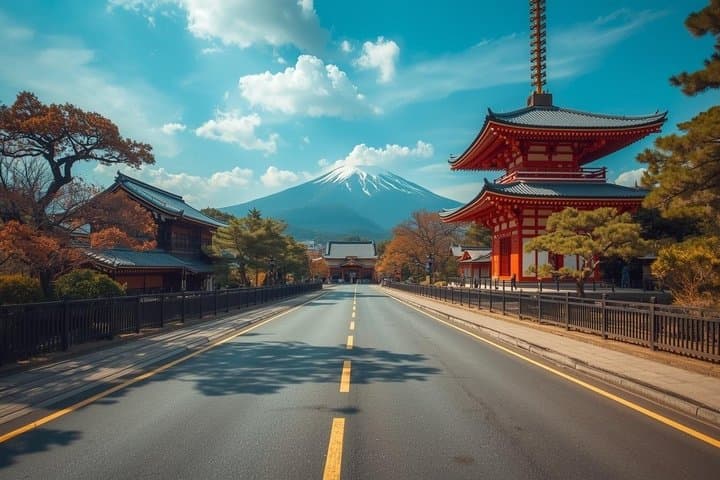
Lake Kawaguchi, Fuji reflection | Yamanashi | Free from the shore | Dawn, October to February |
Shirakawa-go village | Gifu | Free to walk; some houses charge entry | Before 9 am, or after 16:00 |
Tokyo Metropolitan Government Building | Tokyo | Free | Sunset, December to February |
SHIBUYA SKY | Tokyo | ¥2,700–3,400 (~$17–22) | 30–45 min before sunset |
teamLab digital art museums | Tokyo | Ticketed; check the venue's own price | First slot of the day |
Ferry and observatory prices are the only real costs, and the rest of the list is public space.
Tokyo: the crossing and the skyline
Shibuya Scramble Crossing is the most photographed intersection in the world, and it is best at night when the screens are lit and the crowd is densest. The classic elevated angle is from the pedestrian bridge and the station walkway; SHIBUYA SKY gives you the same view from 229 metres, which is a different photograph and needs a ticket.
The Metropolitan Government Building in Shinjuku is free, has two observatories, and on a clear winter day gives you Mount Fuji on the horizon. It closes early on the north side, and the south deck runs to 22:00.
The Tokyo Tower and Skytree are best photographed from a distance rather than climbed. The Shiba Park area and the Sumida riverbank both give you the tower against the sky for nothing.
Kyoto: the two that everyone wants
Fushimi Inari is free, open 24 hours, and effectively empty before 7 am. The lower gates are the photograph; the upper trails take two hours and are quiet all day. If you want the tunnel of torii with nobody in it, be there at 6:30.
Arashiyama bamboo grove is free and open all night, and from 9 am it is a queue. The grove is 200 metres long and takes ten minutes to walk; the photograph needs the path empty, which means before 8 am or after 5 pm.
Both are accessible by train from central Kyoto, and both are worth the early alarm.
The places people forget to check the rules
Japan is relaxed about most photography and strict about a few things.
- Worshippers and graves. At shrines, temples and cemeteries, do not photograph people praying or visiting. It is the single most common offence.
- Some halls ban photography entirely. Look for the sign with a camera and a line through it at the entrance.
- Markets. Tsukiji and Omicho are working markets, and photographing staff without asking is rude.
- Geisha districts. Gion has banned photography in some streets, with fines. The signs are clear.
- Drones. Banned across most of urban Japan without a permit.
- Tripods. Banned at most observatories and on many temple grounds.
The famous ones that do not photograph well
A short list to save you a morning.
The Shibuya crossing from street level is a crowd, not a photograph. The image everyone recognises is shot from above. Go up or do not bother.
The Arashiyama bamboo grove at midday is a queue in a green tunnel. The grove is 200 metres long, and after 9 am you will photograph hats.
Nakamise in Asakusa is at its best at 7 am and its worst at noon. The same street, a completely different picture.
The Golden Pavilion is small, crowded and best in the first hour, and the classic reflection shot needs still water that is often not there.
Any blossom spot in the first week of April — the trees are beautiful and the crowds are dense enough that you will wait for a gap that never comes.
A note on editing and honesty
Japanese tourism boards have become sensitive about photographs that misrepresent a place, and a few municipalities have introduced rules about drone shots and composed scenes. The practical version for a normal visitor is simple.
Do not remove people from a photograph and present it as the place. Do not photograph a private property and post the location. Do not film staff at work without asking. And if you use a location tag, make sure the spot is actually public.
The etiquette is not a legal requirement in most cases. It is what keeps the places open to photography at all.
How to actually get the shot
- Check sunrise and sunset for the date. In winter, golden hour in Tokyo is around 16:30; in summer it is after 18:30.
- Be there 30 minutes early. The light changes fastest in the ten minutes either side of sunrise.
- Use the first train. Stations open before 5 am, and the first trains are empty.
- Shoot wide before tight. The crowd arrives fast; get the wide shot first.
- Stay for the blue hour. The 20 minutes after sunset give the city lights and a blue sky, and the crowds leave.
When to go
November and April are the two months when the light and the foliage cooperate, and both are peak season. Expect the famous spots to be crowded by 8 am in those weeks.
December to February is the best compromise: clear air, Fuji visible, early sunsets that fit a working day, and fewer coaches. June is the rainy season and the least rewarding month photographically, though it does empty the temples.
Common mistakes
- Arriving at 10 am and expecting the shot. The window is 6–8 am. Everything after that is a crowd.
- Photographing people at prayer. It is the one thing that gets visitors told off.
- Carrying a tripod. Banned at observatories and most temple grounds.
- Chasing the same five locations. The best photographs are usually one street away from the famous one.
Sources
Verified 2026-10-26. Entry costs are current; opening hours change seasonally, so check each site before an early start.
Ready to explore Japan?
Browse tours and activities, or tell us what you're looking for and we'll suggest the best options.
Stay Connected in Japan
Airalo eSIMs work on arrival — no physical SIM needed. Data plans from $5 for 7 days.
Travel Insurance for Japan
Medical, trip cancellation, and adventure sports covered. Plans from $1.5/day.