
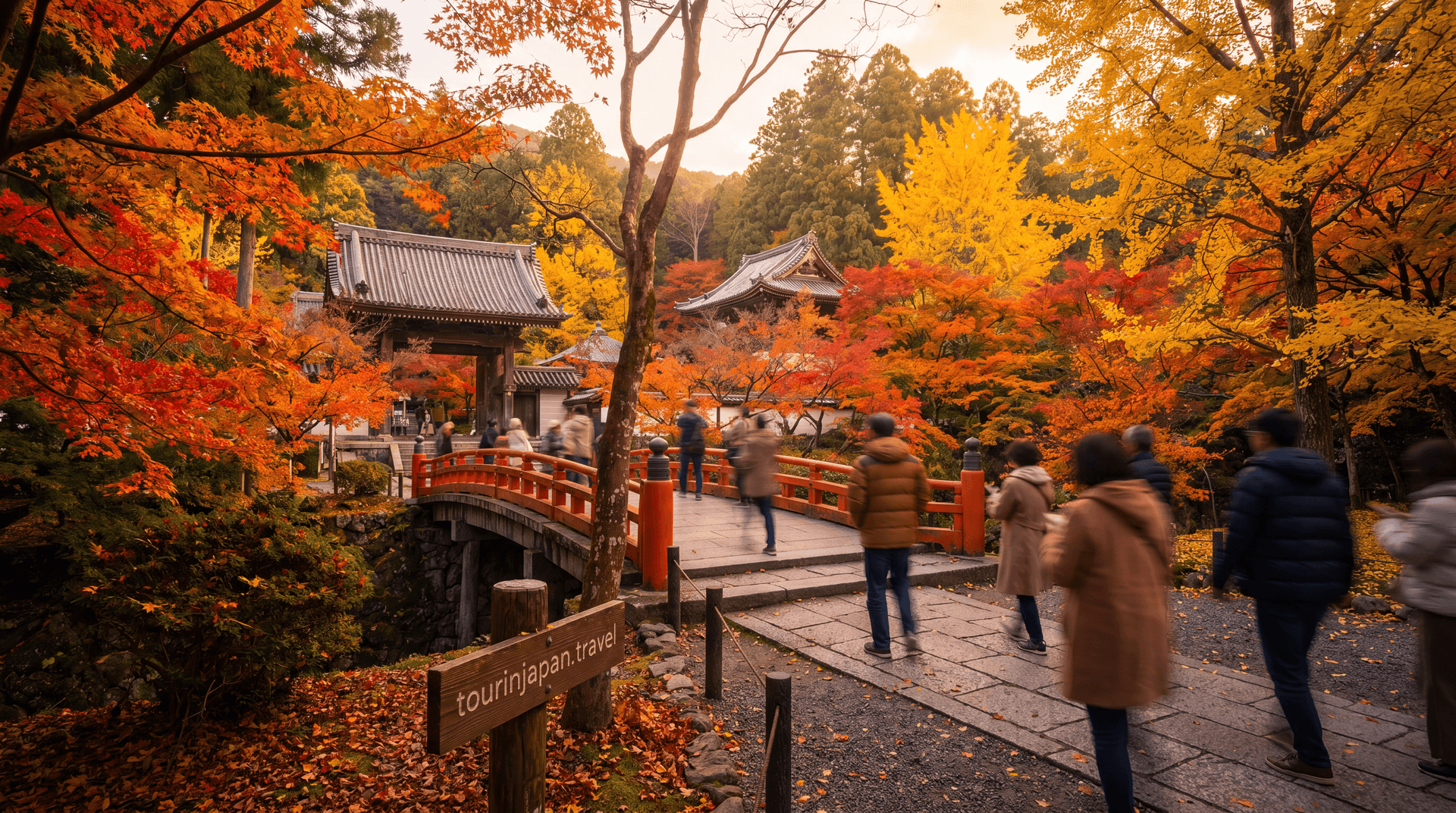
Japan Autumn Foliage 2026: City Dates, Koyo Spots and 2027 Planning
Forecast dates for autumn colour in Japanese cities, with regional viewing spots and practical advice. Check the latest JMC update before booking.
Affiliate link — we may earn a commission at no extra cost to you. Affiliate disclosure
JMC's October forecast has Sapporo's maples turning around 4 November and Osaka's around 4 December. JNTO's traveller forecast runs about a week earlier (Sapporo 28 October, Osaka 1 December) because it tracks popular viewing spots rather than one sample tree per city. The 2027 forecast has not been published; these dates move by a week or two each year with summer heat and autumn rain.
Key facts
- Cost: Temple night viewings ¥600–2,800 (~$4–18). Kifune Shrine's light-up is free.
- Time needed: Two evenings in Kyoto for the illuminations, one morning per garden.
- Best season: Mid to late November in Kyoto, late October in Hokkaido.
- Book ahead: Kyoto hotels for the third week of November, three months out.
- Watch out for: Illumination dates. Each temple publishes its own window, and they differ by weeks.
Japan’s autumn colour moves from north to south and from higher ground into cities. The Japan Meteorological Corporation (JMC) released its 2nd 2026 forecast on 1 October 2026, covering about 700 viewing locations and around 3,000 mountains by altitude. Use the city dates below as a planning guide, then check the latest forecast before you book (JMC forecast).
What this page covers
This page helps you choose where and when to see koyo in 2026. It uses JMC’s 2nd forecast and official travel guidance. Forecast dates move with weather, so check the source again before booking trains or hotels.
Forecast by city
JMC’s 2nd forecast, released on 1 October 2026, gives these dates for sample trees in each city. JMC's next update is due in early November 2026, and this page will be updated when it is out. These are forecast dates for the first day most leaves have turned, not a single peak day; leave a few days either side (JMC forecast).
City | Red leaves (momiji) | Yellow leaves (ginkgo) |
|---|---|---|
Sapporo | 4 Nov | 3 Nov |
Aomori | 13 Nov | 5 Nov |
Sendai | 24 Nov | 29 Nov |
Tokyo | 28 Nov | 26 Nov |
Kanazawa | 30 Nov | 26 Oct |
Nagano | 21 Nov | 14 Nov |
Nagoya | 2 Dec | 17 Nov |
Kyoto | 11 Dec | 27 Nov |
Osaka | 4 Dec | 24 Nov |
Wakayama | 12 Dec | 26 Nov |
Hiroshima | 28 Nov | 21 Nov |
Kochi | 9 Dec | 16 Nov |
Fukuoka | 7 Dec | 28 Nov |
Kagoshima | 10 Dec | 27 Nov |
How accurate are these dates?
The city dates are forecasts for one monitored sample tree per city, not for every park or temple. PeakYet compared 1,015 JMC forecast dates from 2018 to 2025 with the dates JMA recorded those trees turning. The forecast missed by 4.0 days on average for maple and 4.8 days for ginkgo, and 75% of maple dates and 64% of ginkgo dates landed within five days. Maple more often turned a few days earlier than forecast, and later forecast rounds were not reliably closer than earlier ones. Kyoto, Tokyo and Osaka were within about three to four days on average; Kanazawa's ginkgo was much less steady, at 11.4 days. These are past results, not a margin guaranteed for 2026 (PeakYet research).
Kyoto's sample tree also turns late: its average date is 5 December, while the best-known temple gardens peak in the second half of November. Plan Kyoto around the temple dates below, not the city row.
When to go this year
Use the city table as a rough order. The season generally moves from north to south, and mountain areas turn earlier than the city dates (JNTO autumn leaves forecast). Leave flexibility and check the latest JMC forecast before you commit.
Best places by region
Tokyo and around
- JNTO highlights Rikugien Garden in Tokyo for autumn views and evening illumination, and Lake Kawaguchiko at the base of Mt Fuji for lake-and-mountain colour (JNTO autumn guide).
- Mt Takao is about an hour from central Tokyo. From Shinjuku, the Keio Line Limited Express reaches Takaosanguchi Station in as little as 50 minutes. Trail 1 is paved and Trail 6 passes Biwa Waterfall. The cable car takes about six minutes to the mid-mountain area. Autumn leaves are typically at their best from mid-November to early December, but this varies with weather (JNTO Mt Takao guide).
- Meiji Jingu Gaien has a ginkgo avenue about 300 metres long with 146 trees. It is a public road, so walking through costs nothing and needs no booking. The Meiji Memorial Picture Gallery at the end is closed for restoration from April 2025 until the end of May 2027 (planned), so the gallery may be behind scaffolding or protective sheeting. The old Ginkgo Festival has not run under that name since 2019, and evening lighting for 2026 has not been confirmed (Glos Travel).
Kyoto and Kansai
- Rurikoin holds its 2026 autumn special viewing from 1 October to 13 December 2026, 10:00–17:00 (last entry 16:30). Admission is ¥2,000 for adults and ¥1,000 for junior and senior high school students with student ID (2026). Reservation is required from 13 November to 6 December 2026; no reservation is needed from 1 October to 12 November and from 7 to 13 December. Check the temple’s site for the live price and any changes before you go (Kyoto official event page).
- Shokoku-ji opens for autumn special viewing from 26 September to 15 December 2026 (closed 18–21 October), 10:00–16:00. Admission is ¥1,000 general and ¥500 for primary, junior and senior high school students (2026). The Hatto hall has a dragon ceiling painting known as the “crying dragon”. Check the temple’s site for the live price before you go (Kyoto official event page).
- Kogenji opens for autumn special viewing from 3 October to 6 December 2026, 9:00–17:00 (last entry 16:45). Admission is ¥500 for adults and ¥300 for children (2026); a combined ticket with Hokyo-in is ¥1,000 (2026). The garden uses Arashiyama as borrowed scenery. Check the temple’s site for the live price before you go (Kyoto official event page).
- Many Kyoto temples and shrines hold autumn night openings and light-ups in 2026. Examples include Kiyomizudera (21–30 November 2026, 17:30–21:00, ¥500 adults and ¥200 for primary and junior high school students), Eikando (20 November–6 December 2026, 17:30–20:30, ¥1,000 for junior high school students and older), and Daigoji (20 November–6 December 2026, 18:00–20:50, ¥1,500 for junior high school students and older). Check each venue’s official page for changes and live prices before you go (Kyoto night viewing list).
Hokkaido
- Mount Asahidake in Daisetsuzan National Park is known for Japan’s earliest autumn colours. Foliage above 1,500 metres is at its best around 21 September to 5 October (Nippon.com).
For other regions, use the city table above and check local official tourism sites.
Practical tips
- Popular spots get busy. Go early or on a weekday where you can.
- Check opening hours, prices and reservation rules before you go. Some Kyoto temple openings require reservations.
- Book accommodation early for late November to mid-December, especially in Kyoto. If Kyoto is full, Osaka is an easy base by train.
- Carry cash for small temples and rural buses, wear shoes you can remove easily, and bring layers for cool evenings.
- Check whether a rail pass suits your route: rail pass guide. Set up mobile data before you land: eSIM guide.
- Check the latest JMC forecast before booking (JMC forecast).
Related guides
- Tokyo autumn foliage itinerary
- Best autumn leaves in Tokyo
- Nikko autumn foliage
- Hokkaido autumn foliage
- Kyoto autumn travel guide
- Japan autumn photography
- Rail pass guide
- Japan SIM and eSIM guide
- Japan budget breakdown 2026
The 2027 table
No 2027 forecast has been published. The typical peak column is the 2026 JNTO forecast, which is the best published guide until the next one appears.
City or site | Typical peak | 2027 forecast | Book by | Source |
|---|---|---|---|---|
Sapporo | Late October, 28 October in 2026 | Not yet published | August 2027 | JNTO |
Kanazawa | Late November, 24 November in 2026 | Not yet published | August 2027 | JNTO |
Hiroshima | Late November, 22 November in 2026 | Not yet published | August 2027 | JNTO |
Tokyo | Late November, 28 November in 2026 | Not yet published | August 2027 | JNTO |
Osaka | Early December, 1 December in 2026 | Not yet published | August 2027 | JNTO |
Kyoto, Tofuku-ji | Mid to late November | Not yet published | August 2027 | Tofuku-ji |
The 2026 season in Kyoto is already dated. Tofuku-ji's autumn period runs 14 November to 6 December, Eikando's night viewing 20 November to 6 December, Kodai-ji's illumination 23 October to 13 December, and Kifune Shrine's maple light-up 7 to 24 November, free and from sunset to 20:30.
What to book, and when
- Pick the city before the date. Kyoto in the third week of November is the peak and the most expensive. Osaka and Tokyo are cheaper for the same week and a train ride away.
- Book a refundable room three months out, by August. The forecast firms up in September, and November weekends sell first.
- Read each temple's own page. Illumination windows are set individually and change every year: Kifune free and short, Kodai-ji long, Eikando two weeks.
- Plan the evening around one cluster. Kodai-ji and Eikando are close enough for one Kyoto evening; Kiyomizu-dera is a further 15 to 20 minutes south.
- Leave a morning for a garden without a ticket. Kifune's light-up costs nothing, and the walk up from Kifune-guchi takes about 30 minutes.
Why the dates move
Autumn colour follows summer heat and autumn rain. A hot summer pushes the change later; early cold nights bring it forward. That is why the JNTO forecast is a band rather than a date, and why the 2027 version will differ from the 2026 one by a week or two.
Common mistakes
- Booking the first week of November for Kyoto. Mid to late November is the peak, and the first week is usually early.
- Assuming one illumination date fits all temples. They publish separately, and some run for three weeks while others run for two.
- Skipping the free options. Kifune's light-up costs nothing and sits in the same fortnight as the paid ones.
- Ignoring Hokkaido. Sapporo peaks around the end of October, a month before Kyoto, which is useful if your dates are fixed early.
- Trusting a 2027 date today. The forecast has not been published. The table's second column says so for a reason.
FAQ
When is autumn foliage in Japan? From late October in Sapporo to early December in Osaka. The JNTO 2026 forecast gave Sapporo 28 October, Hiroshima 22 November, Kanazawa 24 November, Tokyo 28 November and Osaka 1 December. The 2027 dates have not been published.
When will the 2027 autumn foliage forecast be published? The Japan National Tourism Organization publishes a forecast ahead of the season, usually in September, and revises it as the year develops. Until then, the 2026 dates are the best published guide, and they are not a prediction.
Which Kyoto temples have autumn night viewings? In 2026, Tofuku-ji runs 14 November to 6 December, Eikando 20 November to 6 December from 17:30 to 20:30 at ¥1,000, Kodai-ji 23 October to 13 December at ¥800, and Kiyomizu-dera 21 to 30 November until 21:00. Each temple publishes its own dates, which change yearly.
Is autumn foliage free to see? Often. Kifune Shrine's maple light-up is free, from sunset to 20:30. Temple gardens charge: Tofuku-ji was ¥1,000 in autumn and ¥600 outside it, Eikando ¥1,000, Kodai-ji ¥800, and Ninna-ji's illumination ¥2,800 on selected weekend evenings.
How far ahead should I book for autumn foliage? Three months, with a refundable rate, and then confirm once the forecast appears in September. The third week of November in Kyoto is the single busiest window of the Japanese autumn, and weekend rooms go first. Osaka and Tokyo are cheaper for the same week.
Ready to explore Japan?
Browse tours and activities, or tell us what you're looking for and we'll suggest the best options.
Stay Connected in Japan
Airalo eSIMs work on arrival — no physical SIM needed. Data plans from $5 for 7 days.
Travel Insurance for Japan
Medical, trip cancellation, and adventure sports covered. Plans from $1.5/day.