
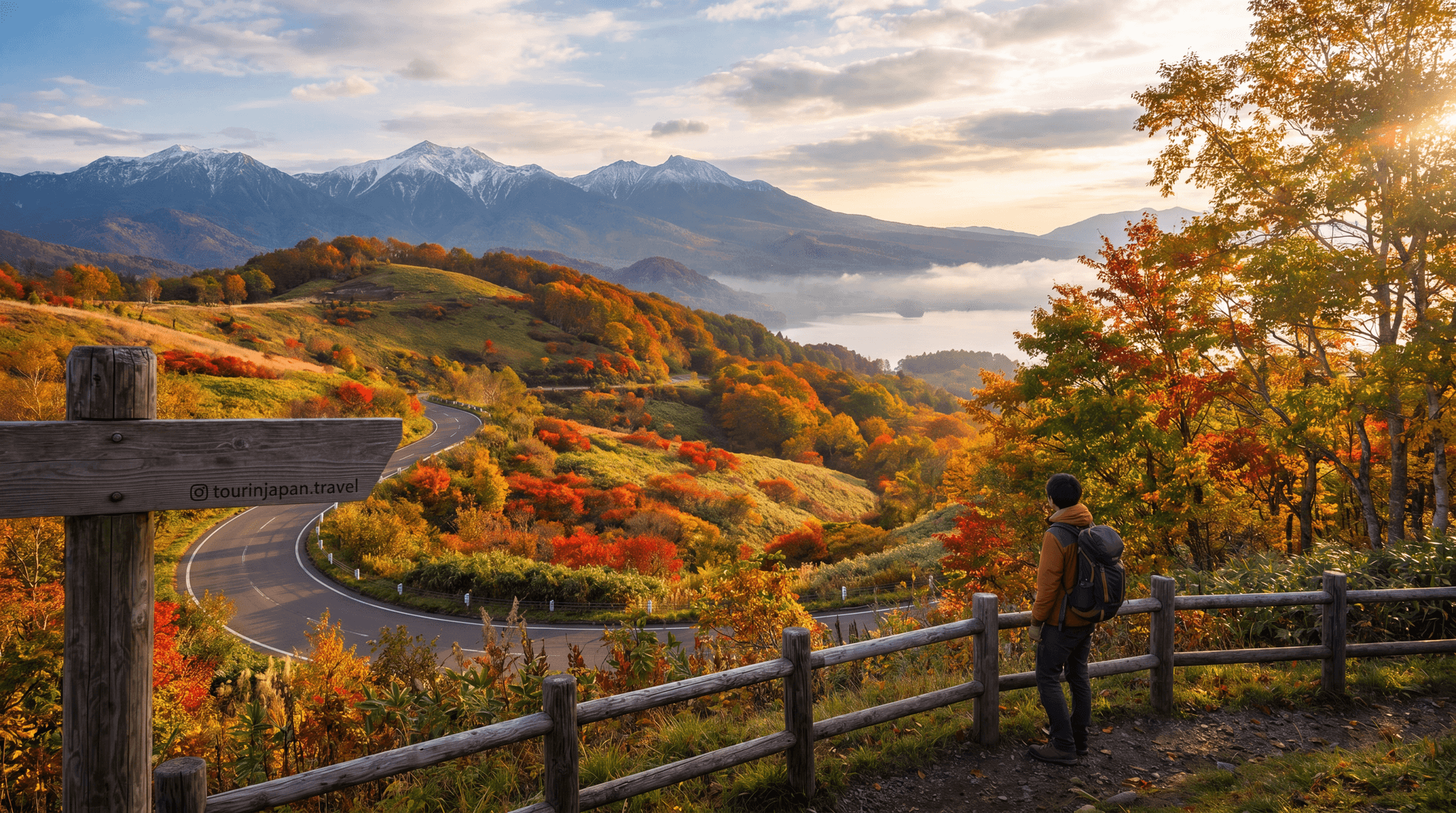
Autumn foliage in Daisetsuzan, Biei and Lake Towada
Autumn colour starts early in Daisetsuzan, moves through Biei's farm hills, and extends to Lake Towada and the Oirase Stream, with access and transport notes.
Affiliate link — we may earn a commission at no extra cost to you. Affiliate disclosure
Autumn in northern Japan starts high and early. Colour appears first on the volcanic peaks of Daisetsuzan, then works its way down through the farm hills around Biei and on to the lakes and gorges of northern Tohoku. Lake Towada sits on the Aomori–Akita border rather than in Hokkaido, but it makes a natural extension to a northern Japan foliage trip. Temperatures drop sharply after sunset, so pack layers even when the daytime feels mild.
Daisetsuzan: Japan's First Autumn Colors
Daisetsuzan National Park covers approximately 2,268 square kilometres of central Hokkaido and holds more than 16 peaks above 2,000 metres, including Mount Asahidake (2,291 m), the island's highest. Its autumn colours are the earliest in Japan and reach their peak in mid-September, with the first winter snows arriving in October — the park's own guidance suggests a late August or early September visit if you want to catch it at its best. Two ropeways give easy access to the high ground: a 10-minute cable car ride from Asahidake Onsen up to Sugatami Station, from which the summit trail takes around 2 hours 30 minutes and the gentler Sugatamiike Pond loop 60–90 minutes past fumaroles and three ponds; and the Kurodake Ropeway from Sounkyo Onsen, which connects to a chair lift and puts you within a climb of around 1,500 metres and 60–90 minutes of the Mount Kurodake summit. The polygonal-pillared walls of Sounkyo Gorge and Tenninkyo Gorge are attractions in their own right (Explore Daisetsuzan National Park).
The Asahidake Visitor Center sits at 1,100 metres on the western slope of Mount Asahidake, right next to the ropeway's lower station, and carries up-to-date information on trail conditions, brown bear sightings and volcanic activity. It is open 9:00–17:00, closed over the New Year holiday, and entry is free, with maps in Japanese and English, short videos, a lounge and outdoor equipment for rent (Asahidake Visitor Center).
At Sounkyo, the visitor centre stands next to the Kurodake Ropeway and is the place to plan routes up Mount Kurodake. It opens 8:00–17:30 from June to October and 9:00–17:00 from November to May, closes on Mondays from November to May and over 31 December–5 January, and is free of charge; seasonal maps on display show where the best foliage can be found along four recommended nature trails, and trail tablets can be borrowed free (Sounkyo Visitor Center).
Getting around takes planning. Sapporo to Asahikawa is a 90-minute ride on the Lilac or Kamui limited express, and flights from Haneda and Narita to Asahikawa Airport take 90 minutes. From Asahikawa Station, Dohoku Bus reaches Sounkyo in two hours, while the Asahikawa Denkikidou bus to Asahidake Onsen takes about 90 minutes; services are infrequent, so staying in Sounkyo Onsen or Asahidake Onsen and renting a car is the practical option. Note that cars are prohibited on many park roads during the peak foliage period in mid-September because of congestion, and that buses to the Ginsendai Trail, the popular autumn hike towards Mount Akadake, run more often in season but are still relatively sparse (How to get there).
Biei: Patchwork Hills and Autumn Farmland
Biei sits in the centre of Hokkaido and is easy to reach. By car it is about 26 km and 40 minutes from Asahikawa on Route 237, about 34 km and 40 minutes from Furano, and roughly 166 km and 2 hours 30 minutes from Sapporo. By train, a regular service from Asahikawa reaches Biei Station in about 32 minutes, and the Furano Bus from Asahikawa Airport takes about 16 minutes (Access).
The farmland around town is best explored on two wheels. The Panorama Road course mapped by the Biei Tourism Association runs 25 km with a maximum elevation gain of 221 m, and threads past named stops including the Christmas Tree, Shikisai-no-Oka, Takushinkan, Shinei-no-Oka View Park, Sanai-no-Oka View Park, Farms Chiyoda and the Shiki-no-Tou tower; the map marks the Blue Pond 16 km along the course (Biei cycling map).
Rental Cycle Station BIEI HILLS is a 3-minute walk from JR Biei Station and rents electric bicycles from ¥600 per hour, with a free bottle of water thrown in; check the current rate when you rent, and note that bicycles are not rented during the rainy or snowy seasons (Rental Cycle Station BIEI HILLS).
Biei's roads carry relatively little traffic, and electric-assisted bikes take the sting out of the hills. Most rental shops close between 16:30 and 17:00, so plan your return; cycle only on paved roads and never enter farmland, since shoes and tyres can carry bacteria that harm crops. Convenience stores and ATMs exist only around JR Biei Station, mobile signal can drop in the hills, and a paper map is more reliable than a phone (Cycling in Biei).
If you would rather ride the bus to the Blue Pond, the Dohoku Bus runs from Biei Station to the Shirogane Blue Pond entrance for ¥800 (2026) and on to Shirogane Onsen for ¥900 (2026); check the live fare and timetable before you travel (Biei–Shirogane bus timetable).
Lake Towada and the Oirase Stream
Lake Towada lies on the border of Aomori and Akita prefectures. The earliest colour appears near the upper reaches of the lake from mid-October, and you can keep enjoying it until early November near Mount Yakeyama downstream. The lakeside promenade from Omaegahama, where the Otome Statue stands, to Katsuragahama is made for a walk, and sightseeing boats, power boats and canoe tours run on the lake (Towada Travel – Autumn).
Inland from the lake, the Tsuta area around Tsuta Onsen is a deep beech forest with a cluster of swamps known as Tsuta Nananuma, linked by a nature observation path and good for birdwatching. Yachi Onsen, further along the Oirase road, is known as one of Japan's three secret hot springs. In Towada city itself, the Towada Art Center was set up as the base for the city's art-led regeneration and shows contemporary works inside and out, with outdoor pieces scattered through the surrounding streets.
JR Bus Tohoku runs the Mizuumi-go from Aomori Station and Shin-Aomori Station to Lake Towada (rest house), and the Oirase-go from Hachinohe Station West Exit. If you board the Oirase-go at Hachinohe Station West Exit you must reserve in advance; the reservation fee is ¥300 per seat (2026), paid online when you book, with the fare paid on alighting. Fares can be paid in cash or with a transport IC card, and there are no toilets on board, though buses make 5–10 minute stops at places such as Tsuta Onsen and Sukayu Onsen (JR Bus Tohoku route information).
In the 2026 timetable, which runs from 18 September to 17 November, Mizuumi-go No. 102 leaves Aomori Station at 7:30 and reaches Lake Towada at 10:15, while Oirase-go No. 21 leaves Hachinohe Station West Exit at 10:00 and arrives at Lake Towada at 12:20. Always check the current timetable before travelling (JR Bus Tohoku timetable).
One thing to watch: in 2026 the Oirase "natural museum" car restriction runs from 7 to 13 September on the Route 102 Oirase Gorge section between the Sobe and Nenokuchi intersections, and on 13 September all vehicles, including tour buses and taxis, are barred, so you will need the shuttle bus or to walk. No restrictions or shuttle buses are planned for October 2026 (Oirase car restriction notice).
Hokkaido Autumn Foliage Timing and Travel Tips
- Daisetsuzan National Park as a whole peaks in mid-September (Explore Daisetsuzan).
- Around Asahidake Onsen, expect colour from mid-September to early October; around Sounkyo Onsen, from early September to late October (JR Hokkaido access map).
- In the Oirase Gorge, colour begins near the upper reaches of Lake Towada in mid-October and lasts until early November near Mount Yakeyama (Towada Travel – Autumn).
- Public transport in Daisetsuzan is infrequent, and a car gives easier access to most areas — but remember the mid-September road closures at peak foliage (How to get there).
- Book accommodation in Biei, Sounkyo and around Lake Towada well ahead for peak dates; small guesthouses in scenic areas fill quickly.
- Onsen are plentiful across Hokkaido and make a good end to a day of hiking.
A loop from Sapporo through Daisetsuzan to Biei and on to Furano, spread over several days, captures the full range of the island's autumn colour.
Ready to explore Japan?
Browse tours and activities, or tell us what you're looking for and we'll suggest the best options.
Stay Connected in Japan
Airalo eSIMs work on arrival — no physical SIM needed. Data plans from $5 for 7 days.
Travel Insurance for Japan
Medical, trip cancellation, and adventure sports covered. Plans from $1.5/day.