Hakone Day Trip from Tokyo: Hot Springs, Art and Mount Fuji
Hakone is a mountainous resort in Fuji-Hakone-Izu National Park, about 90 minutes from Shinjuku, known for hot springs, art museums and Mount Fuji views.
Affiliate link — we may earn a commission at no extra cost to you. Affiliate disclosure
Hakone is a mountainous resort area in western Kanagawa Prefecture and part of Fuji-Hakone-Izu National Park. It's known for its hot springs, art museums and views of Mount Fuji, and it makes an easy day trip from Tokyo — about 90 minutes from Shinjuku Station (Travel Japan).
Getting to Hakone
Hakone-Yumoto Station is the gateway to the area, and two main routes connect it with Tokyo (Travel Japan):
- Odakyu Line from Shinjuku Station to Hakone-Yumoto Station — about 90 minutes.
- JR Tokaido Shinkansen from Tokyo Station to Odawara Station, then the Hakone Tozan Railway from Odawara Station to Hakone-Yumoto Station — the Hakone Tozan Railway leg takes about 55 minutes.
If you hold a Japan Rail Pass, it covers JR lines, including Tokaido Shinkansen Hikari, Kodama, Sakura and Tsubame services, but not Nozomi or Mizuho. Separate fares apply on private railway sections, so check whether your route includes one (Japan Rail Pass).
Must-Visit Attractions
- Hakone Open-Air Museum — Japan's first open-air art museum, opened in 1969 and spread across 70,000 square metres, with around 120 sculptures by Japanese and international artists and a Picasso Pavilion showing works from a collection of 319 pieces. Take the Tokaido Shinkansen from Tokyo Station to Odawara Station, then the Hakone Tozan Line to Chokoku-no-Mori Station; the museum is a short walk from there (Travel Japan).
- Owakudani — a volcanic valley with active sulfur vents and hot springs, created by an eruption more than 3,000 years ago. The main volcanic area is about a 10-minute walk from Owakudani Station, and on a clear day you can see Mount Fuji. The area is sometimes closed because of volcanic gases, so check before you go; people with respiratory or heart conditions, pregnant women, newborn babies and infants, and the elderly are advised to stay away (Travel Japan).
- Hakone Ropeway — a 24-minute, 4-kilometre ride, one of the world's longest ropeways, passing over Owakudani with views of Lake Ashinoko and Mount Fuji. Gondolas depart every minute. The ropeway runs year-round, but operation is suspended when volcanic activity rises to an unsafe level, so check the website in advance. It is open 8:45–17:15 (March–July and September–November), 8:45–17:30 (August) and 9:15–16:15 (December–February) (National Parks of Japan).
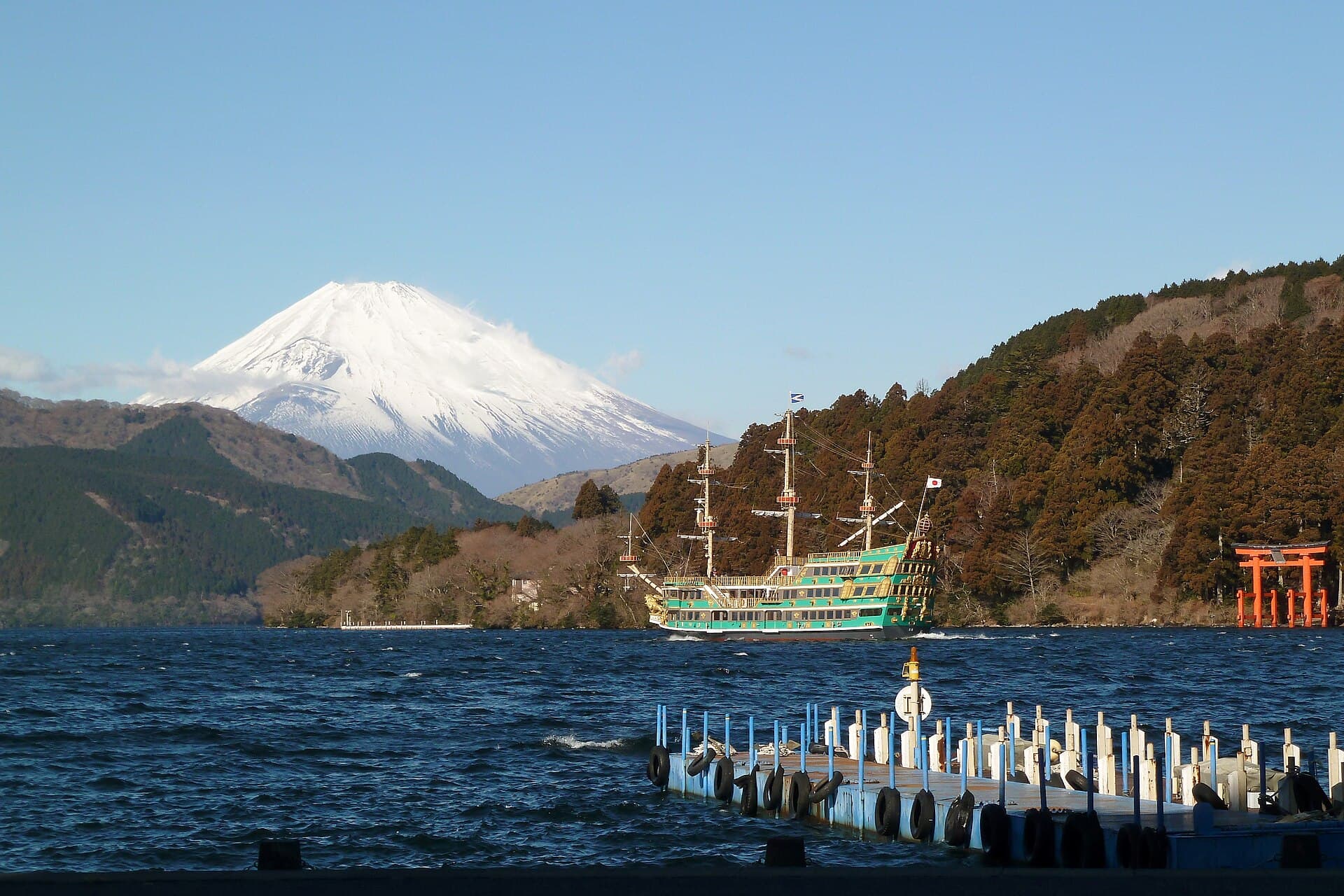
- Lake Ashinoko sightseeing cruise — pirate-themed ships call at Hakone-Machi, Moto-Hakone and Togendai, with views of Mount Fuji and the red torii gate of Hakone-jinja Shrine. The cruise runs 9:30–17:00 daily (National Parks of Japan).
- Hakone-jinja Shrine — a lakeside shrine with a history of more than 12 centuries, known for its red torii gate in Lake Ashinoko and a path through cedar trees, some over 800 years old. The grounds are free to enter; the treasure house is open 9:00–16:30 (last admission 16:00) and costs ¥500 for adults (middle school students and older) and ¥300 for elementary school students — check the current price before you visit (National Parks of Japan).
- Hakone GeoMuseum — at Owakudani, this museum explains Hakone's volcanic past with interactive exhibits. It is open 9:00–16:30 daily and admission is ¥100 (free for preschool children) — check the current price before you visit (National Parks of Japan).
Onsen and Relaxation
Hakone is made up of seven hot spring resorts and has 17 types of hot springs. Miyanoshita, one of the resorts, has been operating since the Edo period (1603–1867), and its Fujiya Hotel opened in 1878. For a less traditional soak, Hakone Kowakien Yunessun is a hot spring theme park with unusual baths such as coffee, red wine and green tea tubs, plus both swimsuit-friendly and non-clothed areas (Travel Japan).
Day-use bathing is widely available. Hakone Yuryo (箱根湯寮) in Tonosawa has large communal baths and 19 private open-air baths. It is open weekdays 10:00–20:00 (last entry 19:00) and weekends and holidays 10:00–21:00 (last entry 20:00), and is about a three-minute free shuttle ride from Hakone-Yumoto Station or about five minutes on foot from Tonosawa Station. Bathing costs ¥1,700 for adults on weekdays and ¥2,000 on weekends and holidays, and ¥1,000 for elementary school students; private open-air baths start at ¥9,400 for 120 minutes on weekdays and ¥10,400 on weekends and holidays — check the current prices before you go (Hakone Tourist Association).
Local Specialties and Dining
Owakudani's black eggs (kuro tamago) are hard-boiled in the volcanic hot springs; the shells turn black through a reaction with the water, and eating one is said to add seven years to your life (Travel Japan).
Hakone Yuryo's irori restaurant serves irori cuisine cooked over charcoal, including dried fish, deep-fried tofu dengaku and seasonal vegetables (Hakone Tourist Association).
Planning Your Day Trip
Start early to make the most of the transport connections, and check the current public transport operating status before you travel (Hakone Tourist Association). Volcanic activity can close Owakudani and suspend the Hakone Ropeway at short notice, and Mount Fuji is only visible on clear days, so keep an indoor alternative such as the Hakone Open-Air Museum or the Hakone GeoMuseum in reserve. Weekdays are generally quieter than weekends. Whether you're after volcanic scenery, art or a long soak, Hakone is an easy escape from Tokyo.
Ready to explore Japan?
Browse tours and activities, or tell us what you're looking for and we'll suggest the best options.
Stay Connected in Japan
Airalo eSIMs work on arrival — no physical SIM needed. Data plans from $5 for 7 days.
Travel Insurance for Japan
Medical, trip cancellation, and adventure sports covered. Plans from $1.5/day.