
How to choose a luxury ryokan in Japan
Compare rates, meals, onsen access and transport before booking a luxury ryokan in Japan, and confirm dietary needs, tattoos and cancellation terms.
Affiliate link — we may earn a commission at no extra cost to you. Affiliate disclosure
What makes a luxury ryokan different?
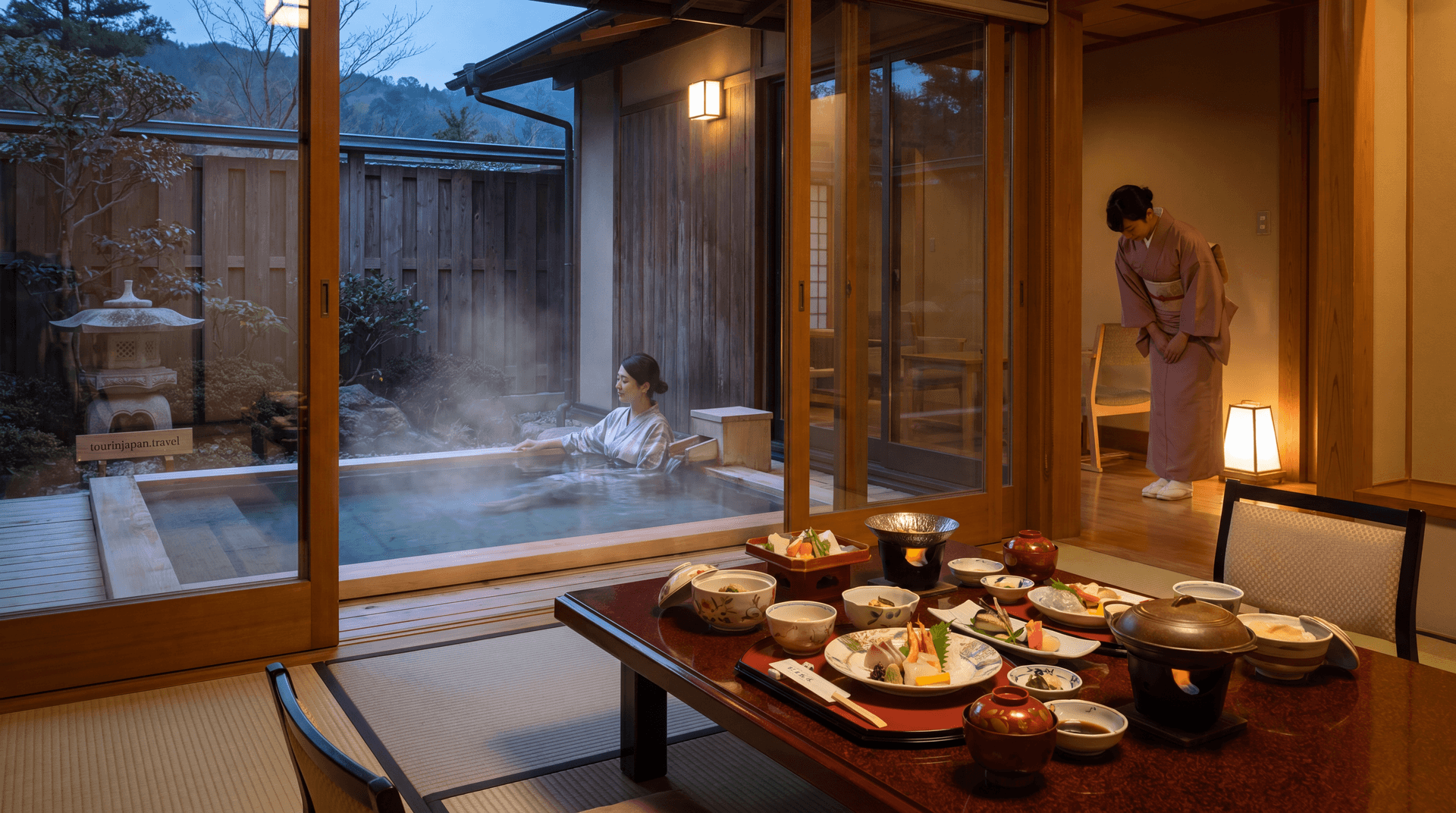
A luxury ryokan is a traditional Japanese inn, usually with tatami rooms, futon bedding, an onsen bath and a multi-course kaiseki dinner. JNTO describes common ryokan elements as tatami flooring, futon bedding, private baths (sometimes outdoor), yukata robes, in-house kaiseki dinners and a traditional Japanese breakfast (JNTO Japanese Ryokan Guide). The best ones are not simply the most expensive; they are the ones that match your route, season and comfort with traditional spaces. If you want the broader ryokan experience first, see Japanese ryokan. For bathing rules, see Japan onsen guide.
How to compare luxury ryokan
JNTO notes that ryokan stays are priced per person, per room, with meals usually included, and that some ryokan offer stays without meals (JNTO Japanese Ryokan Guide). Use this table before you book. The details matter more than star ratings.
Question | Why it matters | What to confirm |
|---|---|---|
Is the rate per person or per room? | Ryokan rates are often quoted per person, not per room, so they are not directly comparable with hotel room rates. | Total price for your party, taxes and service charges. |
Are dinner and breakfast included? | Many ryokan packages include kaiseki dinner and breakfast; some do not. | Meal plan, dining location and whether drinks are extra. |
Is the onsen private or shared? | A public onsen at an accommodation is usually free for overnight guests, while private kashikiri baths usually cost extra and need to be reserved (JNTO onsen etiquette). | Bath type, reservation rules and tattoo policy. |
How do you reach the property? | Rural ryokan may be far from train stations and buses. | Shuttle, taxi, bus times and last check-in. |
What is the cancellation policy? | Policies vary by property. | The property's current policy before you book. |
Is the room traditional or Western-style? | Ryokan range from traditional to modern. | Bedding, bathroom, smoking policy and accessibility. |
Where to look in Japan
Ryokan are found throughout Japan, from Nara and Kyoto to Nagano and Tokyo (JNTO Japanese Ryokan Guide). Onsen towns are another good place to start. Hakone in Kanagawa is one of Japan's most popular hot-spring towns and an easy day trip from Tokyo; the Odakyu Romance Car runs directly from Shinjuku to Hakone-Yumoto in about 1 hr 20 min (Hakone Onsen; Fuji-Hakone-Izu access). Yamanaka Onsen in Ishikawa has traditional ryokan and is reached by train to Kaga Onsen Station, then CANBUS (around 40 minutes on the mountain course) (Yamanaka Onsen). Kyoto also has machiya townhouses, some used as ryokan inns (Kyoto machiya FAQ).
Start with the region you are already visiting: Tokyo, Kyoto, Nara, Nagano, Kanagawa or Ishikawa.
What to confirm before you book
- Ask whether the rate is per person or per room.
- Confirm whether dinner and breakfast are included.
- Explain allergies, vegetarian, vegan, halal or other dietary needs when you book, not on arrival.
- Ask about private onsen availability and whether tattoos are allowed.
- Check the last check-in time and transport from the nearest station.
- Confirm the cancellation policy and deposit.
- Check whether the room has a Western bed, tatami futon or both.
- Ask about children, smoking and accessibility if these matter to you.
For general etiquette, see Japanese etiquette guide. For tipping and money, see Japanese money and tipping.
Booking and budgeting
Book early for cherry blossom and autumn foliage seasons. Rates vary widely by season, room and meal plan. Check the operator's site for current pricing and availability. You can also compare options through hotel search:
Check Kyoto ryokan and hotel availability
Some links on this page are affiliate links: affiliate disclosure.
Check Hakone ryokan and hotel availability
Check Kanazawa ryokan and hotel availability
For a full trip budget, see Japan budget breakdown 2026. For high-cost trips, review travel insurance before you commit; JNTO states that travel insurance is strongly recommended for all visitors to Japan (JNTO travel insurance). If you are combining ryokan stays with rail travel, check the official Japan Rail Pass site for current pass details (Japan Rail Pass).
Etiquette and onsen basics
At a ryokan, remove your shoes at the entrance and change into the yukata provided; ask staff whether the yukata and slippers can be worn outside your room (JNTO manners and etiquette). In the onsen, wash and rinse thoroughly before entering, keep your towel out of the water, tie up long hair, and follow the facility's rules on clothing; tattoo rules vary by property, so ask in advance and consider a private kashikiri bath (JNTO onsen etiquette). See Japan onsen guide and Japanese etiquette guide.
Getting there
Many luxury ryokan are outside city centres. Plan the last train, bus or taxi before you book. For airport transfers, see airport guides for Narita, Haneda and Kansai. For rail travel, see Japan Rail Pass guide. If you have large luggage, consider luggage forwarding.
Common mistakes
- Comparing a per-person ryokan rate with a per-room hotel rate.
- Assuming dinner is included without checking the meal plan.
- Booking a remote ryokan without confirming transport.
- Waiting until arrival to mention dietary needs.
- Ignoring tattoo policies if you plan to use the onsen.
- Not checking the last check-in time.
Sources
Ready to explore Japan?
Browse tours and activities, or tell us what you're looking for and we'll suggest the best options.
Stay Connected in Japan
Airalo eSIMs work on arrival — no physical SIM needed. Data plans from $5 for 7 days.
Travel Insurance for Japan
Medical, trip cancellation, and adventure sports covered. Plans from $1.5/day.