
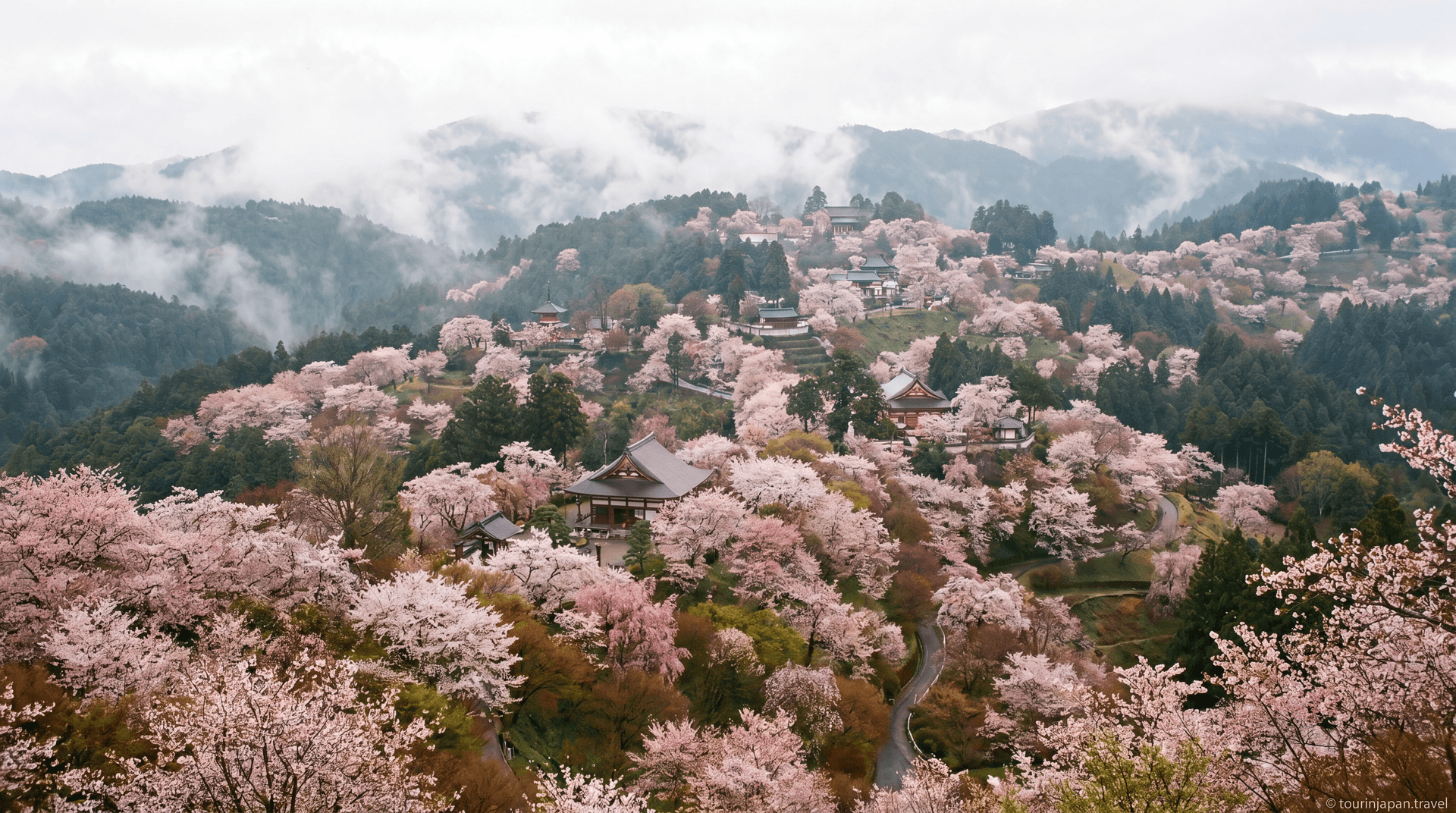
Yoshino Mountain Cherry Blossoms: 30,000 Trees in One View
By Tour in Japan editors · Updated
Yoshino Mountain in Nara has 30,000 cherry trees planted across four zones covering a sacred mountain. It is one of Japan's oldest and most spectacular sakura sites.
Mount Yoshino (吉野山) in Nara Prefecture is Japan's most famous cherry blossom mountain — 30,000 trees cascading down four mountain zones create a pink ocean visible for miles.
Why Yoshino Is Japan's Most Spectacular Cherry Blossom Site
Mount Yoshino has been celebrated for cherry blossoms for over 1,300 years. The mountain features 30,000 cherry trees of 200 varieties, arranged in four distinct zones (senbon) that bloom progressively from bottom to top. This creates a month-long blooming season and one of Japan's most breathtaking natural spectacles.
Yoshino vs Other Cherry Blossom Spots
| Feature | Yoshino | Meguro River (Tokyo) | Philosopher's Path (Kyoto) |
|---|---|---|---|
| Number of trees | 30,000 | 800 | 500 |
| Terrain | Mountain (4 zones) | Flat riverbank | Flat canal path |
| Duration | 4–6 weeks | 1–2 weeks | 1–2 weeks |
| Hiking | ✅ Yes (3+ hours) | ❌ No | ❌ No |
| Crowds | Moderate | Very crowded | Very crowded |
| Best for | Photography, hiking | Night viewing, atmosphere | Peaceful walks |
The Four Zones of Yoshino
1. Shimo-senbo (下千本) — Lower Zone
- Elevation: 400–600m
- Trees: 7,000
- Bloom time: Earliest (early April)
- Highlights: Kinpusenji Temple, Yoshino Shrine
- Difficulty: Easy (paved paths)
2. Naka-senbo (中千本) — Middle Zone
- Elevation: 600–800m
- Trees: 10,000
- Bloom time: Early–Mid April
- Highlights: Best panoramic views, Moeyo Hill
- Difficulty: Moderate (steep paths)
3. Kami-senbo (上千本) — Upper Zone
- Elevation: 800–1,000m
- Trees: 8,000
- Bloom time: Mid–Late April
- Highlights: Seiganji Temple, mountain views
- Difficulty: Challenging (steep climb)
4. Oku-senbo (奥千本) — Inner Zone
- Elevation: 1,000–1,200m
- Trees: 5,000
- Bloom time: Late April–Early May
- Highlights: Remote, few tourists, pristine nature
- Difficulty: Strenuous (mountain trails)
When to Visit
Bloom Forecast 2026
| Zone | Expected Peak | Status |
|---|---|---|
| Shimo-senbo | April 1–7 | Early bloom |
| Naka-senbo | April 5–12 | Peak bloom |
| Kami-senbo | April 10–17 | Approaching peak |
| Oku-senbo | April 15–22 | Not yet bloomed |
Best overall time: April 5–15 (when all zones overlap)
What to See and Do
Must-See Spots
1. Kinpusenji Temple (金峯山寺)
- Admission: ¥500
- Highlight: 17m tall Zao-gonen statues
- Time: 30 minutes
- Tip: One of the most important Shingon temples
2. Yoshino Shrine (吉野神宮)
- Admission: Free
- Highlight: Imperial shrine with cherry blossoms
- Time: 20 minutes
- Tip: Located in Shimo-senbo zone
3. Moeyo Hill (もえぎの嶺)
- Admission: Free
- Highlight: Panoramic viewpoint, best photo spot
- Time: 15 minutes
- Tip: Short hike from Naka-senbo
4. Kimpu Shrine (金峯神社)
- Admission: Free
- Highlight: Ancient shrine in cedar forest
- Time: 20 minutes
- Tip: Located in Kami-senbo zone
5. Seiganji Temple (青岸寺)
- Admission: ¥300
- Highlight: Temple with stunning views
- Time: 30 minutes
- Tip: Five-story pagoda is iconic
Hiking Routes
Route 1: Classic Yoshino (Shimo-senbo → Naka-senbo)
- Distance: 3 km
- Time: 1.5 hours
- Difficulty: Easy-moderate
- Highlights: Temple visits, panoramic views
Route 2: Full Mountain (Shimo-senbo → Kami-senbo)
- Distance: 6 km
- Time: 3–4 hours
- Difficulty: Moderate-challenging
- Highlights: All four zones, varied scenery
Route 3: Inner Mountain (Kami-senbo → Oku-senbo)
- Distance: 4 km
- Time: 2–3 hours
- Difficulty: Challenging
- Highlights: Remote nature, few tourists
Getting There
From Osaka
| Transport | Time | Cost |
|---|---|---|
| Yoshino Line train | 1.5 hrs | ¥1,200 |
| Limited express + train | 1.25 hrs | ¥1,800 |
| Car | 1.5 hrs | ¥2,000 (toll + gas) |
From Kyoto
| Transport | Time | Cost |
|---|---|---|
| Train + transfer | 2 hrs | ¥2,000 |
| Car | 2 hrs | ¥2,500 |
From Nara
| Transport | Time | Cost |
|---|---|---|
| Train | 1 hr | ¥800 |
| Car | 45 min | ¥1,000 |
Local Transportation
- Cable car: ¥500 one-way (connects station to Shimo-senbo)
- Bus: ¥300 (station to trailhead)
- Walking: 20 minutes from station to shrine
Where to Stay
On the Mountain
| Accommodation | Price | Location | Notes |
|---|---|---|---|
| Yoshino Grand Hotel | ¥15,000–25,000 | Shimo-senbo | Best views |
| Kokujoji Temple | ¥8,000–12,000 | Naka-senbo | Temple lodging |
| Mountain lodges | ¥6,000–10,000 | Various | Basic, authentic |
| Minshuku | ¥5,000–8,000 | Shimo-senbo | Family-run |
Nearby Towns
- Yoshino town: Hotels and ryokans (¥8,000–20,000)
- Nara city: Many options (¥6,000–30,000) — 1 hour away
Food and Drink
Must-Try Yoshino Specialties
| Dish | Description | Where |
|---|---|---|
| Yoshino yuba | Tofu skin, local specialty | Restaurants on mountain |
| Yoshino udon | Thick noodles in dashi broth | Mountain lodges |
| Kuzu mochi | Starch cake, traditional sweet | Souvenir shops |
| Persimmon leaves | Sushi wrapped in leaves | Local restaurants |
| Mountain vegetables | Wild greens, fern tips | Mountain lodges |
Dining Options
| Type | Price Range | Location |
|---|---|---|
| Mountain lodges | ¥1,000–2,000 | On the mountain |
| Temple lunch | ¥1,000–1,500 | Temple grounds |
| Town restaurants | ¥1,000–2,500 | Yoshino town |
| Picnic | ¥500–1,000 | Anywhere |
Photography Guide
Best Photo Spots
| Spot | Best Time | What to Capture |
|---|---|---|
| Moeyo Hill | Morning (6–8 AM) | Panoramic mountain view |
| Kinpusenji | Midday | Temple with blossoms |
| Cable car view | Anytime | Aerial perspective |
| Naka-senbo path | Afternoon | Blossom tunnel effect |
| Pagoda viewpoint | Sunset | Five-story pagoda silhouette |
Photography Tips
- Arrive early — fewer crowds, better light
- Use telephoto — compress mountain layers
- Include people — adds scale to vast landscape
- Shoot up — canopy shots create patterns
- Weather matters — overcast days are great for color
1-Day Itinerary
Morning (8:00–12:00)
- 8:00: Arrive Yoshino Station
- 8:15: Cable car to Shimo-senbo
- 8:30: Yoshino Shrine
- 9:00: Hike to Kinpusenji Temple
- 9:30: Explore temple grounds
- 10:00: Continue to Naka-senbo
- 11:00: Moeyo Hill viewpoint
- 12:00: Lunch at mountain lodge
Afternoon (12:00–17:00)
- 13:00: Continue to Kami-senbo (optional)
- 14:00: Seiganji Temple
- 15:00: Hike back to Naka-senbo
- 16:00: Souvenir shopping
- 17:00: Cable car down, return to Osaka/Nara
Budget Breakdown
Day Trip from Osaka (per person)
| Category | Budget | Mid-Range | Luxury |
|---|---|---|---|
| Transport | ¥2,400 | ¥3,600 | ¥5,000 |
| Admission | ¥800 | ¥800 | ¥800 |
| Food | ¥2,000 | ¥3,500 | ¥5,000 |
| Shopping | ¥1,000 | ¥3,000 | ¥5,000 |
| Total | ¥6,200 | ¥10,900 | ¥15,800 |
Overnight Trip from Osaka (per person)
| Category | Budget | Mid-Range | Luxury |
|---|---|---|---|
| Transport | ¥4,800 | ¥7,200 | ¥10,000 |
| Accommodation | ¥6,000 | ¥12,000 | ¥25,000 |
| Food | ¥4,000 | ¥6,000 | ¥10,000 |
| Activities | ¥1,000 | ¥2,000 | ¥3,000 |
| Total | ¥15,800 | ¥27,200 | ¥48,000 |
Frequently Asked Questions
Q: How long do I need at Yoshino? A: Half a day minimum, full day recommended. Overnight allows more exploration.
Q: Is the hike difficult? A: Shimo-senbo to Naka-senbo is moderate. Kami-senbo and Oku-senbo are challenging.
Q: Can I see all four zones in one day? A: It's possible but exhausting. Most visitors see Shimo-senbo and Naka-senbo.
Q: Is there Wi-Fi on the mountain? A: Limited. Download maps and info before going.
Q: What should I wear? A: Comfortable hiking shoes, layers, rain jacket. Mountain weather changes quickly.
Essential Japanese Phrases
| English | Japanese | Pronunciation |
|---|---|---|
| Cherry blossom mountain | 桜の山 | Sakura no yama |
| Cable car | ロープウェイ | Rōpuwei |
| Temple | 寺 | Tera |
| Shrine | 神宮 | Jingū |
| Mountain trail | 山道 | Yamamichi |
| Beautiful! | 綺麗! | Kirei! |
Yoshino's 30,000 cherry trees create a spectacle unlike any other in Japan — a mountain painted pink that has inspired poets, artists, and travelers for over a millennium.
Stay Connected in Japan
Yesim eSIMs work on arrival — no physical SIM needed. Japan data plans from $5.