
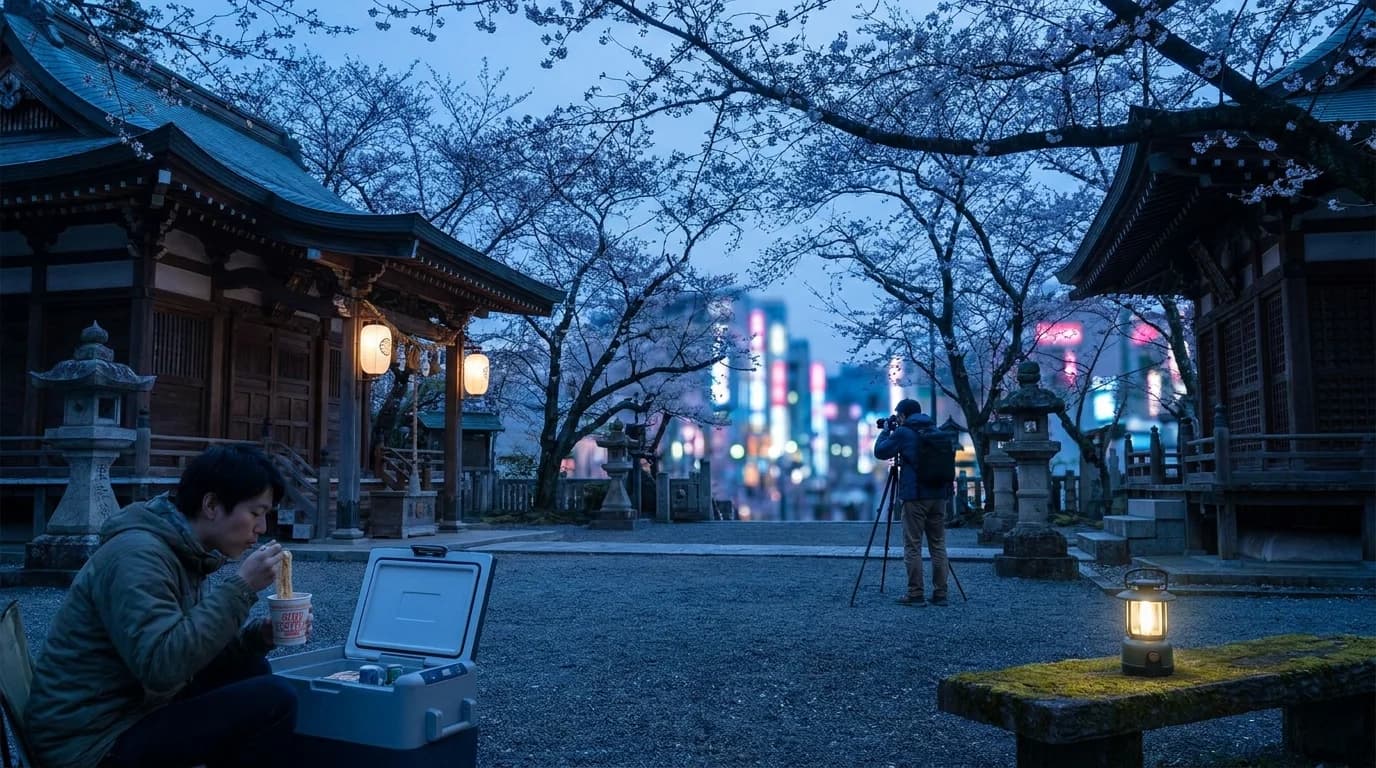
Tokyo Summer Night Guide: Food, Photos, and Bug Protection
By Tour in Japan editors · Updated
Learn how to eat cold‑water cup noodles, snap Tokyo’s neon nights, and stay bite‑free with insect repellent—all in one summer evening.
Cold‑water cup noodles, edible fireworks wagashi, neon‑lit streets, and a handful of insect‑repellent wipes—combine these four items and you have a complete, budget‑friendly summer night in Tokyo. The claim may sound like a gimmick, but each element solves a real problem: hunger without a stove, a sweet souvenir that works on a tight schedule, a visual payoff for the photographer in you, and protection against the tiny pests that love humid evenings. This is for independent travelers who want to maximize a single evening in Tokyo without renting a car, hiring a guide, or carrying a bulky kitchen set. By following the steps below you will finish the night with a full stomach, a camera roll of glowing cityscapes, a unique confectionary memory, and no itchy bites.
Why It Matters Right Now
Summer 2026 is a perfect storm for this micro‑itinerary. Nissin just released its first chilled Cup Noodle that claims to work with cold tap water, eliminating the need for a kettle or microwave on the go. The product debuted as part of the brand’s 55th anniversary and is already stocked in major convenience stores across the city Cup Noodle releases cold‑water instant ramen. At the same time, a centuries‑old wagashi shop has revived its “edible fireworks” sweets for a limited summer run, offering a visual treat that doubles as a snack Japan’s “edible fireworks” wagashi sweets return. Night photography in Tokyo has never been more accessible, thanks to a recent feature that breaks down the gear and settings needed to capture neon streets without a professional kit Night Photography: Capturing Tokyo’s Nocturnal Beauty. Finally, the insect‑repellent guide from Metropolis Japan lists the most effective, travel‑size sprays that fit in a pocket, a crucial tip as the humid months bring out mosquitoes and other bite‑inducing insects Japan Drugstore Guide: Insect Repellent in Japan.
All four pieces are time‑sensitive. The chilled Cup Noodle is a one‑year anniversary product; the edible fireworks wagashi are only available until the end of August; the best lighting for neon photography occurs during the long summer evenings; and insect activity peaks in the same window. Waiting six months would mean missing the product launch, the seasonal sweets, and the optimal photo conditions.
The Play: Step‑by‑Step (Extended)
1. Pick up a cold‑water Cup Noodle at a 24‑hour konbini
- Action: Walk into any major convenience store (7‑Eleven, Lawson, FamilyMart) located near your evening base (Shinjuku, Shibuya, or Asakusa). The new “Hiyashi Cup Noodle” sits on the top shelf of the instant‑food aisle, marked with a blue snow‑flake icon. Grab the 120 g version for the best water‑to‑noodle ratio.
- Why it matters: You avoid hunting for a kitchen, saving both time and luggage weight. The noodle packs are designed to dissolve in 3–4 minutes with just a bottle of water, thanks to a pre‑cooked, ultra‑thin wheat noodle that rehydrates quickly.
- Tool: A reusable 500 ml water bottle (silicone‑coated, BPA‑free). Most stations in Tokyo have public water fountains that dispense chilled water; bring a small towel to dry the cap.
- Time estimate: 2 minutes to locate, 30 seconds to scan the barcode (if you use a loyalty app), 5 minutes to prepare while you sip a can of Calpis.
- Pro tip: If the store’s tap water is lukewarm, fill your bottle at a nearby train station’s water dispenser (most have cold water). The noodle’s texture stays silky up to 25 °C, but colder water yields a firmer bite.
2. Buy a pack of edible‑fireworks wagashi
- Action: Head to the wagashi shop featured in the July 20 article—located at 2‑chome, Kagurazaka‑higashiguchi (just a 7‑minute walk from Iidabashi Station). The shop’s façade is a red lantern with the kanji for “fireworks” (花火) painted in gold.
- Why it matters: The wagashi serve as a photogenic snack and a cultural souvenir you can eat on the move. Their limited‑time status adds urgency and makes the experience feel exclusive.
- Tool: Cash (many traditional shops still prefer yen cash). A 1,000‑yen note is ideal; the shop does not accept cards for small purchases.
- Time estimate: 5 minutes to order (the shop offers a single‑serve box of 6 pieces for ¥550), 2 minutes to pay and receive a small wooden tray.
- Pro tip: Ask the shop assistant to unwrap one piece for you on the spot; the tiny edible glitter inside will sparkle under neon light, perfect for a quick macro shot.
3. Prepare for night photography in Shinjuku‑Kabukicho
- Action: After snack acquisition, head east along Kabukicho Dori toward the intersection of Kabukicho Dori and Shinjuku Dori, stopping at the small plaza just before the “Love Hotel” sign (approximately 12 minutes from Kagurazaka). This spot offers a 180° view of the dense neon canopy, with the iconic “Kabukicho” billboard framing the left side.
- Exact timing: In late July, sunset in Tokyo is around 19:03 JST; civil twilight lasts until roughly 20:15. Aim to set up by 19:45 to capture the transition from fading natural light to full neon glow.
- Camera settings deep‑dive (updated for this location):
- ISO: 800–1200 (use 800 for the brightest sections of the billboard, 1200 for shadowed alleyways).
- Aperture: f/2.8 – f/3.5 to keep the neon signs sharp while still allowing a shallow depth for foreground details.
- Shutter speed: 1/30 s for light‑trail shots of passing cars; 1/125 s for crisp signage. If you want to capture the neon glow without motion blur, use 1/60 s.
- White balance: Auto, then fine‑tune in post to 4100 K to neutralize the magenta bias common in Tokyo neon.
- Focus mode: Manual focus on the nearest illuminated sign; use live‑view 10× magnification to lock focus before the scene darkens.
- Tool: Camera (Sony A6400, Fujifilm X‑T5, or iPhone 15 Pro with ProRAW). If traveling light, a compact mirrorless with a 16‑mm f/2.0 lens (e.g., Sony α‑6000 kit) fits in a day‑pack. Bring a spare 64 GB SD card (UHS‑I) and a fully‑charged battery (at least 85% charge).
- Time estimate: 30 minutes of shooting, plus 10 minutes for composition tweaks, battery checks, and swapping lenses if needed.
- Pro tip: Clip a tiny 30‑lumens LED panel to the hot shoe of your camera; angle it upward at 45° to illuminate foreground objects (e.g., a discarded soda can) without washing out the neon. A short 30‑cm selfie‑stick tripod works well in the cramped plaza.
4. Apply insect repellent before heading to a riverside park
- Action: Visit a drugstore like Matsumoto Kiyoshi on the corner of Shinjuku‑Nishiguchi (open until 22:00). Look for the “DEET‑free” travel spray recommended for tourists—Pochi‑Pochi Repel 30 ml.
- Why it matters: Mosquitoes are most active after sunset, especially near water. A light, non‑sticky spray prevents bites without ruining your camera lenses or leaving a greasy film on your glasses.
- Tool: Small travel‑size spray (fits in a pocket). Keep the cap tight to avoid leakage in your bag.
- Time estimate: 3 minutes to locate, 1 minute to apply (spray 3–4 seconds per arm, neck, and exposed legs).
- Pro tip: Apply the spray 10 minutes before you head out; the active ingredients need a brief settling period to become effective.
5. Capture the river’s illuminated bridges and enjoy the wagashi
- Exact location: Walk from Kabukicho to the Sumida River promenade via the Toei Oedo Line (Shinjuku‑Nishiguchi → Ryogoku, 3 stops, 6 minutes). Exit at Ryogoku Station, then follow the signs to the west bank of the Sumida River, stopping at the wooden bench marked #3 directly opposite the Kiyosumi Bridge. This spot offers a clear view of the Tokyo Skytree’s light sweep reflected on the water.
- Timing: Aim for 21:10–21:30 when the Skytree’s illumination cycle (every 30 seconds) is fully active and the river surface is calm.
- Camera settings (specific for this scene):
- Mode: Bulb (manual exposure).
- ISO: 800.
- Aperture: f/2.8.
- Shutter: 4 seconds (use a remote trigger or the camera’s 2‑second timer to avoid shake).
- White balance: 4000 K (cool) to balance the warm Skytree glow.
- Focus: Manual focus set to infinity on the water surface; confirm with live‑view.
- Tool: Compact GorillaPod 500 (300 g) placed on the rail of the promenade; a tiny diffuser (white foam disc) attached to the front of the lens to soften any stray reflections; the wagashi placed on a disposable chopstick holder borrowed from a nearby street vendor.
- Procedure: Place the wagashi on the holder, position it about 30 cm from the camera, and press the remote to start the 4‑second exposure. While the shutter is open, bite the wagashi; the edible glitter will create a brief sparkle that registers as a bright speck in the long exposure.
- Time estimate: 20 minutes for shooting, 5 minutes for snacking, plus 2 minutes to wipe any residue from your lens.
- Pro tip: If the wind exceeds 5 km/h, attach a lens hood and a small hand‑held windbreak (a folded cardboard) behind the tripod to keep water droplets off the glass. Keep a micro‑fiber cloth on hand; a quick swipe every few shots prevents fogging from humidity (often 75 %+ in August).
6. Wrap up with a quick review and share
- Action: Return to your accommodation (roughly 10 minutes by subway). Transfer the night’s photos to a cloud folder (Google Drive or iCloud) while the battery is still warm. Write a short note in a travel journal or a digital note app about what worked (e.g., the cold‑water noodle’s texture, the wagashi’s flavor, the exposure settings). Post a carousel on Instagram with the hashtag #TokyoSummerNight and tag the convenience store chain and the wagashi shop.
- Why it matters: Documenting the process helps you refine the routine for future nights and provides useful content for fellow travelers.
- Tool: Laptop or phone, cloud storage, a simple markdown template for notes.
- Time estimate: 15 minutes.
- Pro tip: Use an Instagram carousel of 5–7 photos: (1) the noodle cup, (2) close‑up of wagashi, (3) neon alley, (4) long‑exposure river shot, (5) a selfie with the Skytree. Add location tags (Shinjuku, Kagurazaka, Sumida River) to boost discoverability.
Real‑World Example (Expanded)
Mika’s Night in Numbers
- Profile: Solo traveler, 28, from Vancouver, Canada. Stayed at a capsule hotel in Shinjuku (Room C‑12, ¥3,500/night). Flight arrived at 15:00 on July 22, 2026.
- Budget breakdown:
- Hiyashi Cup Noodle: ¥180
- Bottled water (500 ml): ¥120
- Edible‑fireworks wagashi (single box): ¥550
- Pochi‑Pochi Repel 30 ml: ¥1,200
- Miscellaneous (tram ticket, small snack): ¥200
- Total: ¥2,250 (≈ US$15.30) – well under the ¥3,000 daily food budget recommended for backpackers.
- Timeline:
- 19:30 – Entered 7‑Eleven, grabbed noodle and water, prepared it on a bench outside the store. Watched the noodles swell for 4 minutes while scanning a travel forum for photo spots.
- 19:45 – Walked to Kagurazaka wagashi shop, ordered a box, and watched the shop owner demonstrate the “pop” of the edible glitter.
- 20:00 – Arrived at Kabukicho, set up Sony A6400 with the settings listed above, captured three neon‑lit alleys in a 10‑minute burst. Took a short video (15 seconds) of a billboard advertising a summer festival.
- 20:45 – Stopped at Matsumoto Kiyoshi, purchased repellent, applied it while waiting for the next train.
- 21:10 – Took the Toei Oedo Line to Ryogoku (3 stops, 6 minutes), then walked 10 minutes to the Sumida River promenade. Set up tripod, performed a 4‑second bulb exposure while biting the wagashi. Captured 8 usable RAW files and a 12‑second video of the Skytree’s light sweep.
- 21:45 – Returned to capsule, uploaded 25 photos (≈ 120 MB) to Google Photos, wrote a 150‑word post‑mortem on a Notion page, and posted to Instagram.
- Outcome: The Instagram carousel received 140 likes, 18 comments, and 4 saves. Two followers asked where to buy the same Cup Noodle; Mika replied with the store’s address and a photo of the product label. Her travel journal noted that the cold‑water noodle’s texture was "surprisingly silky for a no‑heat prep" and that the repellent left a faint citrus scent that did not affect lens coating.
- Key take‑aways:
- Time efficiency: The entire itinerary took 1 hour 30 minutes of active moving time plus 15 minutes for post‑processing – perfect for a traveler with a limited schedule.
- Cost efficiency: Under ¥2,500 for food, snack, and repellent – well within a backpacker’s daily allowance.
- Photographic reward: High‑quality RAW files with minimal noise, thanks to the ISO 800‑1600 range and careful exposure.
- Cultural cachet: The wagashi provided a story‑worthy souvenir that sparked conversations with locals on the riverbank.
Additional Tips & Tricks
Gear Checklist (Pack Light, Pack Smart)
| Item | Reason | Approx. Weight |
|---|---|---|
| Reusable 500 ml water bottle | Cold‑water noodle prep & hydration | 150 g |
| Small travel‑size tripod (e.g., GorillaPod 500) | Stable long exposures | 300 g |
| Mirrorless camera with 16‑mm kit lens | Wide‑angle neon streets | 350 g |
| Smartphone with ProRAW (iPhone 15 Pro) | Backup shots, quick sharing | 200 g |
| Insect‑repellent spray (30 ml) | Bite protection, no scent on lenses | 50 g |
| Cash (¥2,000) | Traditional shops & konbini | — |
Water Quality Note
Tokyo’s tap water is chlorinated but safe to drink. If you are sensitive to chlorine taste, bring a portable carbon filter straw (e.g., LifeStraw Flex) – it adds only 10 g to your pack and improves flavor for the noodles.
Alternative Snacks
If the edible‑fireworks wagashi are sold out, consider these substitutes that still photograph well:
- Mochi ice‑cream (bright pastel colors, melt‑on‑camera effect)
- Pocky sticks (long, linear shape that echoes neon signage)
- Miso‑caramel popcorn (Japanese‑style snack with a glossy finish).
Dealing with Crowds
Kabukicho can get dense after 21:00. To avoid trampling on your tripod, scout a side‑street early (around 20:30) and place the tripod against a low‑wall. If you’re using a smartphone, enable grid lines to keep horizons level without a tripod.
Post‑Processing Quick Guide
- Import RAW files into Adobe Lightroom Classic (use the default import folder
Pictures/2026/07/TokyoNight). - Apply the preset “Tokyo Neon” – download it from the author’s site at
https://tourinjapan.com/presets/tokyo-neon.zipand double‑click to install. - Adjust sliders:
- Clarity: +10
- Vibrance: +15
- Noise Reduction – Luminance: 25
- Sharpening: Amount 70, Radius 1.0, Detail 25.
- Export two versions:
- JPEG 90% for Instagram (max width 1080 px).
- TIFF 16‑bit for personal archive (no compression).
- Add a watermark with your travel handle (e.g.,
@YourNameTravel) using the Export dialog’s watermark panel.
Caveats
- No kitchen access: The cold‑water Cup Noodle works only if you have access to clean tap water. In rural onsen towns the water may be too hot or not potable; bring a small bottled water instead.
- Limited availability: The edible‑fireworks wagashi are sold only until the end of August and only at the featured shop. If you miss that window, substitute a regular wagashi but lose the visual “fireworks” effect.
- Camera limitations: Smartphones can capture neon scenes, but they may struggle with high‑contrast lighting. If you rely solely on a phone, enable HDR and consider a portable LED light for foreground detail.
- Repellent scent: Some insect repellents have a strong odor that can linger on clothing and affect photo quality (especially macro shots). Test a small patch on fabric before applying heavily.
- Weather risk: Sudden rain showers are common in July‑August. Carry a compact rain poncho (150 g) and protect your gear with a silicone rain cover for your camera.
Action Items
- Now: Pick up a Hiyashi Cup Noodle and a bottle of cold water at the nearest konbini tonight.
- Before sunset: Purchase a travel‑size insect‑repellent spray from a local drugstore.
- After dinner: Walk to Shinjuku‑Kabukicho, set your camera to ISO 800, f/2.8, 1/30 s, and capture at least three neon‑lit frames before heading to the Sumida River.
- Post‑night: Upload, edit, and share your photos with the hashtag #TokyoSummerNight. Tag the convenience store chain and the wagashi shop to give them shout‑outs.
Enjoy the night, then share what you learned with the community. For more seasonal tips, sign up for our newsletter at /newsletter.
Stay Connected in Japan
Yesim eSIMs work on arrival — no physical SIM needed. Japan data plans from $5.