
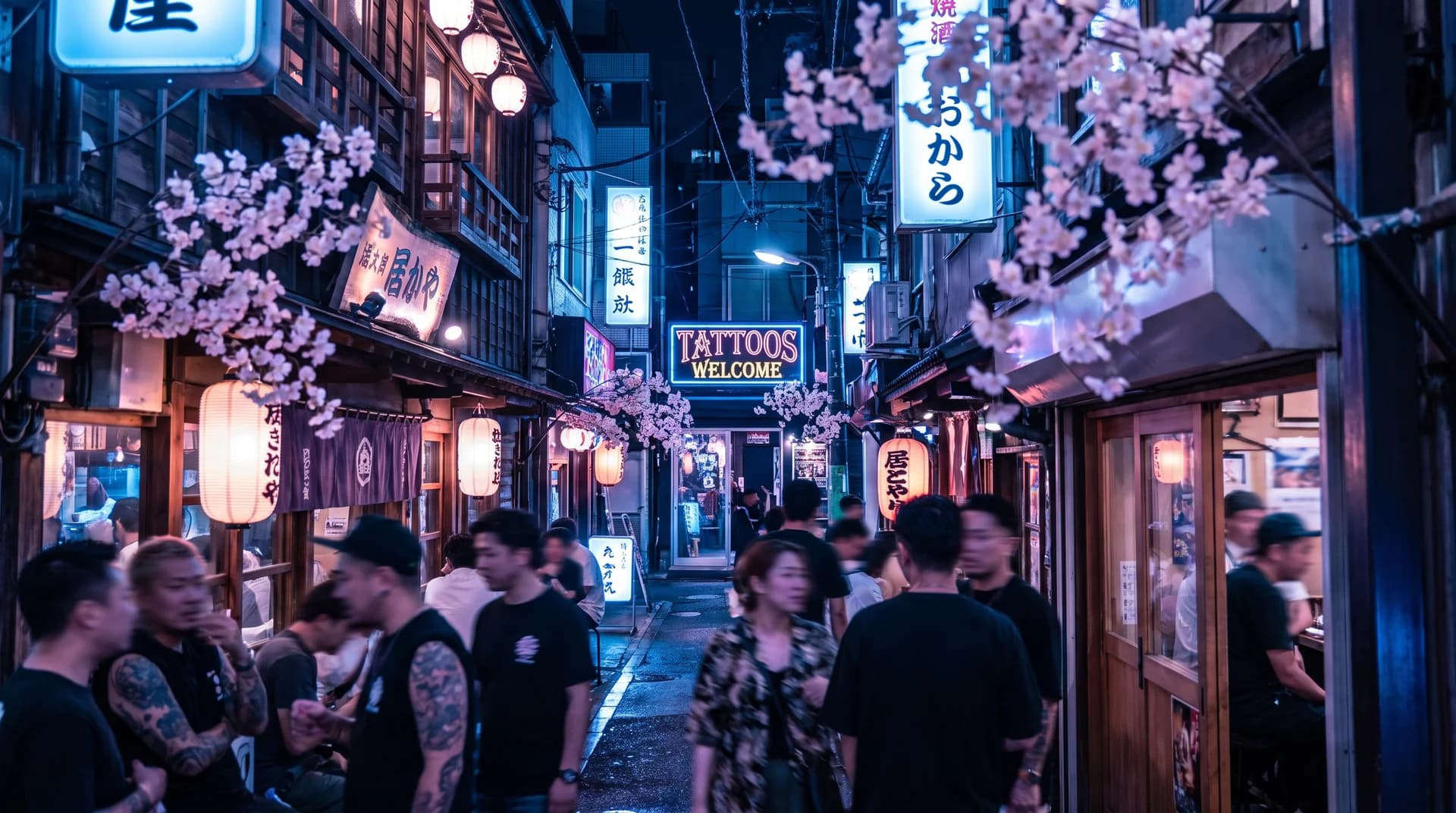
Tokyo Nightlife and Tattoos: A Practical Entry Guide
By Tour in Japan editors · Updated
Navigate Tokyo's bars, clubs, and izakayas with confidence, including specific advice for travelers with tattoos to avoid entry refusals.
The smell of charcoal-grilled yakitori and the neon glow of Golden Gai's narrow alleys define the sensory experience of a night out in Shinjuku. For many, the excitement of exploring these districts is tempered by a specific anxiety: the visibility of ink. If you have tattoos, navigating Tokyo nightlife and tattoos can feel like a gamble. While the city is evolving, the legacy of the yakuza means that some establishments still maintain strict policies against tattooed patrons. This guide is for independent travelers who want to experience Tokyo's late-night bar scene, underground clubs, and traditional izakayas without the stress of being turned away at the door.
Understanding the nuance of tattoo acceptance in Tokyo is less about a city-wide ban and more about the specific type of venue. A high-end hotel bar in Marunouchi likely will not care about your sleeve, whereas a traditional sento (public bath) or a strict soapland may refuse entry. The nightlife scene is a mixed bag. In districts like Shibuya and Roppongi, where the crowd is international and younger, ink is generally welcomed. However, in the smaller, owner-operated bars of Shinjuku, the rules are often left to the discretion of the proprietor. This guide unlocks a stress-free itinerary for a night of drinking and dancing, focusing on areas where tattoos are least likely to be an issue.
Essential Highlights & Local Itinerary
Day 1: Shinjuku's Hidden Alleys
Start your evening in Shinjuku (新宿). The primary goal here is to experience the contrast between the massive corporate towers and the tiny, intimate drinking holes.
Golden Gai (ゴールデン街) Located in the Kabukicho district, Golden Gai consists of six narrow alleys packed with over 200 tiny bars. Most of these bars seat only four to eight people. Because these are independent businesses, tattoo policies vary. However, the majority of Golden Gai bars are welcoming to foreigners and their ink.
- How to get there: Take the JR Yamanote Line or Chuo Line to Shinjuku Station. Walk east toward the Kabukicho area. Follow the signs for the "Toho Cinema" building (the one with the giant Godzilla head); Golden Gai is just a few blocks behind it.
- Timing: Arrive around 7:00 PM to secure a spot before the 10:00 PM rush. Many of the most popular thematic bars (like those dedicated to 80s cinema or punk rock) fill up quickly.
- Cost: Expect a cover charge (called 'charge' or 'otoshi') of ¥500 to ¥1,000 / ~$3 to $7 USD per person, which usually includes a small appetizer like seasoned cabbage or edamame. Drinks typically cost ¥800 to ¥1,500 / ~$5 to $10 USD. A full night of 3-4 bars usually totals around ¥6,000 / ~$40 USD.
Omoide Yokocho (思い出横丁) Also known as "Piss Alley," this is a narrow strip of yakitori stalls and small bars near the station's west exit. It is more open-air than Golden Gai, making it a low-risk environment for those with tattoos. Because these stalls are often open to the street, there is no "door" to be blocked by a bouncer.
- How to get there: A 5-minute walk from the Shinjuku Station West Exit. Look for the narrow alleyways tucked between the train tracks and the main road.
- Timing: Best visited between 6:00 PM and 9:00 PM for the peak atmosphere when the smoke from the grills creates a cinematic haze.
- Cost: A platter of yakitori skewers (usually 5-7 pieces) costs ¥1,000 to ¥2,000 / ~$7 to $14 USD. Beer is roughly ¥600 / ~$4 USD. Budget about ¥3,000 / ~$20 USD for a satisfying meal and two drinks.
Day 2: Shibuya and Roppongi's Modern Scene
Shift your focus to the more liberal, international hubs of Shibuya (渋谷) and Roppongi (六本木). These areas are the safest bets for travelers with extensive tattoos.
Shibuya Clubbing (WOMB or Ce La Vi) Shibuya is the epicenter of Tokyo's youth culture. Large clubs like WOMB—famous for its massive sound system and industrial vibe—are accustomed to international crowds and generally do not have tattoo restrictions.
- How to get there: Take the Ginza Line or Hanzomon Line to Shibuya Station. For WOMB, head toward the Dogenzaka area.
- Timing: Clubs typically peak after 11:00 PM. Spend 3 to 5 hours here. If you arrive before 11:00 PM, you can often avoid the longest queues.
- Cost: Entry fees range from ¥2,000 to ¥4,000 / ~$13 to $27 USD, often including one drink ticket. Cocktails inside usually cost ¥1,200 to ¥1,800 / ~$8 to $12 USD.
Roppongi Bar Hopping Roppongi is designed for expats and tourists. The bars here are the least likely in the entire city to refuse entry based on tattoos. From high-end lounges to dive bars, the atmosphere is permissive.
- How to get there: Take the Oedo Line or Hibiya Line to Roppongi Station.
- Timing: 8:00 PM to late.
- Cost: Cocktails in mid-range bars cost ¥1,200 to ¥2,000 / ~$8 to $13 USD. If you visit a "concept bar," be wary of "touts" on the street; always check the price list before entering to avoid unexpected "membership fees."
Special Consideration: Soaplands and Specialized Venues
If you are planning to visit specialized adult entertainment venues like soaplands or high-end traditional onsens, be aware that tattoo policies are significantly stricter here than in a standard bar. Many of these establishments still view tattoos as a sign of affiliation with organized crime. Even if a venue says "tattoos okay," they may require you to cover them with waterproof bandages.
If you have visible ink, it is highly recommended to use a cover-up or check the venue's specific policy via their website or a concierge before visiting. Refusal at the door is common in these specific environments, and unlike a bar, there is rarely a middle ground for negotiation.
The Play: Step-by-Step Navigation for the Tattooed Traveler
Navigating Tokyo with tattoos requires a strategic approach to avoid the awkwardness of being asked to leave. Follow this step-by-step protocol to ensure a smooth night.
Step 1: The "Layering" Strategy I always recommend starting your night in a light, breathable outer layer—think a linen button-down or a light cardigan. This isn't about hiding your identity; it's about managing the first five seconds of the interaction. In traditional Japanese service culture, the entrance is the most formal moment. By covering your ink during the initial greeting and seating, you signal that you are a respectful guest. Once you're settled with a drink in hand, the atmosphere relaxes, and you can shed the layer without the friction of a "no" at the door.
Step 2: The Initial Inquiry (The Soft Check) If you are entering a smaller bar in Shinjuku or a traditional izakaya, do not just walk in and sit down. Stand at the entrance and use a simple phrase to gauge the vibe.
- Phrase: "Tattoo ari-masu ga, daijobu desu ka?" (I have tattoos, is that okay?)
- The Reaction: If the staff looks hesitant or says "chotto..." (a polite way of saying no), simply smile, say "arigato," and move to the next door. This prevents the embarrassment of being asked to cover up after you've already ordered a drink.
Step 3: The Rapport Build Once you are inside and settled, engage with the staff. Order a drink, comment on the decor, or ask for a recommendation. Once you have established a friendly rapport and the staff sees you are a respectful traveler, you can naturally remove your outer layer. In 90% of modern Tokyo bars, once you are "in," the tattoos become a conversation piece rather than a liability.
Step 4: The Pivot If you encounter a venue that is strictly anti-tattoo, do not argue. Japan's service culture is based on harmony (wa). Simply pivot to a "Tattoo Friendly" alternative. In Shinjuku, if one Golden Gai bar refuses you, the bar literally two feet to the left likely won't.
Real-World Example: A Night in the Life
To illustrate how this works in practice, let's look at a hypothetical itinerary for "Mark," a traveler with a full sleeve on his left arm and a chest piece.
7:00 PM: The Omoide Yokocho Start Mark arrives at Omoide Yokocho wearing a light denim shirt. He finds a yakitori stall with only four seats. Because the stall is open to the air, he doesn't feel the need to ask. He orders five skewers of negima and a Sapporo beer (Total: ¥1,600). He rolls up his sleeves to eat, and the owner, seeing he is a tourist, simply nods and offers him an extra piece of chicken. No issues here because the environment is casual and high-turnover.
9:00 PM: The Golden Gai Gamble Mark moves to Golden Gai. He sees a tiny bar themed around 70s jazz. He stands at the door and asks, "Tattoo ari-masu ga, daijobu desu ka?" The owner, an older man, looks at Mark's arm and gives a thumbs up. Mark enters, pays the ¥500 cover charge, and orders a Nikka Highball (¥900). He spends an hour chatting with the owner about vinyl records. Because he asked first, the owner feels in control and is more welcoming.
11:30 PM: The Shibuya Pivot Mark heads to Shibuya for clubbing. He enters WOMB. The bouncer checks his ID and barely glances at his tattoos. He pays the ¥3,000 entry fee and spends the next four hours dancing. In this environment, his tattoos are actually an asset, fitting right into the edgy, industrial aesthetic of the club.
2:00 AM: The Late-Night Return Since the trains stopped at midnight, Mark opens the Go App. He summons a taxi to take him back to his hotel in Shinjuku. The driver doesn't care about his ink; he only cares about the ¥2,500 fare. Mark ends his night having visited three distinct types of venues without a single refusal.
Practical Details & Dual-Currency Budget
Best Season & Weather
The best time to explore Tokyo's nightlife is during the shoulder seasons: March to May (Spring) and September to November (Autumn). The weather is mild, making the walk between bars comfortable.
- Spring (March-May): Ideal for walking. Temperatures range from 10°C to 20°C (50°F to 68°F). This is the perfect time for the "layering strategy" as a light jacket is socially normal.
- Autumn (September-November): Crisp air and clear nights. Temperatures are similar to spring.
- Summer (June-August): Extreme humidity (often above 80%) and heat (30°C+ / 86°F+). This is the hardest time for tattooed travelers because covering up can lead to heatstroke. If visiting in summer, stick to Roppongi and Shibuya where short sleeves are the norm.
- Winter (December-February): Cold but clear. You'll be wearing heavy coats anyway, which naturally hides tattoos until you are inside a heated venue.
Budget Breakdown
Budget Traveler (Hostel, Street Food, Cheap Beer)
- Daily Food & Drink: ¥4,000 to ¥6,000 / ~$27 to $40 USD. (Focus on convenience store snacks and standing bars).
- Transport: ¥1,000 / ~$7 USD. (Strictly using the subway before midnight).
- Total: ¥5,000 to ¥7,000 / ~$34 to $47 USD per day.
Mid-Range Traveler (Hotel, Sit-down Izakayas, Club Entry)
- Daily Food & Drink: ¥10,000 to ¥15,000 / ~$67 to $100 USD. (Includes a few cocktails and a proper dinner).
- Transport: ¥2,000 / ~$13 USD (including occasional taxis).
- Total: ¥12,000 to ¥17,000 / ~$80 to $113 USD per day.
High-End Traveler (Luxury Hotel, Cocktail Lounges, Private Taxis)
- Daily Food & Drink: ¥25,000 to ¥40,000 / ~$167 to $267 USD. (Includes premium whisky and high-end dining).
- Transport: ¥5,000 / ~$33 USD (Multiple taxi trips).
- Total: ¥30,000 to ¥45,000 / ~$200 to $300 USD per day.
Transit & Access
For getting around at night, the JR Yamanote Line is your primary artery, but remember that most trains stop running around midnight. After 12:00 AM, you will rely on taxis or ride-hailing apps.
- Uber: Works in Tokyo but primarily summons licensed taxis. It is expensive but reliable for non-Japanese speakers because the destination is set in the app.
- Go App: The most popular local taxi app. It allows you to call a cab to your exact location and see the driver's ETA.
- IC Cards (Suica/Pasmo): Essential for seamless travel. You can add these to your Apple Wallet or Google Pay for instant tapping at ticket gates. A typical trip between districts costs ¥170 to ¥320 / ~$1 to $2 USD.
Where to Eat & Local Food Secrets
Eating and drinking in Tokyo is an exercise in variety. To avoid the tourist traps, look for "Tachinomiya" (standing bars). These are often the most welcoming spots for tattooed travelers because they are casual, fast-paced, and less formal than sit-down restaurants.
Must-Try Dishes
- Yakitori (Grilled Chicken Skewers): Found in Omoide Yokocho. Try the negima (chicken and green onion) and tsukune (chicken meatballs). Price: ¥150 to ¥300 / ~$1 to $2 USD per skewer.
- Motsunabe (Offal Hot Pot): A hearty, savory dish common in izakayas during winter. It is rich in collagen and perfect for a cold night. Price: ¥2,000 to ¥3,500 / ~$13 to $23 USD per person.
- Karaage (Japanese Fried Chicken): The ultimate bar snack. It's crispier and juicier than Western fried chicken. Price: ¥500 to ¥800 / ~$3 to $5 USD per plate.
- Highballs: The quintessential Japanese nightlife drink—whisky and soda. It's low-sugar and refreshing. Price: ¥500 to ¥800 / ~$3 to $5 USD.
Dining Etiquette In small bars, especially in Golden Gai, space is at a premium. Do not place your bags or coats on the counter; most bars provide a small hook or a designated shelf. If you are in a standing bar, keep your movements compact to avoid bumping into other patrons.
When ordering, a simple "Sumimasen" (Excuse me) to get the bartender's attention is the standard. If you are enjoying your drink, a "Oishii!" (Delicious!) will go a long way in building rapport with the staff, which in turn makes them more relaxed about your tattoos.
Essential Traveler Checklist
- Pack a light cover-up: A linen shirt or light cardigan can hide tattoos during the initial entry into traditional venues.
- Get a digital IC Card: Add Suica or Pasmo to your phone to avoid queuing at ticket machines during late-night transit.
- Carry Cash: While clubs and large bars take cards, many small Golden Gai bars are cash-only. Carry at least ¥10,000 in small bills.
- Download the Go App: Ensure you have a reliable way to call a taxi after the last train departs at midnight.
- Learn basic phrases: "Tattoo ari-masu ka?" (Are tattoos okay?) is a helpful way to check before sitting down.
- Portable Battery: Using maps and ride-hailing apps all night will drain your battery; don't get stranded in Kabukicho without a phone.
For more insider tips on navigating Japan's hidden corners, sign up for our weekly updates at /newsletter.
Stay Connected in Japan
Yesim eSIMs work on arrival — no physical SIM needed. Japan data plans from $5.