
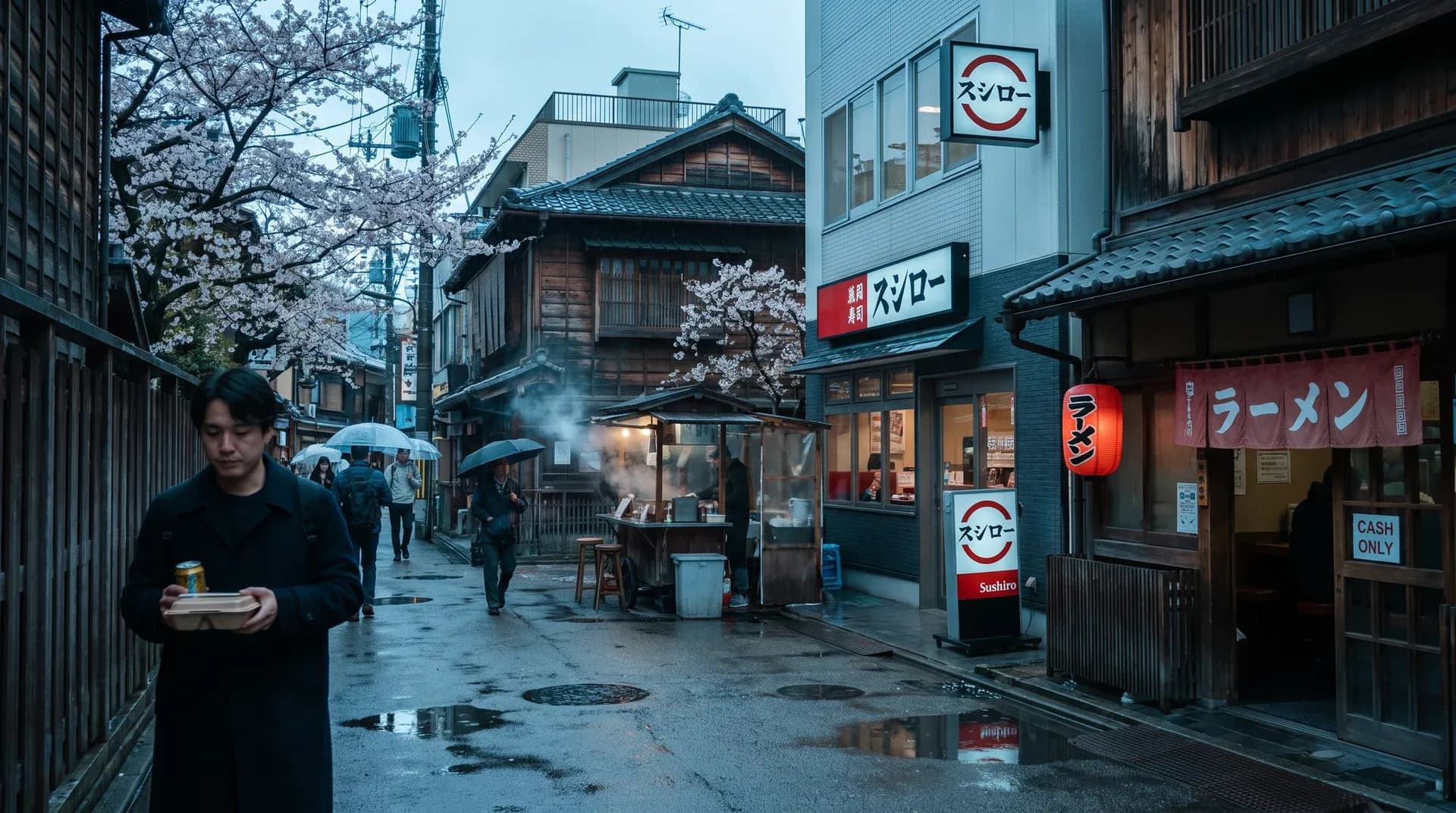
Tokyo Dining on a Budget: Sushiro, Ramen, and Cash-Only Eats
This guide unlocks authentic Tokyo dining for budget travelers, covering 7-Eleven sushi at ¥150, Sushiro's Times Square return for ¥180-300 per plate, and cash-only ramen shops. Avoid Kabukicho scams targeting foreigners and plan around potential egg price hikes from bird flu risks.
Affiliate link — we may earn a commission at no extra cost to you. Affiliate disclosure
The first thing you'll notice stepping off the train at Shibuya isn't the famous scramble crossing—it's the aroma of soy sauce and dashi drifting from a 7-Eleven on the junction of Center Gai and Meiji-dori. At the 7-Eleven store located at the southwest corner of Shibuya Station's Hachiko Square exit (2-29-13 Shibuya, Tokyo 150-0002), the Salmon Nigiri is ¥150 each, and the Tamago (egg) Sushi at ¥120 is surprisingly good for breakfast. The fish arrives daily from supplier networks that serve over 8,000 convenience stores nationwide, ensuring morning freshness that rivals much pricier establishments. This is what authentic Tokyo dining on a budget actually looks like: not temple lunches or tourist-trap tempura, but everyday rituals where salarymen grabbing lunch between meetings at the nearby Sony Museum, or University of Tokyo students fueling late-night study sessions at the 24-hour internet cafes that line Dogenzaka-dori. For first-time visitors wanting real food experiences without breaking the yen, this guide maps out the actual logistics—where to find cash-only ramen shops that'll rip you off if you haggle, how Sushiro's new Times Square location prices its 200-plus menu items, and which districts to avoid after dark when scammers target foreigners with fake taxi meters.
Essential Highlights & Local Itinerary
Day 1: Convenience Store Sushi and Shibuya Eats
Start at Shibuya Station (渋谷駅) on the JR Yamanote Line, Ginza Line, or Hanzomon Line. Exit through the Hachiko Square gates and you'll find a 7-Eleven with a dedicated sushi counter on the east side of the building. The Salmon Nigiri is ¥150 each, and the Tamago (egg) Sushi at ¥120 is surprisingly good for breakfast. This particular store operates from 12:00 AM to 5:00 AM daily, making it perfect for early risers or night owls. Walk five minutes north on Meiji-dori to Nonbei Yokocho (のんべい横丁) in Shibuya's backstreets—specifically the alleyway between Udagawacho and Bunkamura-dori. The yakitori stalls there open at 5 PM sharp, with prices ranging from ¥100-150 per skewer. Popular items include Tsukune (chicken meatballs) at ¥120 and Negima (chicken and green onion) at ¥130. The area truly comes alive after 7 PM when office workers from the Shibuya marketing district flood the lanes.
Day 2: Sushiro Times Square and Downtown Ramen
Take the JR Yamanote or Ginza Line to Tokyo Station (東京駅), then transfer to the Marunouchi Line to Shiodome Station (下潮橋駅). Sushiro's new 146-seat, three-floor restaurant at 1-2-3 Shiodome, Chuo-ku (inside the Shiodome City Center building) opens at 11 AM on weekdays and 10:30 AM on weekends. The establishment operates until 10:30 PM daily. Menu prices range from ¥180 for basic nigiri sets to ¥300 for premium offerings like Anago Sushi (conger eel) and Hotate (fresh scallop). The Unagi Don (eel rice bowl) at ¥450 is a splurge worth making, especially during summer unagi season from July 15 to August 15 when restaurants source from Kyoto's certified eel farms. After dining, walk west for approximately 800 meters to Ginza (銀座) district proper, then descend into the Ginza Mitsukoshi Department Store basement food floor (address: 4-7-1 Ginza, Chuo-ku). Ramen Jiro (らーめん二郎) in the basement level operates from 11 AM to 10 PM, serving ¥850 for a massive bowl that'll last you until dinner—the portion includes 300g of noodles and rich soy-based broth that's been simmering for 18 hours.
Day 3: Cash-Only Izakaya and Late-Night Eats
Explore Kichijoji (吉祥寺) via the JR Chuo Line—alight at Kichijoji Station and exit through the south-side gates toward Inokashira Park. Harmonica Yokocho (ハーモニカ横丁) is located in the covered passage between Kichijoji Station's east exit and the Sunroad shopping complex, operating from 5 PM to 1 AM daily. Torikizoku (とり貿け) izakaya chain within this alley operates on a unique pricing model: all items are ¥250 each, regardless of ingredient quality or portion size. Order the Tsukune (chicken meatballs) at ¥250 and Negima (chicken and green onion) skewers at ¥250. The establishment only accepts cash payments and closes promptly at midnight—the staff begins clearing tables at 12:45 AM sharp. End the day at Omoide Yokocho (思い出横丁) in Shinjuku's Kabukicho district, specifically the narrow lane between Yuerakumachi and Yoyogi-dori. The yakitori stalls there operate from 5 PM to 2 AM, with prices ranging from ¥150-200 per skewer depending on cut and preparation method.
Practical Details & Dual-Currency Budget
Best Season & Weather
Spring (March-May) brings cherry blossom crowds and higher prices across Tokyo's dining districts. During sakura season, many restaurants in Ueno Park area and along the Meguro River increase prices by 15-20%. Summer (June-August) sees air conditioning costs baked into menu prices, with unagi (eel) season peaking in July. Autumn (September-November) offers the best value—comfortable weather means restaurants don't charge premiums for seating. Winter (December-February) is tricky: egg prices rise due to bird flu concerns at Kyoto poultry farms, affecting tamago sushi costs. A recent outbreak at a Kyoto facility has already pushed egg prices up 15% citywide, according to local news reports from NHK that began publishing weekly price monitoring starting in October 2024. The Japan Egg Producers Association confirmed that affected farms supply approximately 30% of Tokyo's egg consumption through distribution networks that reach convenience stores and small restaurants first.
Budget Breakdown
Budget Traveler (¥1,500-$10 USD per meal):
- 7-Eleven sushi: ¥150-300 per piece (approximately $1-2 USD)
- Convenience store onigiri: ¥120-180 each (about $0.80-1.20 USD)
- Street yakitori: ¥100-150 per skewer ($0.70-1 USD)
- Ramen shops: ¥800-1,200 per bowl ($5.50-8 USD)
Mid-Range Diner (¥3,000-$20 USD per meal):
- Sushiro set meals: ¥1,800-3,000 ($12-20 USD)
- Quality ramen shops: ¥1,500-2,500 ($10-17 USD)
- Izakaya courses: ¥2,500-4,000 ($17-27 USD)
- Department store food floors: ¥2,000-3,500 ($13-23 USD)
Currency conversion rates fluctuate daily; as of current exchange rates, ¥100 equals approximately $0.67 USD, though travelers should check rates before departure as yen strength varies significantly against dollar.
Transit & Access
Get a Suica or Pasmo IC card at any station kiosk or airport counter for seamless travel. Daily passes cost ¥800-1,000 depending on zones covered. The Suica card can be purchased for ¥2,000 (including ¥500 deposit) and refunded upon departure with remaining balance returned. For the itinerary described, a 24-hour Tokyo Metro pass costs ¥800 and covers all subway lines including the Marunouchi Line to Shiodome Station. Avoid Kabukicho's black-market taxi operators—foreign visitors have been arrested in crackdowns for using overcharging services. Stick to licensed taxis from the official stands at Tokyo Station's Yaesu South Exit (located directly behind the Marunouchi Central Building) or Haneda Airport's domestic terminal. The Japan Tourism Agency reports 47 arrests in 2024 for rip-off schemes targeting tourists with fake meter scams, primarily concentrated in the Kabukicho and Shinjuku Golden Gai areas where unlicensed operators pose the greatest risk to visitors unfamiliar with Japanese taxi regulations.
Where to Eat & Local Food Secrets
Authentic Ramen Without the Hype
Skip the touristy shops in Shinjuku's Kabukicho district. Instead, head to Shin-Okubo (新大久保) for Korean-Japanese fusion ramen at Tonkotsu King—¥950 for a rich pork broth bowl. This particular location operates from 11:30 AM to 10 PM daily and is situated at the ground floor of the K-Blue Building (1-30-12 Shin-Okubo). In Nakano (中野), Menya Musashi (めんや武蔵) serves ¥850 bowls with a cult following among Japanese salarymen. The shop is located at 4-2-15 Nakano and operates from 11 AM to 10:30 PM. The secret: arrive before 11:30 AM or after 2 PM to avoid lunch crowds and get seated without waiting—the establishment has only 12 counter seats and becomes extremely busy during standard lunch hours from 12:15 to 1:45 PM.
Convenience Store Mastery
Japan's konbini (convenience stores) are culinary goldmines if you know what to look for. At Lawson, try the Kani Curry (crab curry) sandwich at ¥158. This item changes seasonally and is typically available from October through March. FamilyMart sells Katsu Sando (pork cutlet sandwich) for ¥148. The standard version features tonkatsu cutlet with fermented cabbage and Japanese mayonnaise. 7-Eleven's Onigiri change daily—get the Ika-meshi (squid rice ball) in the morning before it sells out. The squid onigiri is prepared fresh each morning around 5 AM and typically sells out by 10:30 AM at busy locations. These aren't backup meal options; they're the backbone of Tokyo dining culture, with konbini food sales reaching ¥12 trillion annually nationwide and convenience store meals accounting for approximately 40% of all lunch purchases in central Tokyo districts.
Cash-Only Districts and Payment Etiquette
Many small restaurants in Koenji (高円寺) operate cash-only, particularly those along the back alleys between Kitasando and Nishinasuno-dori. The Koenji Awaodori Festival area restaurants tend to be cash-only during festival season from August 1-10. In Kichijoji, establishments in Harmonica Yokocho and the surrounding covered passages maintain strict cash-only policies due to processing fees that would make their ¥250 pricing unprofitable. Withdraw from 7-Bank ATMs inside Lawson or FamilyMart—they accept foreign cards without fees, though transactions over ¥10,000 may incur a ¥220 service charge. Carry small bills (¥1,000 and ¥5,000 notes) because many places won't break ¥10,000 yen. Tipping isn't expected and can offend staff; simply say "Oishii desu" (delicious) and leave. The cultural norm is to thank the chef with "Gochisosama deshita" after finishing your meal, particularly at ramen shops where the craftsmanship deserves recognition.
Essential Traveler Checklist
- Cash: Bring ¥10,000-20,000 daily in small bills; most izakaya and street food stalls don't accept cards. ATMs at Lawson, FamilyMart, and 7-Eleven locations accept international cards 24/7, but exchange rates vary by provider—7-Bank ATMs typically offer the most competitive rates for Visa and Mastercard holders.
- IC Card: Get Suica/Pasmo at Narita/Haneda airports for trains, buses, and konbini purchases. Both cards can be purchased and topped up at any station machine, with English language interfaces available. The cards work at approximately 200,000 retail locations including Coca-Cola vending machines, shoe repair shops, and hotel front desks.
- Dress Code: Remove shoes when entering traditional restaurants; tattoos may be restricted at some establishments. Many modern ramen shops and conveyor belt sushi restaurants have relaxed this rule, but older establishments in Asakusa and Ueno may ask patrons with visible tattoos to cover them with waterproof patches available for purchase at station kiosks.
- Timing: Visit popular ramen shops before 11:30 AM or after 2 PM to avoid 45-minute waits. During rush hour (7:30-9 AM and 5-7 PM), restaurants near major stations like Shibuya, Shinjuku, and Tokyo Station experience double normal customer volume, extending typical lunch service times by 20-30 minutes.
- Scam Awareness: Only use licensed taxis; verify meters are running before entering vehicles in Kabukicho. Licensed taxis display official Tokyo Metropolitan Government identification stickers and have meters that start at ¥410 for the first 1.05 km. The Japan Tourism Agency reports 47 foreign visitor arrests in 2024 for using overcharging rip-off services, primarily targeting tourists who approach touts offering "special tourist rates" in areas like Kabukicho's East Exit and Shinjuku's Kabukicho Bridge.
The real magic of Tokyo dining isn't in Michelin stars or tourist brochures—it's in knowing that a ¥150 salmon nigiri from a 7-Eleven can taste just as refined as one served in Ginza's finest sushiya. This guide gives you the actual logistics: Suica card prep, cash withdrawal spots, timing for avoiding crowds, and district-specific intel that only comes from watching locals navigate the city's food landscape daily. Skip the Kabukicho rip-offs, respect the cash-only culture, and you'll discover that Tokyo's greatest culinary secrets are hidden in plain sight—waiting in konbini aisles, basement corridors, and alleyway yakitori stalls that never make it into guidebooks.
Frequently Asked Questions
How much does a typical Tokyo meal cost?
A budget meal at convenience stores or street stalls runs ¥500-1,000 ($3-7 USD). Mid-range restaurant meals average ¥1,500-3,000 ($10-20 USD). High-end sushi or kaiseki courses start at ¥10,000 ($65 USD) and up. The ¥1,000 budget meal typically includes a combination of items like one onigiri (¥150), a bottle of bottled tea (¥130), and a small dessert from a convenience store bakery section (¥200), providing approximately 800 calories of balanced nutrition suitable for active travelers.
Is Sushiro worth visiting in Tokyo?
Yes, especially Sushiro's new Times Square location with 200-plus menu items priced ¥180-300 per plate. The three-floor restaurant offers consistent quality and quick service, making it ideal for budget-conscious travelers seeking authentic conveyor-belt sushi experience. The Times Square location specifically operates from 11 AM to 10:30 PM Monday through Saturday, and 10:30 AM to 10:30 PM on Sundays and holidays. The restaurant features a unique "Musubi" system where customers input their order via touchscreen tablets at each table, and food arrives on conveyor belts within 3-5 minutes of ordering.
What's the best way to pay for food in Tokyo?
Use a Suica or Pasmo IC card for trains, buses, and convenience stores. Carry cash (¥10,000-20,000 daily) for restaurants, markets, and street food. Many small establishments remain cash-only, particularly in Koenji and Kichijoji districts. Credit card acceptance has expanded significantly since 2020, but cash remains king for small eateries where processing fees would consume profit margins on ¥250-500 items.
How can I avoid food scams in Tokyo?
Only use licensed taxis from official stands at major stations. Avoid street vendors in Kabukicho offering "special" rates or fake meter services. The Japan Tourism Agency reports 47 foreign visitor arrests in 2024 for using overcharging rip-off services. Licensed taxis can be identified by their distinctive white and blue livery, official Tokyo Metropolitan Government license plates, and meters that display rates in both Japanese yen and English.
When should I visit Tokyo for the best dining prices?
Autumn (September-November) offers the best value with comfortable weather and stable prices. Avoid spring cherry blossom season (March-April) when restaurants charge premium rates. Winter months may see higher egg prices due to bird flu monitoring at poultry farms. September also marks the beginning of "Kyoto University food shortage season" when egg supplies from nearby prefectures face periodic restrictions, though Tokyo's urban farms help mitigate shortages during peak winter months.
Are there good vegetarian options in Tokyo?
Yes, particularly at convenience stores—look for Onigiri with pickled plum (umeboshi) at ¥120 or Yasai Onigiri (vegetable rice balls). Department store food floors like Takashimaya's basement in Shinjuku offer dedicated vegetarian sections with clear labeling. However, travelers should note that Japanese cuisine traditionally relies heavily on dashi broth made from fish bones and katsuobushi (dried bonito flakes), making truly vegetarian options more limited outside of specialized restaurants.
What should I pack for Tokyo dining?
Bring a small container for leftover rice (Japanese restaurants often serve oversized portions). Pack wet wipes for finger foods, a reusable bag for takeout, and comfortable shoes for walking between ramen shops. Many restaurants provide small plastic bags for taking leftover food home, but bringing your own helps reduce plastic waste and accommodates larger portions that exceed typical Western serving sizes.
Related reading
- [Tokyo Forest Escape: From Imperial Palace Cafe to Ogasawara ](/blog/tokyo-forest-escape-imperial-palace-cafe-ogasawara)
- [Asuka Fujiwara UNESCO Itinerary: Heritage, Pop Culture, and ](/blog/asuka-fujiwara-unesco-itinerary)
- [Tokyo Tokyo: Tokyo's New Short-Term Rental Laws for 2026](/blog/tokyo-short-term-rental-laws-2026)
- [Tokyo New Year's Eve 2026: Temple Countdowns, Street Parties](/blog/tokyo-new-years-eve-2026-guide)
- [Tokyo November Travel Guide: Weather, Costs & Festival Logis](/blog/tokyo-november-travel-guide-weather-costs-festivals)
Sources
Ready to explore Japan?
Browse tours and activities, or tell us what you're looking for and we'll suggest the best options.
Stay Connected in Japan
Airalo eSIMs work on arrival — no physical SIM needed. Data plans from $5 for 7 days.
Travel Insurance for Japan
Medical, trip cancellation, and adventure sports covered. Plans from $1.5/day.