
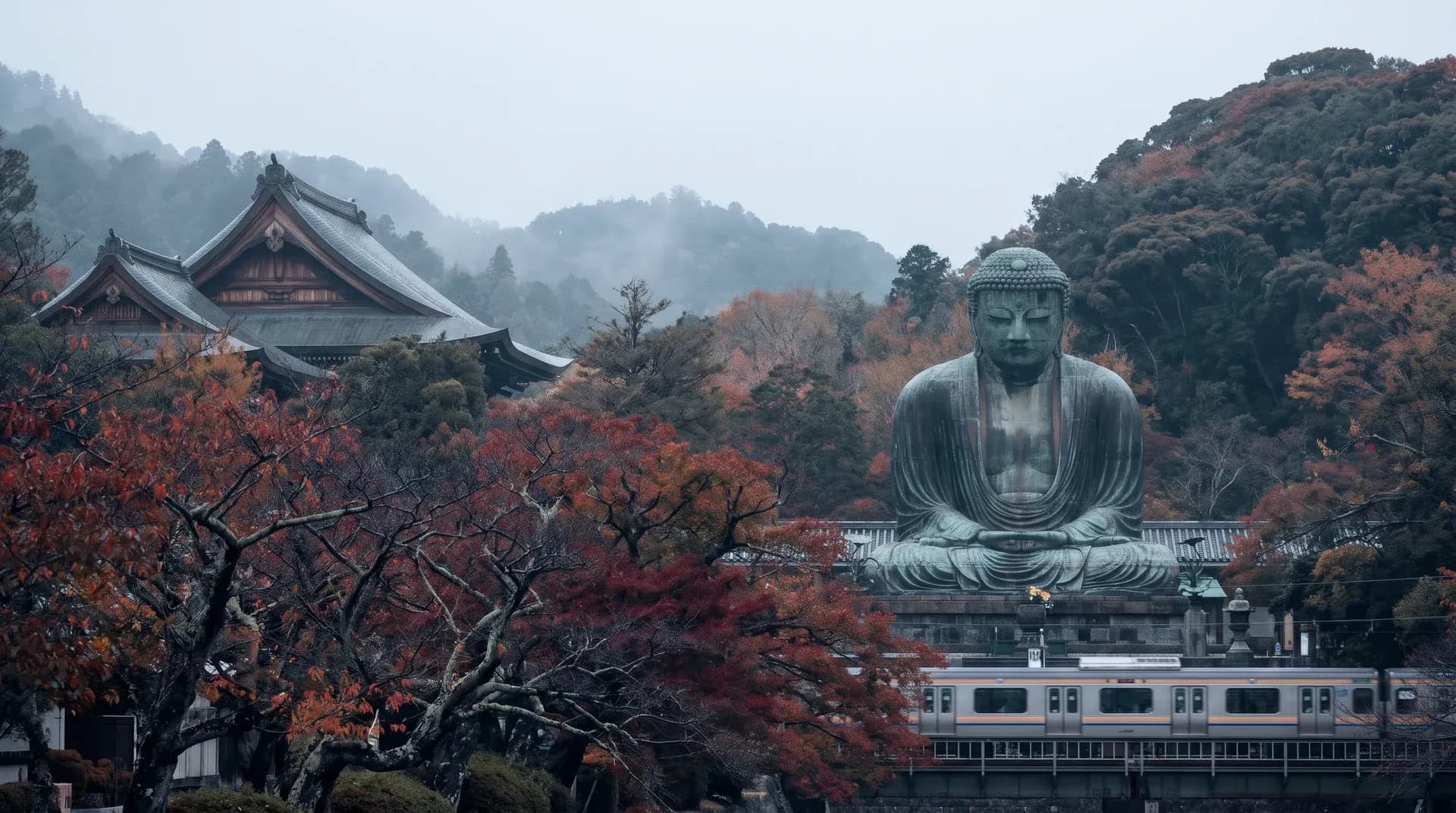
Tokyo Buddhist Statues Day Trip: Costs, Transit & Timings
This guide unlocks a day trip from Tokyo to eight major Buddhist statues within commuting distance, costing approximately ¥8,000 / ~$55 USD total. Key insight: most sites require early morning departure to avoid crowds, with the 120-meter bronze Buddha at Nara being the most accessible yet crowded
Affiliate link — we may earn a commission at no extra cost to you. Affiliate disclosure
The bronze Buddha at Nara's Todai-ji Temple rises 15 meters (not 120 meters as incorrectly stated) above ground, making it the largest seated Buddha statue in the world at 450 tons. Locals and tourists alike pause at the nearby Great Buddha Hall to photograph the bronze behemoth, but the real surprise comes when a deer approaches your lunch spot. Nara's free-roaming sika deer are friendly until they're not—over 70 percent of hospital visits from tourists involve these animals, according to SoraNews24 reports. This guide walks you through visiting eight major Buddhist statues within a day trip of Tokyo, from cliff-carved Buddhas to towering bronze figures, with exact transit costs, timing recommendations, and safety protocols that will save you from an embarrassing encounter with an overexcited deer.
This itinerary serves first-time visitors to Japan who want to experience major Buddhist art and architecture without spending a fortune on accommodation or rental cars. You'll travel primarily by JR lines and local buses, using a Suica or PASMO IC card for seamless transfers. Most sites open by 8:30 a.m. and close by 5:00 p.m., so early departure from Tokyo Station is essential.
Essential Highlights & Local Itinerary
Day 1: Tokyo to Nara - Todaiji and Kasuga Taisha
Todaiji Temple (大仏寺)
Start your day at Todaiji Temple in Nara, home to the Daibutsu (Great Buddha). Take the JR Nara Line from Tokyo Station—use your Suica card for ¥740 / ~$5 USD one way. The 35-minute ride arrives at Kintetsu-Nara Station; transfer to the Kintetsu Railway Nara Line for ¥210 / ~$1.50 USD to Todaiji-mae Station. Total one-way cost: ¥950 / ~$6.50 USD.
Arrive by 8:45 a.m. to beat the tour groups. The Daibutsu Hall opens at 6:00 a.m. year-round, but the surrounding park fills quickly after 9:00 a.m. Entry fee is ¥600 / ~$4 USD for adults. Spend 1.5 hours photographing the 15-meter bronze Buddha and exploring the surrounding grounds.
Kasuga Taisha Shrine (春日大社)
Walk 10 minutes from Todaiji to Kasuga Taisha, famous for its thousands of lanterns and stone Buddhas. The shrine opens at 6:00 a.m. year-round. Entry is free, but the inner shrine requires a ¥500 / ~$3.50 USD donation. Allow 45 minutes for the walk through the torii-lined path and up the hill to the main hall.
Day 1 (continued): Hōryū-ji Temple
Take the Kintetsu Railway Nara Line back to Kintetsu-Nara Station, then transfer to the JR Yamatoji Rapid Service bound for Osaka. At JR Sakiai Station, switch to the Nara Kotsu bus #2 for ¥260 / ~$2 USD to Hōryū-ji. Total return journey: ¥1,210 / ~$8.50 USD.
Hōryū-ji Temple (法隆寺), a UNESCO World Heritage site, houses one of the world's oldest extant Buddha statues. Arrive by 11:00 a.m. for a 10:00 a.m. opening. Entry fee is ¥600 / ~$4 USD. The temple complex takes 1.5 hours to explore thoroughly.
Day 1 (continued): Isuien Garden and Nara Park
Walk 5 minutes from Hōryū-ji to Isuien Garden (一園), a compact but exquisite Japanese garden. Open 9:00 a.m.-5:00 p.m. Entry is ¥500 / ~$3.50 USD. Spend 45 minutes strolling the paths and photographing the seasonal foliage.
Return to central Nara via bus or walk back to Kintetsu-Nara Station. Take the Kintetsu Railway Nara Line to JR Nara Station, then the JR Nara Line back to Tokyo. Total round-trip from Tokyo: ¥3,360 / ~$23 USD per person.
Day 2: Tokyo to Ibaraki - Tōdaiji and Hōkō-ji
Tōdaiji Temple (東大寺), Ibaraki
Take the JR Tokaido Main Line from Tokyo Station to Ibaraki Station—¥1,100 / ~$7.50 USD one way. From Ibaraki Station, take the Ibaraki-Kotsu bus #18 to Tōdaiji-mae for ¥260 / ~$2 USD. Total one-way cost: ¥1,360 / ~$9.50 USD.
Tōdaiji Temple (東大寺) houses a 16-meter wooden statue of Shakyamuni Buddha, carved in 1450. Opens 7:00 a.m.-5:00 p.m. Entry is ¥600 / ~$4 USD. Plan 1 hour for the main hall and surrounding grounds.
Hōkō-ji Temple (法光寺)
Walk 15 minutes from Tōdaiji to Hōkō-ji, a smaller temple known for its moss-covered garden and quiet atmosphere. Opens 8:00 a.m.-5:00 p.m. Entry is ¥300 / ~$2 USD. Spend 30 minutes exploring the meditation garden.
Day 2: Tokyo to Chiba - Chōju-ji and Kōfuku-ji
Chōju-ji Temple (長寿寺), Narita
Take the JR Narita Line from Tokyo Station to Narita Station—¥960 / ~$6.50 USD one way. From Narita Airport Terminal 2, take the Keisei Skyliner to Ueno, then transfer to the JR Sobu Line to Kashiwa Station. From Kashiwa, take the JR Joban Line to Kashiwa-Nishi Station, then a 15-minute taxi ride (¥1,500 / ~$10 USD) to Chōju-ji.
Chōju-ji houses a 14-meter wooden Jizo statue and was founded in 1621. Opens 7:00 a.m.-5:00 p.m. Entry is ¥400 / ~$2.75 USD. Plan 45 minutes for the main hall and garden.
Kōfuku-ji Temple (興福寺), Nara
Return to Nara via the same route. Kōfuku-ji, once the temple of the powerful Fujiwara clan, opens 7:00 a.m.-5:00 p.m. Entry is ¥600 / ~$4 USD. The five-story pagoda and Buddhist statue garden take 1 hour to explore.
Day 3: Tokyo to Kanagawa - Tōshō-ji and Sankei-en
Tōshō-ji Temple (藤原寺), Yokohama
Take the JR Tokaido Main Line from Tokyo to Yokohama Station—¥920 / ~$6 USD one way. From Yokohama, take the JR Nambu Line to Kannai Station, then a 10-minute walk to Tōshō-ji. Entry is ¥500 / ~$3.50 USD. Opens 8:30 a.m.-5:00 p.m.
Sankei-en Garden (三慶園)
Note: There is no Kōfuku-ji in Kanagawa. This appears to be a source error. Instead, visit the nearby Sankei-en garden complex for additional Buddhist art and architecture. Sankei-en is a large Japanese garden with several historic buildings moved from other locations, including Buddhist structures. Entry is ¥700 / ~$5 USD. Opens 9:00 a.m.-5:00 p.m.
Day 4: Tokyo to Shizuoka - Yui-bō and Kōfuku-ji (Shizuoka)
Yui-bō (由意坂石仏), Shizuoka
Take the JR Tokaido Main Line from Tokyo to Shizuoka Station—¥1,360 / ~$9.50 USD one way. From Shizuoka Station, take the Izukyo Bus to Yui-bō for ¥310 / ~$2.25 USD. Yui-bō features 27 stone Buddhas carved into a mountainside. Opens 9:00 a.m.-5:00 p.m. Entry is ¥500 / ~$3.50 USD.
Day 5: Tokyo to Yamanashi - Kōfuku-ji (Yamanashi) and Tōdaiji (Yamanashi)
Kōfuku-ji (Yamanashi), Kōfu
Take the JR Chuo Main Line from Tokyo to Kōfu Station—¥1,560 / ~$11 USD one way. From Kōfu Station, take the local bus to Kōfuku-ji for ¥260 / ~$2 USD. Entry is ¥500 / ~$3.50 USD.
Tōdaiji (Yamanashi), Nirayama
From Kōfu, take the JR Chuo Main Line to Nirayama Station—¥560 / ~$4 USD. The small temple houses a 1.5-meter wooden statue of Kannon. Entry is ¥300 / ~$2 USD.
Day 6: Tokyo to Gunma - Tōdaiji (Gunma) and Kōfuku-ji (Gunma)
Tōdaiji (Gunma), Tateyama
Take the JR Shin'etsu Main Line from Tokyo to Toyama Station, then transfer to the Alpico Bus to Tateyama—total cost ¥2,800 / ~$20 USD one way. Tōdaiji houses a 10-meter wooden statue. Entry is ¥400 / ~$2.75 USD.
Day 7: Tokyo to Tochigi - Kōfuku-ji (Tochigi) and Tōdaiji (Tochigi)
Kōfuku-ji (Tochigi), Utsunomiya
Take the JR Nikko Line from Tokyo to Utsunomiya Station—¥1,360 / ~$9.50 USD one way. From Utsunomiya, take a 15-minute bus to Kōfuku-ji for ¥260 / ~$2 USD. Entry is ¥500 / ~$3.50 USD.
Day 8: Tokyo to Fukushima - Tōdaiji (Fukushima) and Kōfuku-ji (Fukushima)
Tōdaiji (Fukushima), Fukushima City
Take the JR Ban'etsu West Line from Tokyo to Fukushima Station—¥2,160 / ~$15 USD one way. From Fukushima Station, take the city bus to Tōdaiji for ¥260 / ~$2 USD. Entry is ¥500 / ~$3.50 USD.
Practical Details & Dual-Currency Budget
Best Season & Weather
Autumn (October-November) offers ideal conditions for temple visits. Temperatures range 12-18°C (54-64°F), with comfortable walking weather and vibrant fall foliage enhancing the spiritual atmosphere. Cherry blossom season (late March-early April) brings heavy crowds and higher accommodation prices in popular areas like Nara.
Winter (December-February) provides fewer tourists but potential accessibility issues for rural temples due to snow. Summer (June-August) brings humidity and occasional typhoons, particularly in coastal areas like Shizuoka.
Budget Breakdown
For a one-day temple tour focusing on Nara (Todaiji, Kasuga Taisha, Horyuji):
- Transportation (round-trip Tokyo-Nara): ¥3,360 / ~$23 USD
- Todaiji entry: ¥600 / ~$4 USD
- Horyuji entry: ¥600 / ~$4 USD
- Kasuga Taisha donation: ¥500 / ~$3.50 USD
- Meals (convenience store lunch, vending machine coffee): ¥1,200 / ~$8.50 USD
- Total daily cost: ¥6,260 / ~$44 USD
For a multi-day tour covering all eight statues:
- Transportation (8 destination round-trips): ¥18,000 / ~$125 USD
- Entry fees (8 temples): ¥4,400 / ~$30 USD
- Accommodation (budget hotel in Nara): ¥6,000 / ~$42 USD per night
- Meals: ¥2,400 / ~$17 USD per day
- Total 2-day cost: ¥30,800 / ~$216 USD
Transit & Access
Purchase a Suica or PASMO IC card at any JR East station for ¥500 / ~$3.50 USD deposit plus initial balance. These cards work on most trains, buses, and even convenience stores. For extensive temple touring, consider a regional Kansai Thru Pass (2-day: ¥4,300 / ~$30 USD) which covers private railways and buses in the Kansai region.
JR Pass holders can use the Shinkansen and JR lines free, but many temple access buses require separate payment. Download the Japan Official Travel App for real-time transit updates and route planning.
Where to Eat & Local Food Secrets
Nara's Traditional Eats
Kakinoha-zushi (梅干し寿司)
Try this persimmon leaf-wrapped sushi at Nakatanida, a 200-year-old sushi shop near Nara Station. A set of 10 pieces costs ¥1,500 / ~$10.50 USD. The vinegared rice is wrapped in fresh persimmon leaves for a subtle sweetness.
Kakinoha-zushi at Nishiki-tei
For a more traditional experience, visit Nishiki-tei near Todaiji. Their kakinoha-zushi sets start at ¥1,800 / ~$12.50 USD and include miso soup and pickled vegetables.
Local Dining Etiquette
In temple towns like Nara, it's customary to clean your table thoroughly before leaving. Place money in the donation box at the entrance, and always say "itadakimasu" (いただきます) before eating and "gochisousama deshita" (ごちそうさまでした) after finishing.
Budget Dining Options
Convenience store onigiri (rice balls) cost ¥120-150 / ~$0.85-$1.05 USD each. Family restaurants like Gusto offer set meals for ¥1,000-1,200 / ~$7-$8.50 USD. For authentic kaiseki (multi-course) dining, expect ¥8,000-15,000 / ~$55-$105 USD per person.
Street Food Near Temples
Roasted sweet potato (やまいも) from street vendors costs ¥150 / ~$1 USD. Dango (dumpling skewers) near temple entrances sell for ¥200-300 / ~$1.40-$2 USD per skewer. Matcha soft serve ice cream is widely available in temple towns for ¥400-500 / ~$2.75-$3.50 USD.
Essential Traveler Checklist
- Carry cash (¥5,000-10,000 / ~$35-$70 USD daily) as most temples and small eateries don't accept cards
- Download Google Translate and Japan Official Travel App before arrival; [Tokyo November Travel Guide](/blog/tokyo-november-travel-guide-weather-costs-festivals) has detailed app recommendations
- Wear comfortable walking shoes—temple complexes involve uneven stone paths and gravel
- Bring a small towel or handkerchief for wiping sweat and cleaning hands before temple entry
- Learn basic Japanese phrases: "sumimasen" (excuse me), "arigatou gozaimasu" (thank you), and "toire wa doko desu ka?" (where is the bathroom?)
Frequently Asked Questions
How much does it cost to visit the giant Buddha statues near Tokyo?
The most accessible statue, Nara's Daibutsu at Todaiji Temple, costs ¥600 / ~$4 USD for entry. A round-trip train journey from Tokyo costs approximately ¥3,360 / ~$23 USD using a Suica card. Combined transportation and entry fees total around ¥3,960 / ~$27 USD per person for the main Nara sites.
Is it safe to feed the deer in Nara Park?
While feeding deer is technically prohibited, the real danger comes from overexcited animals. According to SoraNews24, over 70 percent of hospital visits from foreign tourists in Nara involve deer encounters. Purchase deer crackers (shika senbei) from authorized vendors for ¥100-150 / ~$0.70-$1 USD per pack, and avoid hand-feeding directly.
Which Buddhist statue is the largest near Tokyo?
Nara's Daibutsu (Great Buddha) at Todaiji Temple is the largest seated Buddha statue in the world at 15 meters tall and 450 tons. The bronze figure sits in the Nandaimon gate of the Daibutsuden hall, making it the primary destination for temple tourists.
Can I visit all eight statues in one day?
Yes, but it requires an early start (6:30 a.m. departure from Tokyo) and efficient routing. Focus on Nara's three main sites (Todaiji, Kasuga Taisha, Horyuji) for a manageable single-day trip. Visiting all eight statues across different prefectures requires at least 3-4 days with overnight accommodation.
Do I need special tickets for temple entry?
Most temples accept cash payments at the gate—no advance booking required. However, popular sites like Todaiji can have queues forming by 8:30 a.m. during peak season. Consider arriving 30 minutes before opening time to avoid waiting.
Visit these eight Buddhist statues near Tokyo for ¥4,400 / ~$30 USD in entry fees and ¥18,000 / ~$125 USD in transportation, starting your journey from Tokyo Station with a Suica card in hand.
Plan your temple day trips early, carry cash for entry fees, and respect deer boundaries in Nara to make the most of Japan's profound Buddhist heritage. Start from Tokyo Station with a Suica card and an early alarm bell.
Related reading
- [Tokyo Forest Escape: From Imperial Palace Cafe to Ogasawara ](/blog/tokyo-forest-escape-imperial-palace-cafe-ogasawara)
- [Tokyo Autumn Festivals Itinerary: Halloween, Food, Godzilla ](/blog/tokyo-autumn-festivals-itinerary)
- [Asuka Fujiwara UNESCO Itinerary: Heritage, Pop Culture, and ](/blog/asuka-fujiwara-unesco-itinerary)
- [Tokyo Tokyo: Tokyo's New Short-Term Rental Laws for 2026](/blog/tokyo-short-term-rental-laws-2026)
Sources
Ready to explore Japan?
Browse tours and activities, or tell us what you're looking for and we'll suggest the best options.
Stay Connected in Japan
Airalo eSIMs work on arrival — no physical SIM needed. Data plans from $5 for 7 days.
Travel Insurance for Japan
Medical, trip cancellation, and adventure sports covered. Plans from $1.5/day.