
Tokyo Autumn Foliage Itinerary: 2026 Guide & Costs
By Tour in Japan editors · Updated
Plan your Tokyo trip with peak foliage timing, art gallery coffee in Yanaka, convenience store food finds, and full dual-currency budgets.
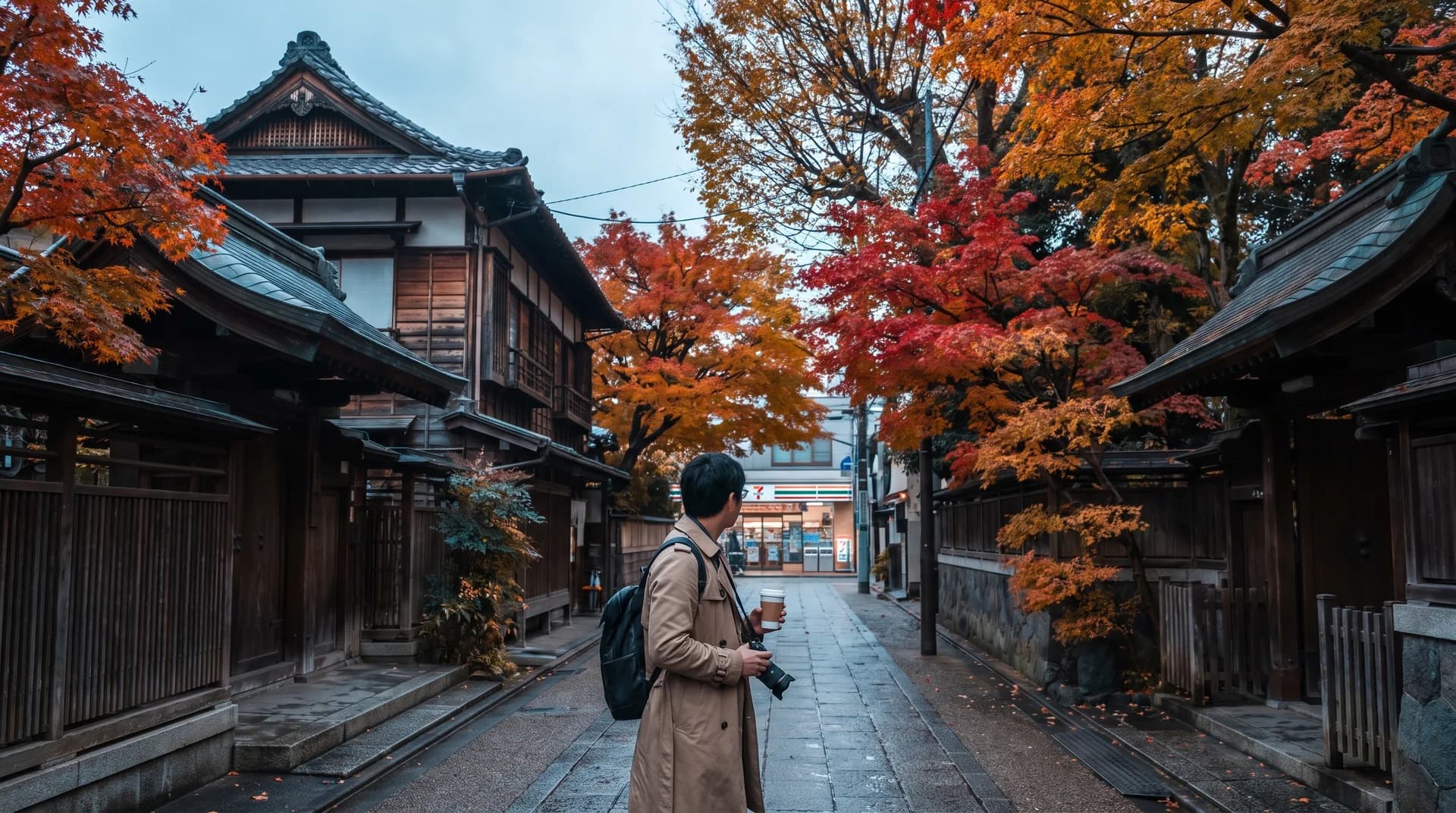
Stepping off the JR Yamanote Line at Nippori Station on a crisp November morning, the scent of roasting green tea mingles with cool autumn air flowing down from the Yanaka ridge. Deep crimson leaves from Japanese maple trees overhang the soot-stained wooden gates of centuries-old temples, while quiet residential alleyways offer a refreshing contrast to the high-density commercial centers of Ueno and Shinjuku. Exploring Tokyo in the autumn months requires more than just visiting iconic public parks. It demands a clear, actionable plan to catch peak foliage timing, navigate traditional residential districts, and sample limited-time seasonal foods.
This three-day Tokyo autumn foliage itinerary layers Yanaka's shitamachi alleys, two of the city's top ginkgo and maple gardens, and a Mount Takao day trip into a self-guided route totaling roughly 16–20 km of walking. The guide includes concrete departure points at named stations, dual-currency cost breakdowns updated for late 2026, and specific time-stamped tactics (such as the 8:30 AM ginkgo avenue strategy and the 9:00 AM garden-gate arrival) that I have personally tested in previous November visits.
If you have only one full day in Tokyo during peak foliage, skip straight to Day 2's Gaien-to-Rikugien circuit. If you have three days, follow the itinerary in order: Yanaka's temples and gallery coffee on Day 1, the ginkgo and maple garden pair on Day 2, and the Shinjuku Gyoen plus Mount Takao pairing on Day 3. Both budget and mid-range daily totals are broken out in the Practical Details section below.
Essential Highlights & Local Itinerary
Day 1: Historic Yanaka & Contemporary Gallery Coffee
Begin your journey in Yanaka, one of Tokyo's preserved shitamachi (historic low-city) neighborhoods located in Taito Ward. Unlike commercial districts that were rebuilt after World War II, Yanaka retains narrow street grids, wooden shopfronts, and dozens of neighborhood temples.
Exit Nippori Station via the West Exit and walk five minutes west along Yuyake Dandan, a famous stepped slope that leads down to the Yanaka Ginza shopping street. Here, local vendors sell traditional crafts, handmade ceramics, and freshly roasted senbei rice crackers. Spend roughly 45 minutes meandering through the side alleys before the crowds swell.
After exploring the main shopping street, head south through the quiet residential streets toward the Tokyo University of the Arts campus. In early 2026, Starbucks opened a unique branch in Yanaka that functions as an official neighborhood art gallery. Designed to integrate into the local creative community, this specific location features rotating exhibitions by painters, sculptors, and fine art students from Tokyo's premier arts institution. Grab a seat at the long communal cedar counter that runs along the south wall rather than at the small two-top tables near the entrance — the counter sits directly beneath the hanging canvas works and lets you read the artist cards without craning your neck. Order a standard drip coffee (¥420 / ~$2.85 USD) and ask the barista which wall was rotated in that week; they keep a printed exhibition sheet at the register. Pair the coffee with a seasonal matcha latte (¥590 / ~$4.00 USD) if you want something photogenic, and budget exactly 90 minutes — long enough for one slow loop through the gallery space plus a refill, short enough to reach Tennoji before the 3:00 PM closing bell on weekdays. Photographs of the artwork are allowed without flash; tripods are not.
From the coffee gallery, walk ten minutes east to Tennoji Temple, founded in 1274. The temple's open grounds feature a large bronze Buddha statue framed by mature Japanese maple trees (momiji) that turn brilliant shade of red in late autumn. Admission to the temple grounds is free, and the courtyard provides a quiet space for photography. The single momiji directly behind the main hall is the most photographed tree in the complex — frame it through the gate arch for the cleanest composition.
Day 2: Autumn Foliage Circuit – Gaien and Rikugien
To experience Tokyo's golden ginkgo trees at their absolute peak, board the Tokyo Metro Ginza Line to Aoyama-itchome Station and exit toward Meiji Jingu Gaien. The famous Ginkgo Avenue (Icho Namiki) features 146 neatly pruned ginkgo trees lining a 300-meter promenade, creating a brilliant golden canopy overhead.
Plan to arrive by 8:30 AM to beat the mid-day tourist crowds. Walking the avenue is free of charge and takes roughly 45 minutes. Pop-up food stalls at the northern end of the avenue sell warm green tea and seasonal chestnut snacks during peak weeks.
In the afternoon, board the JR Yamanote Line northbound to Komagome Station to visit Rikugien Garden, an Edo-period landscape garden built between 1695 and 1702. Adult entry is ¥300 (~$2.05 USD). During late November and early December, Rikugien extends its operating hours until 8:30 PM for its autumn illumination event. Powerful, warm spotlights illuminate hundreds of red maples reflecting off the central pond. Plan for at least two hours to walk the gravel perimeter trails and cross the traditional stone bridges.
Day 3: Shinjuku Gyoen & Mount Takao Excursion
Start Day 3 at Shinjuku Gyoen National Garden, reachable via a five-minute walk from Shinjuku-sanchome Station on the Tokyo Metro Marunouchi Line. Entry costs ¥500 (~$3.40 USD). Spanning 58.3 hectares, the park mixes French Formal, English Landscape, and Traditional Japanese garden styles. Enter through the Shinjuku Gate, turn left into the Formal French garden, and walk the straight cedar-lined axis until you reach the central fountain — the symmetry of the cedar canopy with a few early-turning ginkgos at the far end is the cleanest morning shot. From there, cut northeast through the English Landscape Garden toward the Japanese Garden section, where the Momijiyama (maple hill) and the old kakuha teahouse pond hold the densest concentration of red momiji in the park. The wooden arch bridge over the inner pond, photographed looking back toward the teahouse at low sun, is the single most reliable shinrin shot in Tokyo. Budget 2.5 hours total: 45 minutes in the Formal and English gardens, 75 minutes circling the Japanese Garden pond loop, and 30 minutes for a rest at the kyūsokutei teahouse if queues allow.
In the afternoon, travel to Mount Takao for an accessible nature getaway within Tokyo Prefecture. Head to Shinjuku Station and take the Keio Line express train directly to Takaosanguchi Station (50 minutes, ¥390 / ~$2.65 USD one way). Mount Takao offers dense forest trails vibrant with fall colors. Take the Mount Takao Cable Car (¥490 / ~$3.35 USD one way) up through a canopy of yellow and red leaves, then complete a gentle 30-minute walk along Trail 1 to Yakuoin Temple. On clear autumn days, the summit lookout offers views of Mount Fuji framed by fiery red foliage.
The Play: Step-by-Step
Mastering the Morning Strategy for Peak Foliage Spots
Foliage windows in Tokyo's major gardens open and close within a 10-day band each November. To land inside that band at peak color without tour-bus silhouettes, follow this exact pre-dawn protocol.
- Set the 6:00 AM Alarm: Tokyo transit systems hum to life by 5:00 AM, but the streets are blissfully quiet until around 8:00 AM. Aim to leave your hotel or hostel no later than 6:45 AM.
- Grab Convenience Store Breakfast En Route: Don't waste precious morning hours sitting down for breakfast in a restaurant. Stop by a local Lawson, FamilyMart, or 7-Eleven at 7:00 AM. Pick up a packaged sandwich (sando), an onigiri, and a hot canned coffee from the heated beverage shelf. Eat this while riding the train or walking toward your first outdoor destination.
- Hit the Gates at Opening Time: Major gardens like Shinjuku Gyoen (opens at 9:00 AM) and Rikugien (opens at 9:00 AM during regular hours) experience massive tour bus arrivals starting at 10:30 AM. Arrive 15 minutes before opening to secure your spot at the front of the ticket queue. This grants you a 45-minute window to photograph iconic mirror-like reflection ponds while the water is entirely undisturbed by wind or foot traffic.
- Leverage Mid-Day Transition Windows: Between 12:00 PM and 2:00 PM, when the sun is at its harshest for photography, transition between neighborhoods. Use this time to ride cross-town subway lines, enjoy a sit-down bowl of ramen, or explore indoor art galleries like the Yanaka Starbucks gallery.
- Secure Your Evening Illumination Tickets in Advance: For evening events like the Rikugien autumn lights, tickets can sell out online or generate 90-minute queues at the gate. Book your timed-entry ticket through the official Tokyo Metropolitan Park Association website exactly seven days before your planned visit.
Navigating Complex Subway Interchanges
Tokyo's rail network is a marvel of efficiency, but transferring between private rail companies (like Keio and Odakyu) and municipal subways (Tokyo Metro and Toei) can disorient first-time visitors.
- Always Follow the Floor Markings: Look down at the station platforms. Brightly colored vinyl stickers indicate where specific train cars open, where doors align with platform screen doors, and which color-coded exit numbers lead to your destination street.
- Download Offline Transit Maps: While Google Maps and JapanOfficialTravel are exceptionally accurate, underground cell signal can occasionally drop in deep transfer tunnels between the Marunouchi and Oedo lines. Keep a saved PDF map of the central Tokyo subway ring on your phone.
- Keep Your IC Card Readily Accessible: Do not bury your smartphone or physical Suica card at the bottom of your backpack. Keep it in an outer coat pocket or a dedicated lanyard pouch so you can tap through ticket gates at a brisk walking pace without causing human bottlenecks.
Real-World Example: A Day in the Life of a Fall Explorer
To see how these logistical steps, costs, and timing strategies integrate into a seamless 24-hour window, follow Sarah, a solo mid-range traveler from Chicago, through her exact itinerary on November 24th.
7:15 AM: Sunrise Stroll at Meiji Jingu Gaien
Sarah wakes up at her business hotel in Akasaka, grabs a quick black coffee and egg salad sandwich from a local 7-Eleven (¥450 / ~$3.10 USD), and catches the Tokyo Metro Ginza Line. She arrives at Aoyama-itchome Station at 7:55 AM. By 8:15 AM, she is walking beneath the towering, golden-leafed ginkgo canopy of Meiji Jingu Gaien.
Because she arrived before the tourist rush, she manages to capture pristine shots of the yellow carpeted path without crowds. She spends 50 minutes strolling slowly, stopping to buy a warm roasted sweet potato (yaki-imo) from a street vendor for ¥400 (~$2.75 USD).
11:30 AM: Art Gallery Coffee & Shitamachi Exploration
After riding the subway north to Nippori Station, Sarah spends two hours wandering Yanaka Ginza. She stops at Niku no Suzuki to sample a piping-hot menchi-katsu (¥250 / ~$1.70 USD) eaten outside the shopfront.
By 1:30 PM, she walks over to the Yanaka Starbucks art gallery. She orders an iced oat milk latte (¥540 / ~$3.70 USD) and sits at a communal cedar table for an hour, sketching in her notebook while observing original oil paintings created by local university students hung along the exposed concrete walls.
4:30 PM: Evening Illumination at Rikugien Garden
Sarah takes the JR Yamanote Line to Komagome Station, arriving at Rikugien Garden just as dusk settles at 4:45 PM. She pays her ¥300 (~$2.05 USD) entry fee at the gate. The temperature drops to 9°C (48°F), prompting her to zip up her fleece jacket.
For the next 90 minutes, she follows the illuminated gravel path looping around the central Tsutsuji-chaya teahouse and Togetsukyo Bridge. The artificial amber lights cast a warm glow across scarlet maple branches that mirror flawlessly onto the dark pond water. She finishes her evening by dining at a cozy neighborhood izakaya near Komagome Station, ordering grilled chicken yakitori, pickled cucumbers, and a draft beer for a total of ¥3,200 (~$21.90 USD).
Daily Expense Summary for Sarah:
- Hotel (Akasaka Business Hotel): ¥16,000 / ~$109.50 USD
- Breakfast & Snacks (7-Eleven & Street Food): ¥1,090 / ~$7.55 USD
- Lunch & Dinner (Gallery Coffee & Izakaya): ¥3,740 / ~$25.60 USD
- Transit & Attractions (Subway Fares & Garden Entry): ¥1,190 / ~$8.15 USD
- Total Daily Spend: ¥22,020 / ~$150.80 USD
Practical Details & Dual-Currency Budget
Best Season & Foliage Timing
Japan's autumn foliage season progresses slowly from north to south. While Hokkaido leaves peak in October, Tokyo's peak foliage window generally occurs between mid-November and early December. Ginkgo trees (icho) turn golden yellow first, usually peaking between November 15 and November 25. Japanese maples (momiji) peak slightly later, turning vivid red between November 20 and December 5.
Tokyo autumn weather is dry, crisp, and sunny. Expect average daytime temperatures around 15°C to 18°C (59°F to 64°F), dropping to nighttime lows of 8°C to 10°C (46°F to 50°F). Pack light layers, including a fleece jacket, windbreaker, and comfortable walking shoes suitable for gravel paths and light mountain trails.
Dual-Currency Daily Budget Breakdown
Budget Traveler (Hostel or Capsule Hotel, Convenience Store Meals, Local Subway Transit):
- Accommodation: ¥5,500 / ~$37.50 USD
- Meals & Snacks: ¥3,000 / ~$20.50 USD
- Transit & Entry Fees: ¥1,500 / ~$10.25 USD
- Total Daily Budget: ¥10,000 / ~$68.25 USD
Mid-Range Traveler (3-Star Business Hotel, Sit-down Teishoku/Izakaya Meals, Day Trips):
- Accommodation: ¥16,000 / ~$109.50 USD
- Meals & Drinks: ¥8,000 / ~$54.75 USD
- Transit & Sightseeing Fees: ¥3,500 / ~$24.00 USD
- Total Daily Budget: ¥27,500 / ~$188.25 USD
Transit & Local Access Logistics
Upon arriving at Narita Airport (NRT) or Haneda Airport (HND), load a digital Suica or Pasmo IC card directly into your smartphone wallet. Alternatively, pick up a physical IC card at airport train station counters. Tap-to-pay IC cards work across all JR train lines, Tokyo Metro subways, local buses, and convenience stores.
For visitors flying into Narita Airport, the Keisei Skyliner offers the fastest rail transport into northern Tokyo, reaching Nippori Station in 36 minutes for ¥2,570 (~$17.50 USD). If you plan to ride subways heavily, purchase a Tokyo Subway 72-Hour Pass for ¥1,500 (~$10.25 USD), which grants unlimited rides on all Tokyo Metro and Toei Subway lines.
Where to Eat & Local Food Secrets
Convenience Store Finds: FamilyMart Donbei Rice Balls
Japanese convenience stores (konbini) are essential for quick, affordable meals on a busy itinerary. A notable budget food release at FamilyMart is the official collaboration onigiri (rice ball) made with Nissin Donbei, Japan's widely popular instant udon brand.
Rather than standard white rice with a single filling, this rice ball uses rice steamed directly in Nissin's signature dashi broth, brewed with smoked bonito flakes and Kansai-style kelp. Inside, the rice ball contains seasoned chunks of fried tofu (abura-age) that absorb the rich stock. Selling for just ¥160 (~$1.10 USD), it makes an easy, filling breakfast or trail snack before embarking on morning foliage walks.
Yanaka Market Snacks & Autumn Delicacies
While exploring Yanaka Ginza, stop by Niku no Suzuki for their signature menchi-katsu (crispy minced beef and pork cutlet) for ¥250 (~$1.70 USD). Prepared fresh throughout the day, these piping hot cutlets are handed to you in greaseproof paper.
Near major parks like Meiji Jingu Gaien and Shinjuku Gyoen, look for street carts selling yaki-imo (stone-roasted sweet potatoes) cooked over hot river rocks. Sold by weight, a warm sweet potato costs approximately ¥400 (~$2.75 USD) and features a sweet, caramelized interior.
In addition, warm up during outdoor walks by grabbing hot canned green tea, black coffee, or corn soup directly from Japanese vending machines for ¥140 to ¥160 (~$0.95 to $1.10 USD).
Local Dining Etiquette Tips
- Avoid Walking While Eating: Eating on the move (aruki-kui) is generally considered impolite in Japan. Enjoy street food, cutlets, or convenience store snacks directly near the shop front or next to public waste disposal bins provided by the vendor.
- Carry Physical Cash: Smaller food vendors in market streets like Yanaka Ginza, temple entry booths, and park tea stalls remain strictly cash-only. Keep ¥1,000 notes and ¥100 coins readily available.
Essential Traveler Checklist
- Digital IC Card: Add a digital Suica or Pasmo card to your smartphone wallet before departure for seamless transit access across Tokyo's subway networks.
- Local Data Connectivity: Reserve a digital eSIM with unlimited data to navigate complex train stations and lookup live transit schedules on Google Maps.
- Physical Currency Reserve: Keep at least ¥10,000 (~$68.00 USD) in cash for street market stalls, vending machines, and temple admission gates.
- Slip-On Walking Shoes: Wear comfortable, easy-to-remove walking shoes, as traditional teahouses, galleries, and historic temples require removing footwear before entry.
- Essential Etiquette Phrases: Memorize practical Japanese phrases like Kore o onegaishimasu ("This one, please"), O-kaikei o onegaishimasu ("The check, please"), and Arigatou gozaimasu ("Thank you very much").
Sign up for our newsletter at /newsletter to receive weekly travel updates, seasonal foliage forecasts, and hidden gem guides directly in your inbox.
Stay Connected in Japan
Yesim eSIMs work on arrival — no physical SIM needed. Japan data plans from $5.