
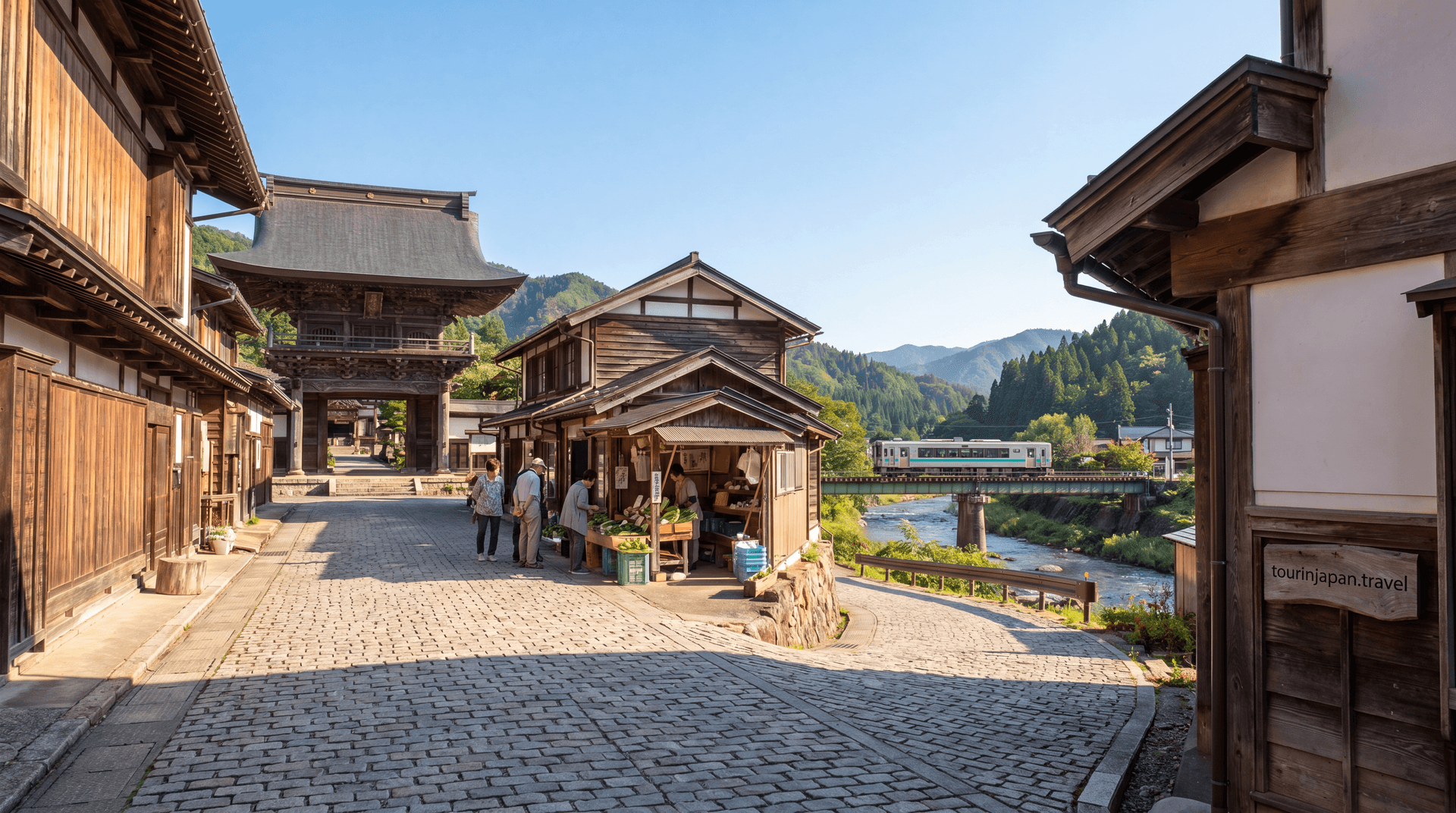
Tohoku Region Guide: Six Prefectures, Zero Crowds
By Tour in Japan editors · Updated
Tohoku's six northern prefectures offer ancient temples, wild coasts, and world-class festivals with almost none of the crowds found further south.
The Tohoku region is Japan without the crowds: six prefectures of mountains, coastlines, onsen towns, and ancient temples spread across the northern third of Honshu. Tohoku travel remains genuinely underexplored despite its extraordinary range of destinations. You will find samurai castle towns, cliff-hanging Buddhist temples, some of Japan's most celebrated summer festivals, and hot spring villages buried in forest that look unchanged from the Edo period. The region is accessible on the Tohoku Shinkansen from Tokyo in as little as one hour to Sendai, and two hours forty minutes to the northern end at Shin-Aomori.
Miyagi: Matsushima and Sendai
Sendai, Tohoku's largest city, makes the best regional base. It is large enough for good food and hotels, small enough to feel navigable. The Tanabata festival in early August draws three million visitors to streets hung with enormous paper streamers, and the autumn Pageant of Starlight illuminates the city's famous zelkova-lined boulevard. Twenty minutes away by train, Matsushima Bay contains 260 pine-covered islands that Edo-era poet Matsuo Basho famously found too beautiful for words. The bay cruise costs 1,500 yen and takes fifty minutes.
Zuigan-ji Temple at Matsushima is one of Tohoku's finest Zen temples, founded in 828 and rebuilt in its current form in 1609 by Date Masamune, the one-eyed samurai lord who ruled Miyagi. Admission is 700 yen. The cave corridors carved into the cliff beside the main gate are unusually atmospheric.
Iwate: Hiraizumi and Geibikei Gorge
Hiraizumi was the capital of a twelfth-century Buddhist civilization that rivaled Kyoto in wealth and ambition. Its ruins are now a UNESCO World Heritage Site. Chuson-ji Temple contains the Konjiki-do, a golden hall completely sheathed in gold leaf and lacquer, one of the most breathtaking interior spaces in Japan. Entry to the hall is 1,000 yen. Motsu-ji Temple preserves the finest Heian-era paradise garden in the country, though the buildings are long gone.
Geibikei Gorge, reachable from Ichinoseki, offers a two-kilometer flat-bottomed boat ride through sheer limestone cliffs. The boatman punts using a long pole, singing traditional folk songs. Costs 1,800 yen round trip. This is one of the quietest and most beautiful excursions in all of Tohoku.
Aomori: Nebuta Festival, Hirosaki, and Osorezan
Aomori hosts the Nebuta Matsuri every August 2 to 7, arguably Tohoku's most spectacular festival. Enormous illuminated floats depicting warriors from mythology parade through the streets while thousands of haneto dancers in traditional costume accompany them with rhythmic chanting. Hirosaki, in western Aomori, has the finest original castle keep in northern Honshu and cherry blossom celebrations ranked among Japan's best. Mount Osorezan, sacred to the spirits of the dead, sits on a volcanic caldera smelling of sulfur with a temple at its center that sees summer pilgrims seeking communication with deceased relatives.
- Akita: Kakunodate samurai district with cherry-lined river and preserved clan houses, free to walk
- Akita Kanto Festival (early August): performers balance bamboo poles hung with 46 paper lanterns on forehead, chin, and shoulder
- Yamagata: Ginzan Onsen, a historic hot spring village accessible only by mountain road, ryokan from 15,000 yen per person
- Yamagata: Yamadera temple complex on a mountain face, 1,015 stone steps to the summit, 300 yen entry
- Fukushima: Ura-Bandai highlands with volcanic lakes in vivid shades of blue and green, best visited September to October
- JR East Pass (Tohoku area): 20,000 yen for 5 days, covers all Tohoku shinkansen and local lines
- Best season: late summer for festivals (July to August) or autumn foliage (mid-October to November)
Plan at least five days for a Tohoku circuit. A recommended route: Sendai and Matsushima (2 nights), Hiraizumi day trip, Yamagata or Ginzan Onsen (1 night), Aomori (2 nights) including Hirosaki. The Tohoku Shinkansen connects most major cities; local JR lines and rental cars fill the gaps. Tohoku rewards slow travel most of all.
Stay Connected in Japan
Yesim eSIMs work on arrival — no physical SIM needed. Japan data plans from $5.