
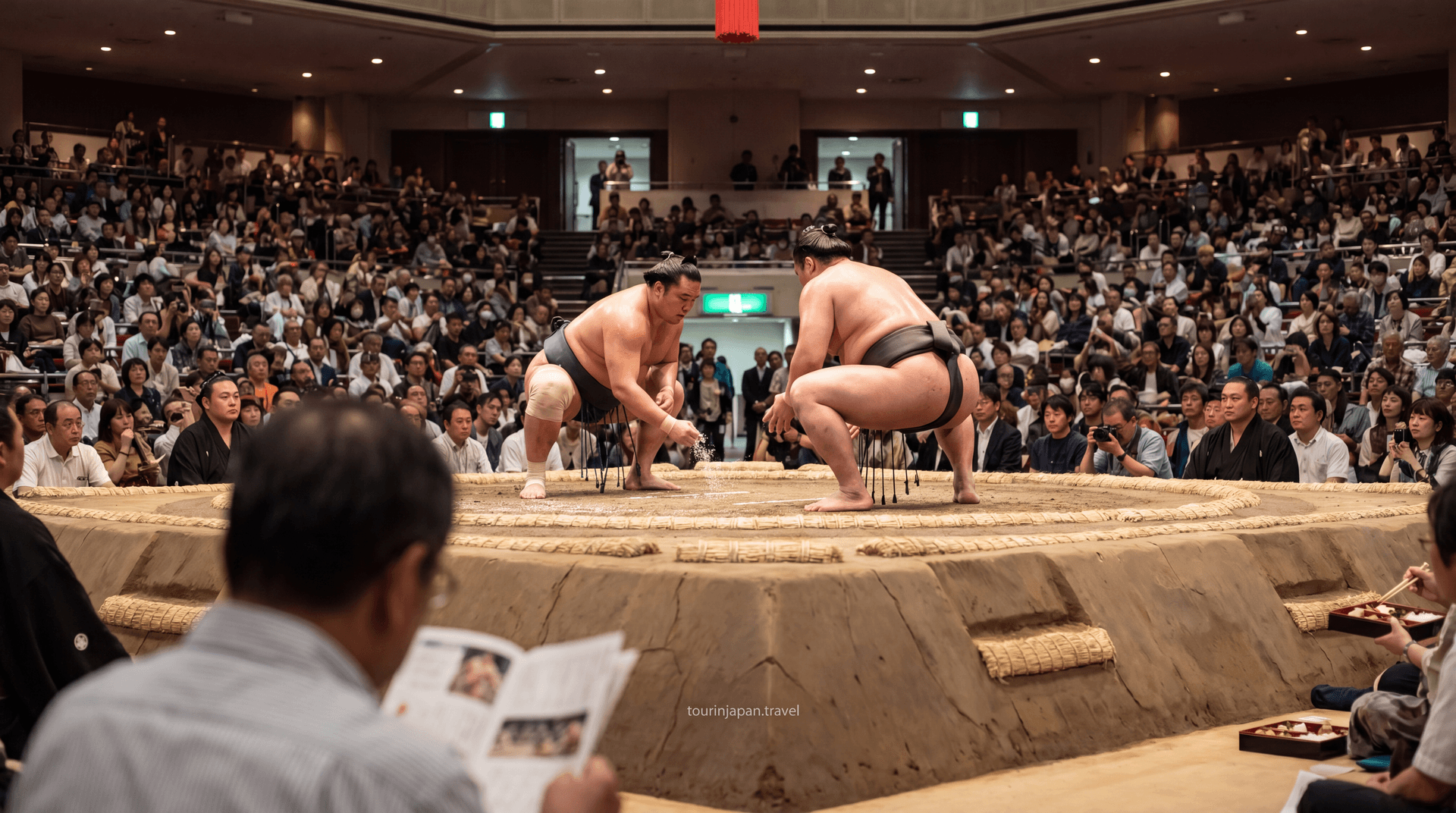
Sumo Wrestling in Japan: How to Watch, Where to Buy Tickets, What to Expect
By Tour in Japan editors · Updated
Sumo (相撲 / sumō) is Japan's national sport — a ancient wrestling tradition dating back over 1,500 years. Watching a live sumo tournament (本場所 / honbasho) is one of the most unforgettable experiences in Japan. The power, ritual, and pageantry of sumo is unlike anything else in sport.
Understanding Sumo
The Basics
- Objective: Force your opponent out of the ring (土俵 / dohyō) or touch the ground with anything other than the soles of your feet
- Ring: 4.55m diameter circular clay platform
- Match duration: Typically 10–30 seconds (but can last minutes)
- Weight: Wrestlers range from 100–200+ kg (220–440 lbs)
The Ritual
Each bout follows a strict ritual:
- Salt throwing — wrestlers throw salt to purify the ring
- Stomping — leg lifts to drive away evil spirits
- Eye contact — wrestlers stare each other down
- Final preparation — adjusting mawashi (belt)
- Bout — explosive collision
Rikishi (力士) — Sumo Wrestlers
| Rank | Japanese | Number | Significance |
|---|---|---|---|
| Yokozuna (横綱) | Grand Champion | 1–2 | Highest rank, cannot be demoted |
| Ōzeki (大関) | Champion | 2–3 | Second highest |
| Sekiwake (関脇) | Junior Champion | 2–3 | Third rank |
| Komusubi (小結) | Top of lower division | 2–3 | Fourth rank |
| Makuuchi (幕内) | Top division | 42 | Professional wrestlers |
| Jūryo (十両) | Second division | 28 | Semi-professional |
| Makushita (幕下) | Third division | 120 | Up-and-coming |
| Sandanme (三段目) | Fourth division | 200 | Lower ranks |
| Jonidan (序二段) | Fifth division | 200+ | Beginner professionals |
| Jonokuchi (序ノ口) | Lowest division | 200+ | Newest wrestlers |
Tournament Schedule
Six Annual Tournaments (本場所)
| Tournament | Location | Dates | Duration |
|---|---|---|---|
| Spring (春場所) | Ryōgoku, Tokyo | Mid-January | 15 days |
| Summer (夏場所) | Ryōgoku, Tokyo | Mid-May | 15 days |
| Autumn (秋場所) | Ryōgoku, Tokyo | Mid-September | 15 days |
| Winter (冬場所) | Ryōgoku, Tokyo | Mid-November | 15 days |
| March (三月場所) | Osaka | Mid-March | 14 days |
| September (九月場所) | Nagoya | Mid-July | 14 days |
Daily Schedule
| Time | Event |
|---|---|
| 8:00 AM | Doors open, lower division bouts begin |
| 8:00–2:00 PM | Lower division matches (Jonokuchi → Makushita) |
| 2:00–3:00 PM | Juryo matches |
| 3:00–4:00 PM | Top division (Makuuchi) warm-ups |
| 3:40 PM | Yokozuna ring-entering ceremony |
| 4:00–6:00 PM | Top division matches |
| ~6:00 PM | Emperor's Cup ceremony (final day) |
Best time to arrive: 3:00–4:00 PM for the main attractions Full day: 8:00 AM – 6:00 PM
Seating Guide
seating Types
| Section | Price Range | View | Notes |
|---|---|---|---|
| Masu-seki (枡席) | ¥4,000–¥12,000 | Excellent | Box seats, 4 people, floor cushions |
| Tamari-seki (溜まり席) | ¥14,000–¥20,000 | Front row | Right at ringside, splashed with salt |
| Isu-seki (椅子席) | ¥3,000–¥5,000 | Good | Chair seats, 2nd floor |
| Free seats (自由席) | ¥2,500–¥4,500 | Decent | 2nd floor, no assigned seat |
| Box seats (上段) | ¥10,000–¥15,000 | Good | Upper level box seats |
Recommended for First-Timers
- Isu-seki (chair seats): Best value, comfortable view
- Masu-seki (box seats): Traditional experience, split cost with friends
- Avoid: Free seats if possible — they're far and hard to see
Buying Tickets
When to Buy
- General sale: One month before tournament starts
- Popular dates: Sell out within hours (opening day, weekends, final day)
- Weekdays: Easier to get, less expensive
Where to Buy
| Method | Details | Tips |
|---|---|---|
| Ticket Pia (チケットぴあ) | pia.co.jp | Most common, requires Japanese phone number |
| Lawson Ticket | l-tike.com | Similar to Ticket Pia |
| Sumo Association | sumo.or.jp | Official site, limited online sales |
| Foreign buyer services | BuySumoTickets.com, etc. | More expensive but easier |
| Day-of tickets | Box office at Ryōgoku | Last resort, often sold out |
Price Example (15-day tournament)
- Weekday: ¥3,500–¥8,000
- Weekend: ¥5,000–¥15,000
- Opening/Final day: ¥8,000–¥25,000
- Ringside: ¥14,000–¥20,000 (any day)
Where to Watch Sumo
Ryōgoku Kokugikan (両国国技館)
The main sumo arena in Tokyo
| Feature | Details |
|---|---|
| Location | Ryōgoku, Tokyo |
| Capacity | 11,000 |
| Tournaments | January, May, September, November |
| Getting there | JR Sobu Line to Ryōgoku Station (1 min walk) |
Osaka (Edion Arena Osaka)
| Feature | Details |
|---|---|
| Location | Namba, Osaka |
| Tournament | March |
| Capacity | 8,000 |
Nagoya (Dolphins Arena)
| Feature | Details |
|---|---|
| Location | Nakamura, Nagoya |
| Tournament | July |
| Capacity | 10,000 |
Year-Round Sumo Experiences
Practice Sessions (稽古 / Keiko)
Watch wrestlers train at stables (部屋 / heya) — often more intense than tournament bouts.
| Stable | Location | Schedule | Cost | Notes |
|---|---|---|---|---|
| Arashio (荒汐) | Ryōgoku | Morning | Free | Watch from window |
| Kokonoe (九重) | Ryōgoku | Morning | Free | Famous stable |
| Dewanoumi (出羽海) | Ryōgoku | Morning | Free | Historic stable |
| Miyagino (宮城野) | Ryōgoku | Morning | Free | Hakurozan's stable |
Best time: 7:30–10:00 AM Etiquette: Be quiet, don't take photos (unless permitted), bow when entering
Sumo Museum (相撲博物館)
- Location: Inside Ryōgoku Kokugikan
- Cost: Free
- Hours: 10 AM–4:30 PM (tournament days)
- Highlights: History, masks, photos, Emperor's Cup
Sumo Stables Tour
Some stables offer guided tours for foreigners:
- Cost: ¥3,000–¥5,000
- Duration: 2–3 hours
- Includes: Watch practice, meet wrestlers, Q&A
- Book: Through tour operators or hotels
Sumo Etiquette
Do's
- ✅ Clap when wrestlers touch hands — signals the start
- ✅ Stay seated during bouts — don't block views
- ✅ Eat and drink — it's part of the experience
- ✅ Cheer — shout wrestler names, it's encouraged
- ✅ Bow when entering — if sitting near the ring
Don'ts
- ❌ Don't take photos with flash — distracts wrestlers
- ❌ Don't stand during bouts — blocks views
- ❌ Don't throw objects — only salt is thrown
- ❌ Don't be late for final bouts — they're the main event
- ❌ Don't leave early — the last bout is the most exciting
Sumo Food
Bento Boxes at the Arena
Sumo tournaments have their own food culture:
| Item | Price | Description |
|---|---|---|
| Sumo bento | ¥1,500–¥3,000 | Traditional boxed lunch |
| Chankonabe (ちゃんこ鍋) | ¥1,500–¥2,500 | Wrestler's hot pot stew |
| Soba/udon | ¥800–¥1,200 | Noodle bowls |
| Beer/sake | ¥500–¥800 | Drinks |
| Sweets | ¥300–¥500 | Matcha, mochi |
Chankonabe (ちゃんこ鍋)
The hearty stew that sumo wrestlers eat to gain weight. Available at restaurants near Ryōgoku:
- Chankonabe Kawasaki — famous restaurant
- Chankonabe Narutaki — popular with tourists
- Budget: ¥2,000–¥4,000 per person
Budget Summary
| Category | Budget | Mid-range | Premium |
|---|---|---|---|
| Ticket | ¥3,500 | ¥8,000 | ¥20,000 |
| Transport | ¥500 | ¥1,000 | ¥3,000 |
| Food | ¥1,500 | ¥3,000 | ¥5,000 |
| Souvenirs | ¥500 | ¥2,000 | ¥5,000 |
| Total | ¥6,000 | ¥14,000 | ¥33,000 |
Tips for First-Timers
- Go on a weekday — cheaper and less crowded
- Arrive by 3 PM — catch the top division matches
- Buy a tournament program — ¥200, has all the info
- Try chankonabe — it's delicious and filling
- Watch the salt throwing — it's mesmerizing
- Learn a wrestler's name — cheer for them specifically
- Stay for the final bout — it's the most exciting
- Visit a stable — see the real training
Japanese Phrases
| Japanese | Pronunciation | Meaning |
|---|---|---|
| 相撲を見に来ました | Sumō wo mi ni kimashita | "I came to watch sumo" |
| おすすめの力士は? | Osusume no rikishi wa? | "Which wrestler do you recommend?" |
| 今日の一番は? | Kyō no ichiban wa? | "What's the main bout today?" |
| お茶ください | O-cha kudasai | "Tea, please" (at arena) |
| ごちそうさまでした | Gochisōsama deshita | "Thank you for the meal" |
Related Articles
Stay Connected in Japan
Yesim eSIMs work on arrival — no physical SIM needed. Japan data plans from $5.