
88 Temple Pilgrimage of Shikoku: The Complete First-Timer Guide
By Tour in Japan editors · Updated
The Shikoku Ohenro pilgrimage is one of Japan's great spiritual journeys. This first-timer guide covers routes, costs, how long it takes, and what to expect on Japan's famous 1,200 km circuit.
The 88 Temple Pilgrimage of Shikoku — known as the Ohenro or simply The Pilgrimage — is one of the great religious walks of the world, a 1,200-kilometer circuit of the four prefectures of Shikoku island visiting 88 temples associated with the Buddhist saint Kobo Daishi (Kukai), the 9th-century founder of Shingon Buddhism who is said to accompany every pilgrim throughout the journey. The walking version takes 30-60 days and draws thousands of pilgrims annually, from deeply devout Japanese Buddhists to foreign trekkers seeking challenge and cultural immersion on a route that has been walked continuously for over 1,200 years.
What Makes the Shikoku Pilgrimage Unique
Unlike the Kumano Kodo or the Camino de Santiago, the Ohenro is not a linear route to a single destination but a circuit of an entire island, beginning and ending at Temple 1 (Ryozen-ji) in Tokushima Prefecture. The 88 temples represent different stages of Buddhist awakening — temples 1-23 in Tokushima are the zone of Spiritual Awakening (Hosshin), 24-39 in Kochi are Discipline (Gudo), 40-65 in Ehime are Enlightenment (Bodai), and 66-88 in Kagawa are Nirvana (Nehan). Most pilgrims complete the circuit in one direction — counterclockwise is considered auspicious.
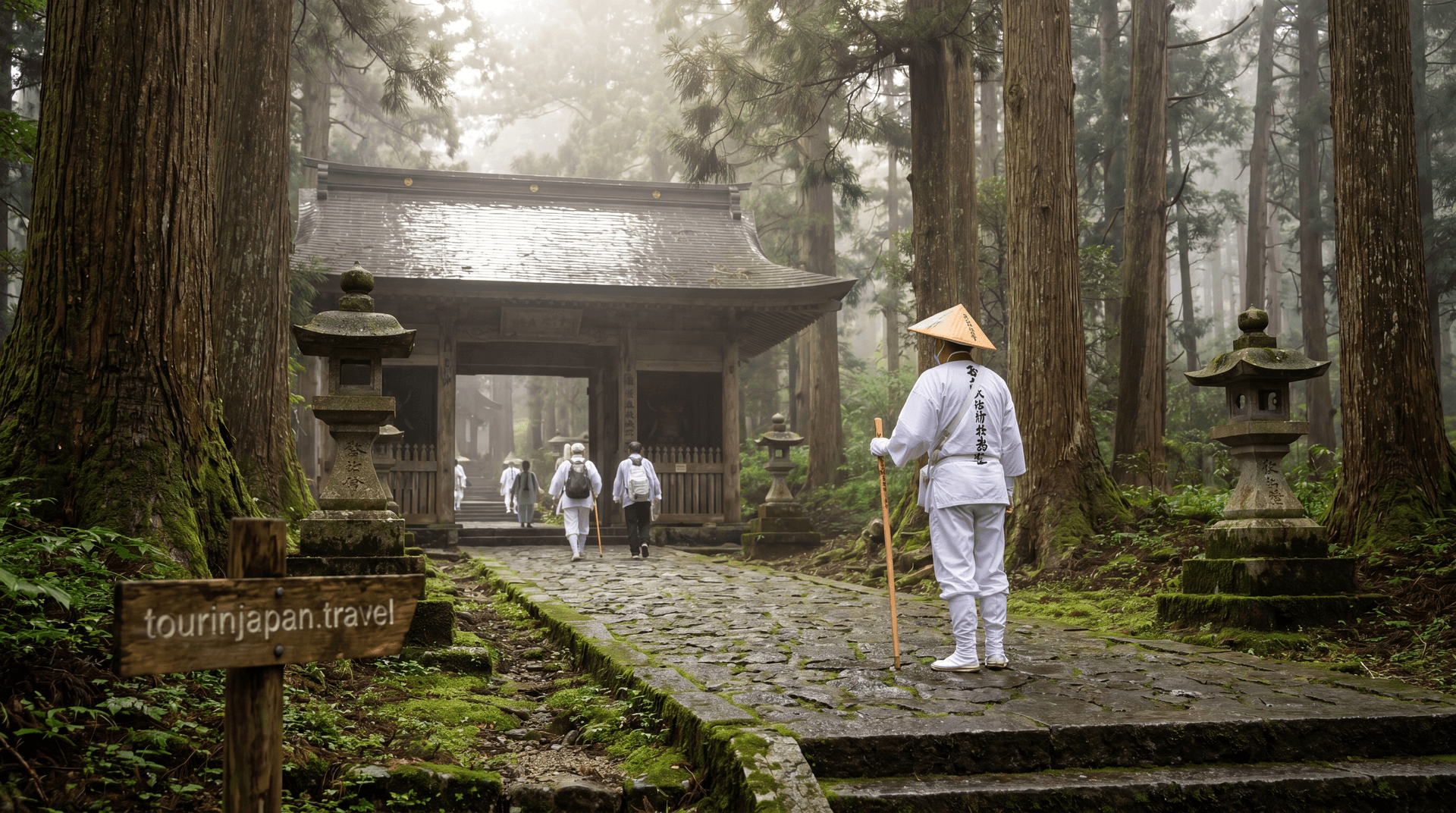
The concept of osettai — gifts of food, money, or accommodation given freely to pilgrims by local residents — is unique to the Ohenro and creates a social contract of generosity that has persisted for centuries. Accepting osettai graciously is considered important; refusing is considered rude. Pilgrims in the white vest (hakui) and sedge hat are recognized symbols of the route and often receive small gifts of rice balls, fruit, or coins from strangers.
Methods of Travel and Time Required
Walking the complete circuit takes 35-60 days depending on daily distance and physical condition. The daily average for a walker is 20-30 kilometers, with considerable variation as some days between temples involve long flat stretches while others cross mountain passes. Many pilgrims do the route in segments over multiple years, and this is entirely acceptable — there is no requirement to complete it consecutively. Cycling takes 10-15 days; a bus tour covers the circuit in 10-12 days.
Practical planning details for the Ohenro
- Best seasons: March-May (mild weather, plum blossoms) and September-November (cool, autumn foliage); avoid July-August heat and humidity
- Accommodation: henro lodges (zenkonyado) charge 0-1,000 yen; pilgrim lodges (henro no ie) charge 5,000-8,000 yen with meals; business hotels are available in cities
- Budget: walkers should expect 3,000-6,000 yen per day including accommodation, meals, and temple offerings
- Essential gear: white vest (hakui, 1,500 yen), sedge hat (kasa, 3,000 yen), wooden staff (shakujo, 1,000 yen), temple book (nokyocho, 2,000 yen) for collecting calligraphy stamps at each temple
- Temple offering: 1-5 yen at each temple is traditional; 300-500 yen to have temple book stamped at each temple
- Access to Shikoku: fly to Tokushima, Kochi, Matsuyama, or Takamatsu; or take Shinkansen to Okayama and cross via the Seto Ohashi bridge by train
- English resources: Ohenro-san website and David Turkington's guidebook are the best English-language planning resources
Starting Shorter: The Best First Temple Segments
For first-timers or those with limited time, a 5-7 day walk covering Temples 1-12 in Tokushima gives a complete introduction to the pilgrimage culture without committing to the full circuit. This section is the most heavily walked, has the most henro infrastructure, and passes through the most accessible landscape of rice paddies and small towns between the temples. You can then take a bus or train back to Tokushima City and fly home, with the option to continue from Temple 12 on a future trip.
The Shikoku Ohenro is ultimately about something difficult to explain in a travel guide — a meditative rhythm of walking that changes how you see Japan, and perhaps yourself. Many pilgrims report that the act of dressing in white each morning, hefting the staff, and walking through rain and mountain mist toward the next temple becomes meaningful in a way that begins in the body and gradually extends elsewhere. It is one of the great journeys available to any traveler willing to put on their boots and begin.
Stay Connected in Japan
Yesim eSIMs work on arrival — no physical SIM needed. Japan data plans from $5.