
Sendai City Guide: Tanabata, Date Masamune, and Gyutan Beef Tongue
By Tour in Japan editors · Updated
Sendai, the largest city in Tohoku, blends samurai heritage from the one-eyed warlord Date Masamune with Japan's most spectacular Tanabata festival and the city's signature grilled beef tongue cuisine.
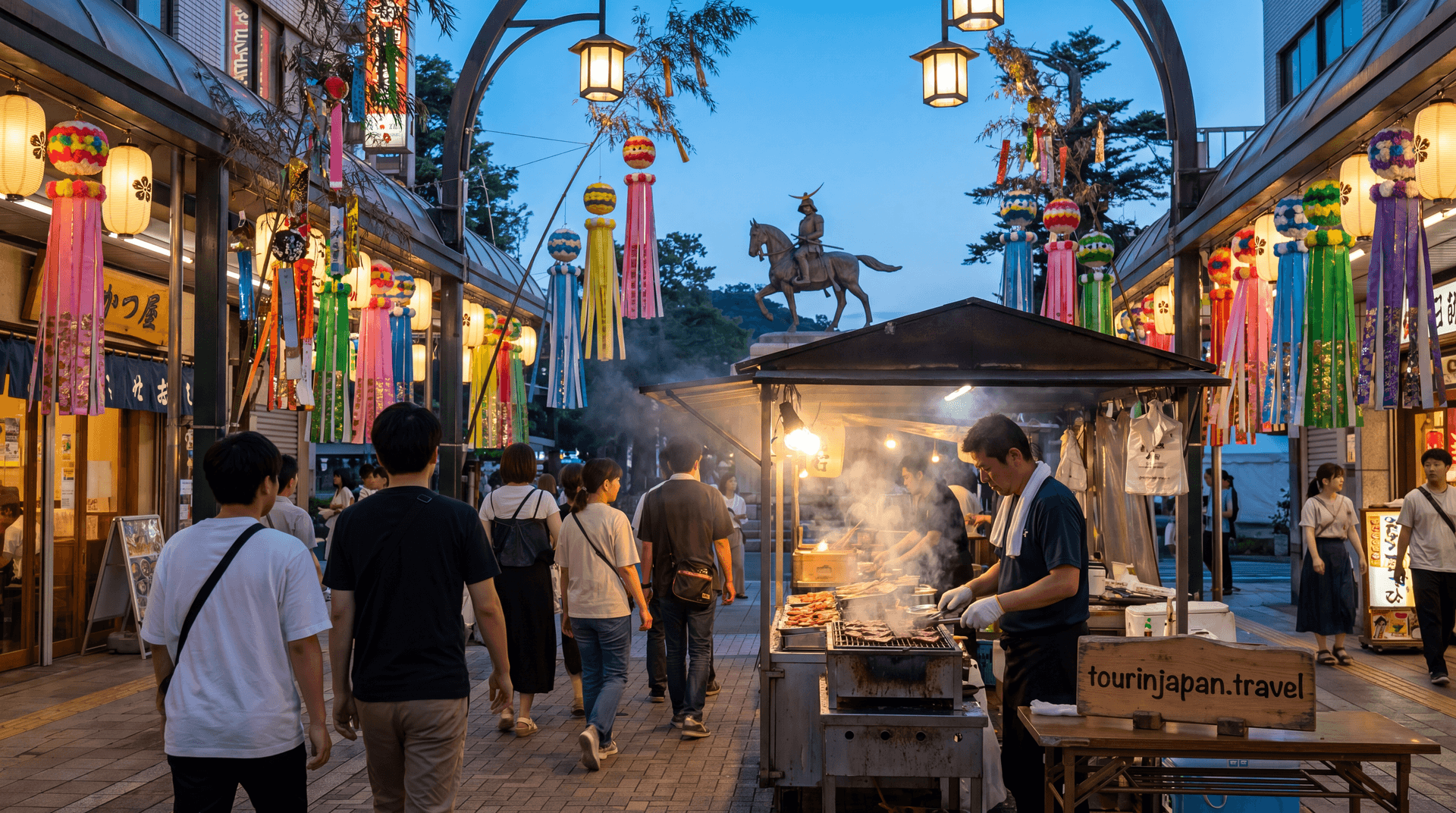
Sendai is the largest city in Japan's Tohoku region and one of the country's most livable cities, known as the City of Trees for the zelkova-lined boulevards running through its center. The Sendai city experience is shaped by one dominant historical figure: Date Masamune, the 16th-century warlord who unified northern Japan under his crescent-moon helmet and whose castle ruins still overlook the city from Aoba Hill. Sendai is equally known for the Tanabata Matsuri in August, where millions of colorful paper streamers hang from bamboo poles along the covered Ichibancho shopping arcade in the most elaborate celebration of the star festival held anywhere in Japan, and for gyutan, thick-sliced grilled beef tongue that Sendai has elevated to a regional cuisine worth traveling for. Sendai is also the entry point for Matsushima Bay, ranked among Japan's three most scenic views.
Aoba Castle Ruins and Date Masamune
Sendai Castle (Aoba-jo) sits on a forested hilltop above the Hirose River with commanding views over the city and toward Matsushima Bay on clear days. The castle was demolished by order of the Meiji government in 1882, but the stone walls, gates, and the iconic bronze equestrian statue of Date Masamune remain, alongside a good museum (700 yen) about the Date clan's rule over northern Japan. Zuihoden Mausoleum, a 20-minute walk from the castle hill, is the burial site of Masamune and his successors. The 1637 mausoleum was rebuilt in 1979 in the Momoyama style with lacquer, gold leaf, and vivid color that surprises visitors expecting Zen minimalism. Entry costs 570 yen.
Gyutan: Sendai's Grilled Beef Tongue Specialty
Gyutan was invented in Sendai in 1948 by Keishiro Sano, who developed the technique of slicing beef tongue thick, marinating it overnight in salt and sake, and grilling it over charcoal until charred on the outside but chewy and flavorful within. The standard set meal, gyutan teishoku, includes four or five thick slices of tongue, barley rice, oxtail soup, and pickled vegetables for 1,800-2,500 yen. The concentrated gyutan restaurant district near Sendai Station includes Rikyu, Tasuke, and Kisuke among the most respected shops, all with queues at lunch. The oxtail soup accompanying every set is a slow-cooked richness that contrasts beautifully with the charred tongue.
Matsushima Bay and Tanabata Festival
Matsushima Bay, 40 minutes from Sendai by train, contains 260 pine-covered islands scattered across calm water that the poet Basho declared one of Japan's three great scenic views. Boat cruises (1,500 yen) loop through the bay for 50 minutes. Zuigan-ji temple on the shore is a Zen temple with elaborately carved caves and a main hall decorated with gold leaf panels by Kano school artists, entry 700 yen. The Tanabata Matsuri (August 6-8) transforms the Ichibancho arcade with handmade paper streamers up to 5 meters long suspended from bamboo poles, creating an unforgettable corridor of color and movement.
- Getting there: 90-min Shinkansen from Tokyo (Hayabusa or Yamabiko, 11,190 yen unreserved)
- Getting around: Loople Sendai tourist bus loops all main sights for 260 yen per ride or 620 yen day pass
- Osaki Hachimangu Shrine: Tohoku's most ornate shrine, a national treasure with black and gold lacquer architecture
- Sendai Mediatheque: Toyo Ito's glass building is a landmark of contemporary Japanese architecture (free entry)
- Yamadera day trip: cliff-side temple 75 min by train, 1,015 stone steps lead to mountain views
- Akiu Onsen: hot spring town 30 min by bus from Sendai, traditional ryokans with dinner courses
- Zelkova avenue cherry blossoms: late March to mid-April the city center turns pink
- Accommodation: central hotels from 7,000 yen/night; good options near Sendai Station for early Shinkansen departures
Sendai works well as a one or two-night stop on a Tohoku itinerary or as a Shinkansen day trip from Tokyo. The city is frequently overlooked in favor of Kyoto and Osaka but offers a genuinely different side of Japan: robust, historically rich, and proud of its local culture in a way that feels refreshingly unperformed.
Stay Connected in Japan
Yesim eSIMs work on arrival — no physical SIM needed. Japan data plans from $5.