
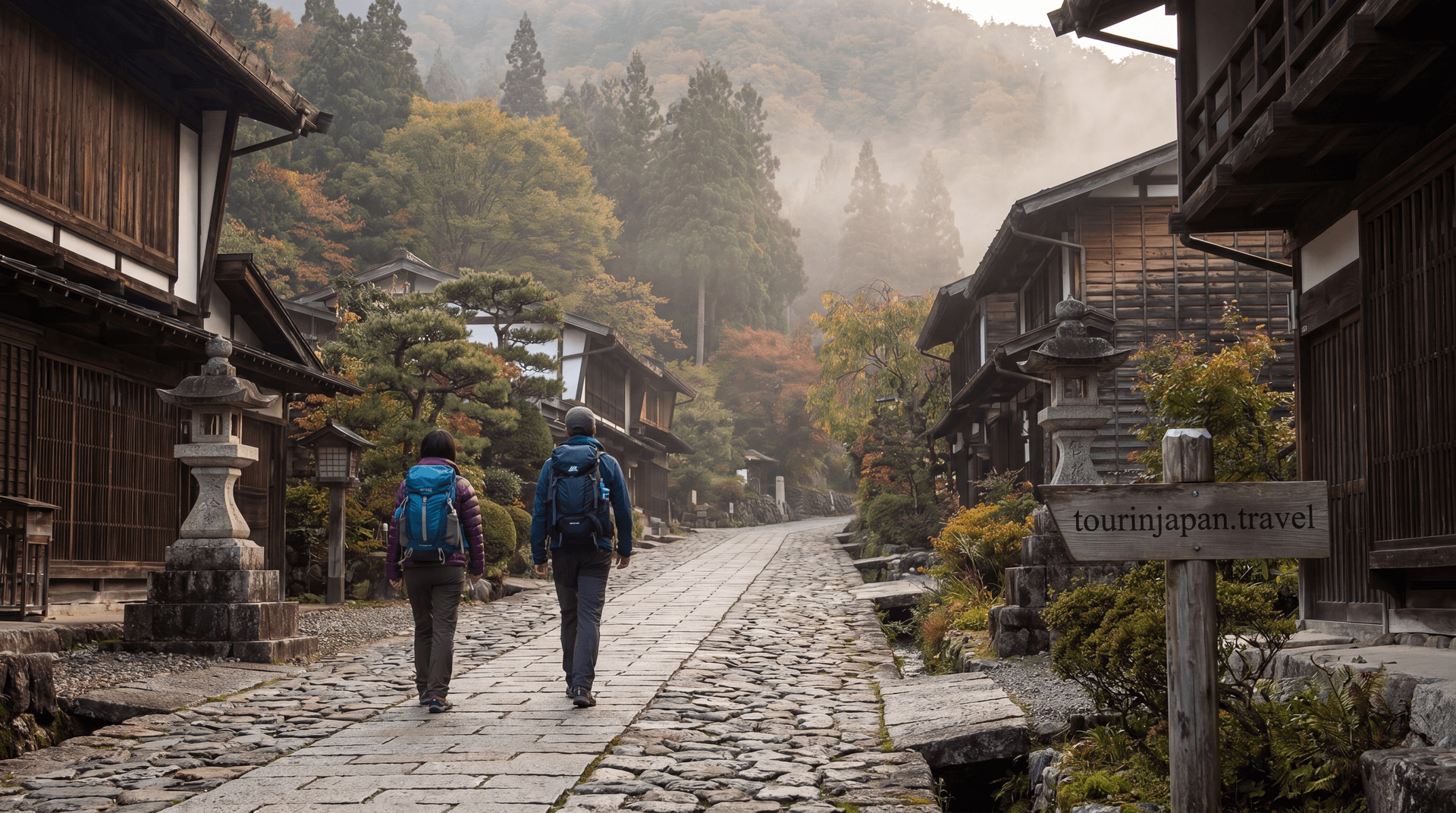
Nakasendo Trail: Walking Japan's Ancient Samurai Highway
By Tour in Japan editors · Updated
The Nakasendo linked Edo to Kyoto for 500 years. Walk the best-preserved section between Magome and Tsumago for an unforgettable glimpse of Edo-era Japan.
The Nakasendo trail was one of Japan's five great highways of the Edo period, running 534 kilometers between Edo (present-day Tokyo) and Kyoto through the mountains of central Honshu. Today the most celebrated and walkable section passes through the Kiso Valley in Nagano Prefecture, where the post towns of Magome and Tsumago survive in near-perfect preservation — no power lines, no concrete buildings, no obvious signs of modernity — making an 8-kilometer walk between them feel like stepping directly into the 18th century.
Magome: The Southern Gateway
Magome post town sits at 800 meters on a steep hillside, its main street of preserved machiya (wooden merchant houses) dropping in stone-paved steps toward the valley. The buildings now house inns, buckwheat noodle restaurants, and souvenir shops selling kiso lacquerware and woodblock prints. Magome is the former home town of novelist Shimazaki Toson, whose work documented Meiji-era Japan, and a small museum in town houses his manuscripts.
Tsumago: The Perfectly Preserved Town
Tsumago, in Nagano's Nagiso Town, was one of the first places in Japan to establish a formal preservation agreement — residents agreed in 1968 not to sell, destroy, or alter historic buildings, and the national government backed the initiative with a restoration program. The result is Japan's most complete Edo-era streetscape. Photography along the main street is exceptional at any hour, but dawn light on the dark timber facades before the tour buses arrive is particularly magical.
The Walk Between the Towns
The 8-kilometer walk from Magome to Tsumago takes 2.5-3 hours at a relaxed pace and is almost entirely on the historic stone-paved or gravel path, with minimal road walking. The route climbs through cedar forest to Magome Pass (801 meters), then descends past waterfalls, farmhouses, and rice paddies to Tsumago. The path is well-signed in English. Most walkers start at Magome (slightly higher elevation, making the walk predominantly downhill) and take the bus back to Nagiso or Nagoya from Tsumago.
Essential information for the Magome-Tsumago walk
- Access to Magome: Local bus from Nakatsugawa Station (15 min, 530 yen); Nakatsugawa is on the JR Chuo Line from Nagoya (35 min) or from Matsumoto
- Access from Tsumago: Bus to Nagiso Station (10 min, 270 yen); JR Chuo Line to Nagoya or back toward Matsumoto
- Luggage forwarding: available between Magome and Tsumago tourist offices (500 yen per bag); operates late March to late November, 8:30 AM-11:30 AM drop-off window
- Best season: April-May (spring fresh green), September-November (autumn foliage), or winter snow for atmospheric photography
- Overnight stay: strongly recommended in either town — Tsumago and Magome empty completely after day-trippers leave by 4 PM
- Minshuku rates: from 9,000-15,000 yen per person with dinner (often includes local mountain vegetable dishes and soba)
Extending the Walk: Beyond the Famous Section
Experienced walkers can continue north from Tsumago through Nojiri and Midono to Nagiso, adding another 9 kilometers. Further north, the post towns of Narai and Kiso-Fukushima are worth a day each — Narai in particular has a preserved 1-kilometer main street and makes a logical overnight stop for walkers doing multi-day sections. The full Kiso Valley section of the Nakasendo from Shiojiri to Nakatsugawa covers about 80 kilometers through 11 post towns and takes 4-5 days.
Stay Connected in Japan
Yesim eSIMs work on arrival — no physical SIM needed. Japan data plans from $5.