
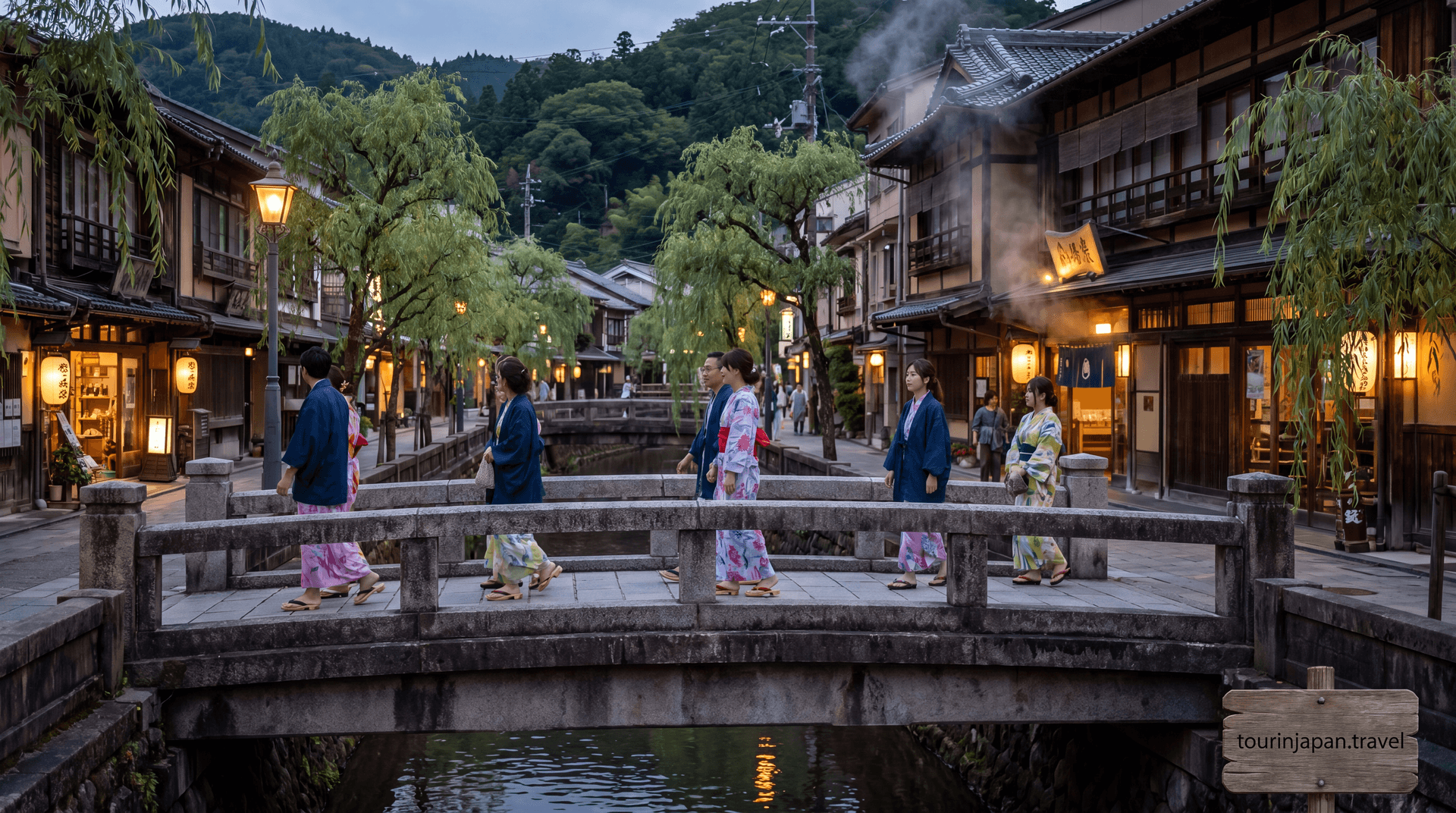
Kinosaki Onsen: Seven Baths, One Town, One Yukata
By Tour in Japan editors · Updated
Kinosaki Onsen is Japan's most charming bath-hopping village. Walk between seven distinct bathhouses in a provided yukata — here's how to plan the perfect visit.
Kinosaki Onsen in Hyogo Prefecture has perfected a concept that most hot spring towns only approximate: guests arrive at any inn, change into a provided yukata and wooden geta sandals, and spend their evenings walking between seven distinct public bathhouses scattered along a willow-lined canal. There are no private bath fights, no upselling, no queuing for a single overcrowded facility — just the rhythmic clatter of geta on stone, the hiss of steam, and the simple pleasure of bathing somewhere different every hour.
The Seven Bathhouses
Each of Kinosaki's seven soto-yu (outer baths) has its own architectural character, water temperature, and legendary virtue. An inn-issued bath pass allows entry to all seven; day visitors can purchase a 1,200 yen all-seven pass at any bathhouse entrance. The seven baths are Sato-no-Yu (the newest and largest, with a Roman bath and open-air bath), Gosho-no-Yu (the grandest exterior, red lanterns and imperial garden theme), Mandara-yu (the most artistic interior), Jizo-yu (the most traditional, fronted by stone jizo statues), Ichi-no-Yu (cave bath, cut into a rocky cliff face), Yanagi-yu (the most intimate, in a small historic building), and Kouno-yu (the most rustic, said to be where a wounded white stork first bathed to heal its leg — the origin myth of Kinosaki's springs).
The Kinosaki Hot Spring Water
All seven bathhouses draw from the same sodium chloride-calcium source, at around 42-44 degrees Celsius. The water is clear, mildly salty, and has a warming quality that persists for hours after bathing — particularly pleasant in cold weather. Because all seven baths share the same source, the bathing experience is about atmosphere, architecture, and ritual rather than mineral variety.
The town was immortalized by the writer Shiga Naoya, who wrote his 1917 short story At Kinosaki while convalescing here. Literary tourism around the story remains part of the town's identity, and a small Shiga Naoya museum is near the main canal.
Practical details for visiting Kinosaki
- Access: 2.5 hrs from Osaka by Kinosaki limited express; 3 hrs from Kyoto; Kinosaki Onsen is the last stop on the JR Sanin Line
- Size: the town is tiny — all seven bathhouses are within 15 minutes' walk of one another
- Closure day: each bathhouse is closed one day per week on a rotating schedule — check the current schedule at your inn
- Crab season: November through March brings matsuba crab (snow crab) from the Japan Sea — a delicacy served at all major ryokan
- Recommended stay: one to two nights — enough to visit all seven baths and experience evening and morning at different times
- Ryokan prices: from 12,000 yen per person (meals included); crab dinner plans significantly more, from 25,000 yen
- Baggage delivery: most inns accept luggage before check-in time, allowing early afternoon bath-hopping
Combining Kinosaki with Nearby Attractions
Kinosaki is well-positioned for a Kansai coastal extension. Amanohashidate, one of Japan's three scenic views — a pine-covered sandbar across Miyazu Bay — is 30 minutes by train. Tottori Sand Dunes are 90 minutes east. Himeji Castle, Japan's most complete feudal castle, is 90 minutes south by limited express. A logical multi-day loop from Osaka or Kyoto visits Kinosaki for two nights, then takes the scenic San-in Coast route east to Amanohashidate before returning to Kyoto.
Stay Connected in Japan
Yesim eSIMs work on arrival — no physical SIM needed. Japan data plans from $5.