
Kanazawa Food Guide: Seafood, Gold Leaf, and Market Food
By Tour in Japan editors · Updated
Kanazawa is Japan's hidden food capital — a city that rivals Kyoto in culinary tradition but receives a fraction of the visitors. Here's what to eat.
Kanazawa is one of Japan's great undervisited food destinations. Facing the Sea of Japan on the Noto Peninsula coast, the city receives some of the most diverse seasonal seafood in the country — crab in winter, sweet shrimp in spring, yellowtail and squid in autumn — and has a culinary tradition shaped by 400 years as the seat of the powerful Maeda clan, whose wealth allowed for sophisticated cuisine that has passed down intact. Kanazawa food often appears in lists of Japan's top three food cities alongside Osaka and Tokyo.
Omicho Market: The Kitchen of Kanazawa
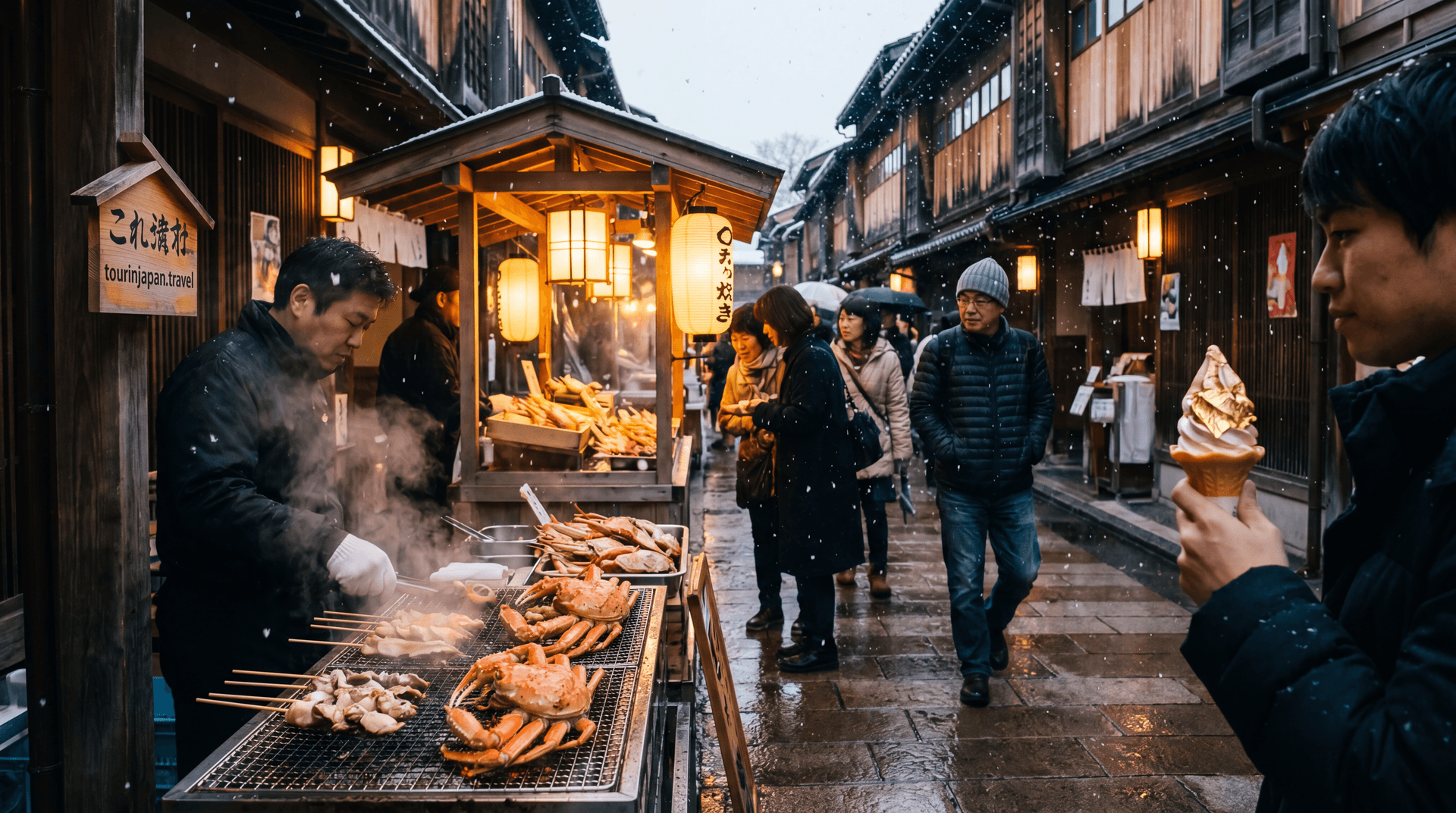
Omicho Market (Omicho Ichiba) has operated near central Kanazawa since the 1700s and remains the city's principal fresh food market. Over 200 stalls and small shops sell seafood, vegetables, pickles, and prepared foods. The most famous product is jibuni — a Kanazawa stew made with duck or chicken and fu (wheat gluten), thickened with starch in a style unique to the city. But the market is most vivid in winter, when tanks of live snow crab, red king crab, and the beloved kano-gani (female snow crab loaded with rich orange roe) fill every fish stall.
Restaurants within and around the market serve kaisendon (seafood rice bowls) at prices considerably lower than equivalent quality in Tokyo. A bowl piled with amaebi (sweet shrimp), crab, and local fish can be had for 1,800-3,000 yen at market-adjacent restaurants.
Gold Leaf, Wagashi Sweets, and Sake
Kanazawa produces 99% of Japan's gold leaf, and food culture has embraced it extravagantly. Gold leaf soft serve ice cream (about 800 yen) is sold at the Higashi Chaya teahouse district. Hakuichi, the city's famous gold leaf manufacturer, sells gold leaf-covered mochi and gold leaf matcha chocolate from its showroom near Higashi Chaya. It is touristic but genuinely delicious. The wagashi (traditional confectionery) tradition in Kanazawa is also exceptional — the Kenroku-en area has several craft confectionery shops producing seasonal sweets that rival Kyoto's best.
Kanazawa food and drink highlights
- Jibuni: Kanazawa's signature stew of duck, fu, shiitake, and vegetables in thick dashi sauce — a must-order at traditional restaurants
- Amaebi (sweet shrimp): raw sweet shrimp from the Sea of Japan, smaller than tropical prawns but intensely sweet, best at Omicho Market
- Kano-gani: female snow crab with rich roe, available November to January — one of Japan's great seasonal delicacies
- Gold leaf soft serve: at Higashi Chaya district, visually dramatic and genuinely good vanilla ice cream with edible gold
- Kanazawa sake: the Noto Peninsula has a strong brewing tradition; Fukumitsuya near Omicho Market offers tastings and tours
- Wagashi at Morihachi or Murakami: Kanazawa's oldest confectionery shops, making seasonal sweets using local ingredients for over 300 years
- Noto salt: the Noto Peninsula produces mineral-rich sea salt used in local cooking; sold at Omicho Market as a premium ingredient
Kanazawa became significantly more accessible after the Hokuriku Shinkansen opened in March 2015, connecting it to Tokyo in about 2.5 hours (12,000-14,000 yen on the Kagayaki express). A 2-3 night visit comfortably covers Kenroku-en garden, the samurai and teahouse districts, Omicho Market, and a serious restaurant meal. The city is less crowded than Kyoto year-round and the cultural experience is comparable in depth — a pairing that makes it one of Japan's most rewarding stops for food-focused travelers.
Stay Connected in Japan
Yesim eSIMs work on arrival — no physical SIM needed. Japan data plans from $5.