
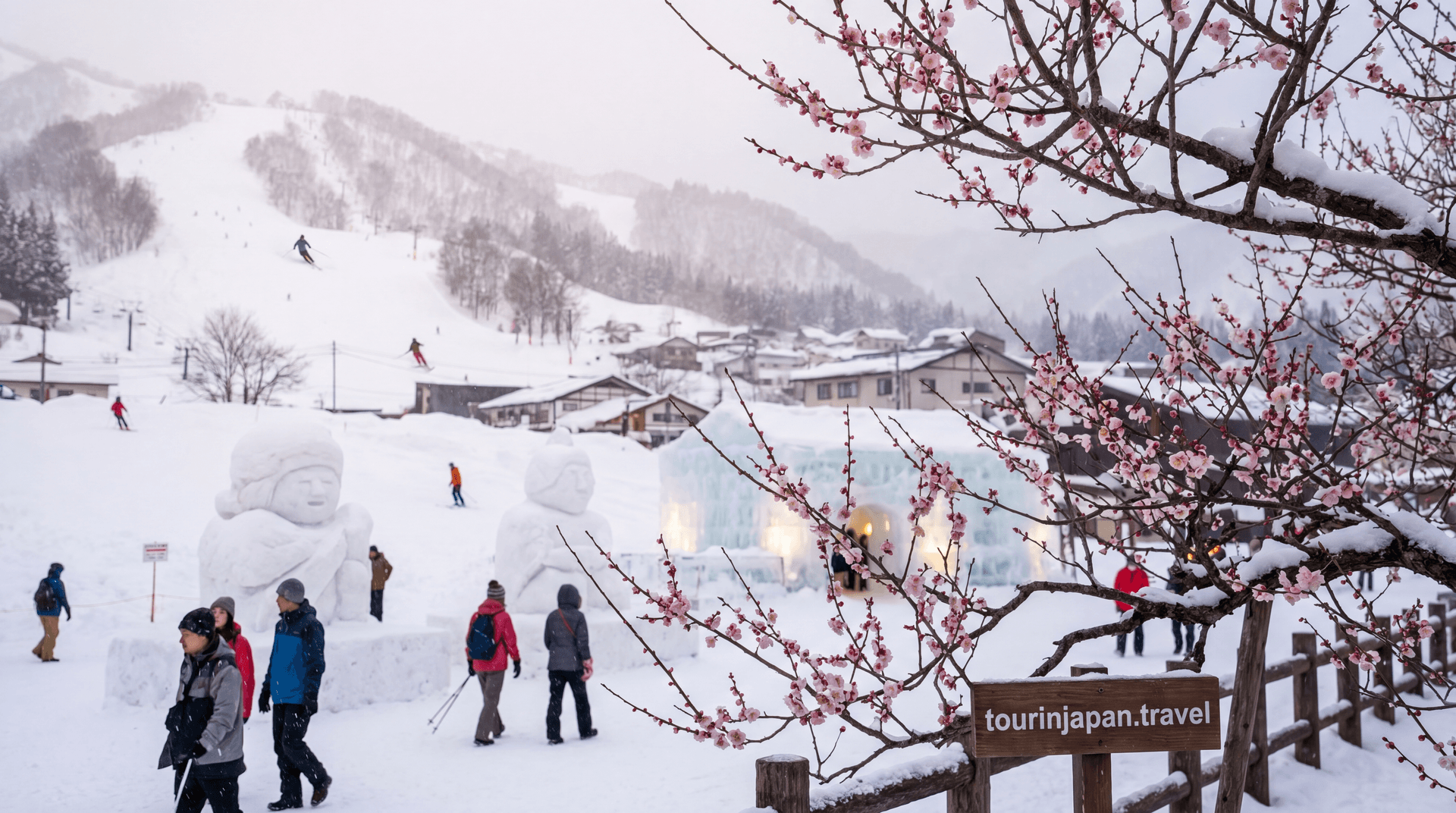
Japan in February: Plum Blossoms, Ski Season Peak, and Sapporo Festival
By Tour in Japan editors · Updated
February brings Japan's plum blossom season, the Sapporo Snow Festival, and the deepest powder skiing of the year — all with remarkably thin tourist crowds.
Japan in February rewards travelers who don't mind cold weather with some of the country's most distinctive seasonal experiences. While cherry blossoms get all the global attention, the plum blossoms that precede them in late January through March have a subtler beauty and a sweet fragrance that cherry blossoms lack. Plum blossom viewing, known as kanko, takes place at dedicated plum groves across Japan that are far less crowded than cherry blossom spots. Meanwhile, the Sapporo Snow Festival draws two million visitors to Hokkaido for its incredible ice and snow sculptures, and ski resorts across northern Japan are running at their deepest powder season. February is a genuinely excellent month to visit Japan if you are prepared for the cold.
Plum Blossom Viewing: Japan's Quieter Spring Preview
Japan has over 800 varieties of plum tree, and the blossoms appear in shades ranging from pure white to deep crimson. Unlike cherry blossoms, plums bloom while the trees are still bare of leaves, creating a spare, elegant aesthetic that aligns perfectly with Japanese wabi-sabi sensibility. Atami Plum Garden in Shizuoka, one of Japan's oldest plum viewing sites, hosts over 472 trees across a hillside overlooking Sagami Bay and typically peaks in late January to mid-February. Admission costs 500 yen.
Korakuen Garden in Okayama and Kenrokuen in Kanazawa both have famous plum groves within their grounds. In Tokyo, Yushima Tenjin shrine holds its plum festival from late January through early March, and the small shrine garden with several hundred plum trees becomes a genuinely lovely spot despite the central Tokyo location. The shrine is dedicated to scholarship and the plum is associated with the deity Tenjin, so the combination feels culturally authentic rather than tourist-staged.
Sapporo Snow Festival
The Sapporo Snow Festival, held in early February across three main venues in Sapporo, is one of Japan's most popular winter events. The Odori Park site features enormous snow sculptures up to 25 meters high depicting famous buildings, anime characters, and abstract designs. The Susukino site focuses on ice sculptures that glow at night under colored lights. The festival runs for about a week and admission to the main outdoor venues is free. Book flights and accommodation in Sapporo at least three months in advance for festival dates as the entire city fills up.
Combine the Snow Festival with a visit to Otaru, a 40-minute train ride from Sapporo. This former herring fishing port has a romantic canal district lined with converted warehouses, and the Otaru Snow Light Path event held in parallel with the Sapporo festival fills the canal and hillside alleys with hundreds of snow lanterns lit at dusk.
February Skiing and Powder Season
February is statistically the best month for powder skiing in Japan. Niseko averages around 600mm of snowfall in February alone, and the cold, dry air produces a snow quality that is hard to find anywhere else in the world. Resorts at Furano, Rusutsu, and Tomamu in Hokkaido are all excellent alternatives with fewer international visitors than Niseko. In Honshu, Hakuba has hosted international ski competitions and offers 10 ski resorts connected by shuttle bus, making it the largest ski area in Japan outside Hokkaido.
February in Japan: Planning Essentials
- Sapporo Snow Festival: usually runs first or second week of February
- Plum blossoms: Atami peaks late January to mid-February; Tokyo peaks late February to early March
- Setsubun bean-throwing festival at shrines nationwide on or around February 3rd
- Valentine's Day in Japan: women give chocolate to men; White Day (March 14) is the reciprocal
- Average February temperatures: Tokyo 1-9C, Sapporo -8 to -1C, Kyoto 0-9C
- Ski resorts in full operation; Niseko and Hakuba at peak powder condition
- February is off-peak for city sightseeing; hotel prices in Tokyo and Kyoto remain low
- Yuki-mi, snow viewing, at temple gardens in Kanazawa and Kyoto can be arranged at top ryokan
February's combination of cultural events, winter scenery, and skiing makes it a compelling month that most visitors overlook in favor of the more famous spring and autumn seasons. The tradeoff is simple: fewer crowds, lower prices, and a Japan that feels more genuinely lived-in and less touristic. If you can handle cold and dress for it properly, February delivers experiences that rival any other time of year.
Stay Connected in Japan
Yesim eSIMs work on arrival — no physical SIM needed. Japan data plans from $5.