
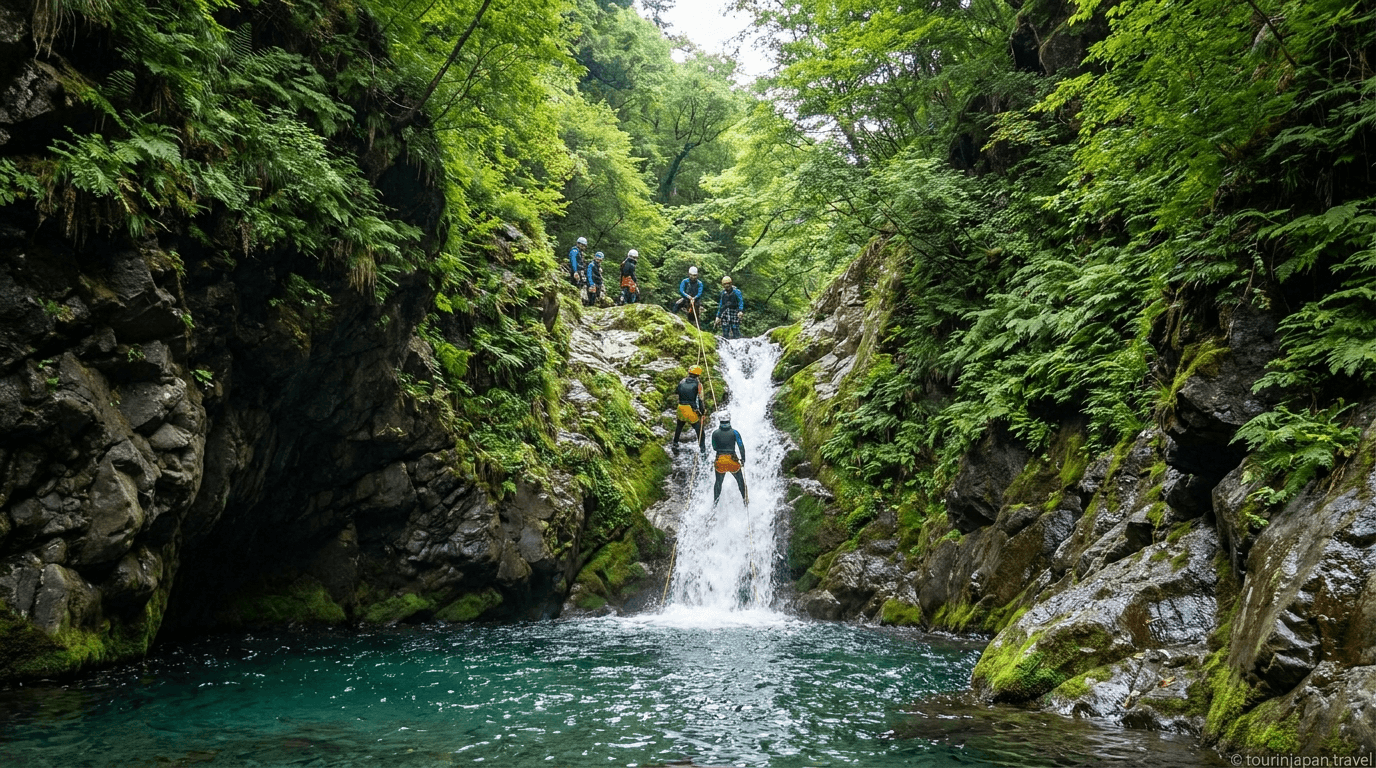
Canyoning in Japan: Gorge Walking and Waterfall Rappelling
A guide to canyoning in Japan, covering Minakami, Nikko, Nametoko Gorge and Oboke, with what to wear and how to get there.
Affiliate link — we may earn a commission at no extra cost to you. Affiliate disclosure
Canyoning in Japan: Gorge Walking and Waterfall Rappelling
Canyoning (キャニオニング) — also called canyoneering or gorge walking — is one of Japan's most exciting outdoor activities. You swim, scramble, leap and climb along rocky crevices carved by alpine water, sliding down natural chutes and dropping into pools below waterfalls. Put simply, it is whitewater rafting without the raft: you move through a rocky canyon in a wetsuit, and the sport has only been established in Japan for around 20 years (JNTO).
What is Canyoning?
Canyoning means travelling through a gorge under your own steam, using whatever the terrain demands:
Technique | What it involves |
|---|---|
Walking and scrambling | Following the riverbed and climbing over rocks |
Swimming | Crossing pools at the foot of waterfalls |
Sliding | Riding natural rock chutes and water slides |
Jumping | Leaping into deep pools |
Rappelling | Descending a waterfall on a rope |
Your guide sets the route and decides which slides and jumps are open on the day.
Where to Go Canyoning in Japan
Minakami, Gunma
Minakami, in the mountains of northern Gunma, is the premier destination for the sport in Japan and has even been called the biggest canyoning destination in the world. The onsen town sits inside Joshin'etsukogen National Park (JNTO), and the Tone River running through the valley supplies the whitewater — in April, as the snow melts, it consistently produces grade four rapids (JNTO).
The best-known operator here is Canyons, Japan's longest-running canyoning company and the country's original pioneer of the sport, which has been running tours since 1998. It was founded by a New Zealander with a quarter of a century of experience, and its base is at 45 Yubiso, Minakami-machi, Tone-gun, Gunma. Tours last around three hours or more, the line-up includes a snow canyoning tour in winter, and rafting on the Tone River runs from April to October. Pickup by bus is available from Jomo-Kogen Station (JNTO).
To get there, take the Joetsu Shinkansen from Tokyo Station to Jomo-Kogen Station (about 75 minutes), then a bus to Minakami Station (25 minutes). By local train, the JR Takasaki Line reaches Takasaki in two hours, where you transfer to the JR Joetsu Line for the hour-long run to Minakami Station; a Japan Rail Pass covers the JR legs. English-speaking guides are available for most tours and activities in the area, which is also set up for rafting, canoeing and bungee jumping (JNTO).
Nikko and Kinugawa Onsen, Tochigi
Nikko's canyoning runs on the Kinugawa River, where you slide down natural chutes on the rock face, swim in pools at the foot of waterfalls and ride over smaller falls. Guides and safety equipment are provided, and the courses suit all levels. The meeting point is a five-minute walk from Kinugawa-Onsen Station, and the season runs from mid-April to mid-November; operators include NAOC, Nikko Nasu Outdoor Service and e-rafting (Nikko Official Guide).
A standard half-day course with Nikko Jumbo takes about three hours 30 minutes, is open to junior high school students and older, and has English-speaking guides. It runs in spring (March to May), summer (June to August) and autumn (September to November) (JNTO National Parks).
Nikko is about two hours from Tokyo by train (Nikko Official Guide), and the JR TOKYO Wide Pass covers JR East lines plus the Tobu limited express through services to Tobu-nikko and Kinugawa-onsen (JR East). It pairs easily with a day at Nikko's World Heritage shrines and temples.
Nametoko Gorge, Ehime
In Ashizuri-Uwakai National Park in southwest Shikoku, erosion has left Nametoko Gorge with a smooth riverbed of stone pipelines, canyons and slides. The highlight is a 40-metre natural stone waterslide and a jump into Yukiwa Falls. A full-day guided tour runs about six and a half hours and a half-day about three; all safety equipment is supplied and your guide teaches you how to move through the canyon safely (JNTO).
One operator, Forest Canyon Inc., lists availability from late April to October and requires participants to be fit and at least 130 cm tall (JNTO).
Oboke and Koboke, Tokushima
The V-shaped gorges of Oboke and Koboke, on the Yoshino River in the mountains of Tokushima, are prime whitewater rafting, canyoning and kayaking territory, and hosted the World Rafting Championship in 2017. Oboke is the usual starting point for full-day and half-day trips, and outfitters cater for a range of abilities. From Tokushima Station, limited express trains on the JR Tokushima Dosan Line reach Koboke in about 2 hours 10 minutes and Oboke in about 1 hour 50 minutes via Awa Ikeda; limited expresses between Okayama and Kochi also stop at Oboke hourly, and buses from Awa Ikeda take 40 minutes, with four departures a day (JNTO).
What to Wear and Bring
Operators supply the safety kit, typically a wetsuit, helmet and buoyancy aid, and will tell you what else you need — confirm what is included when you book.
Bring:
- Swimsuit — worn under the wetsuit
- Towel and a change of clothes — you will get wet
- Waterproof camera if you want photographs
- Water — canyoning is thirsty work
Leave behind:
- Jewellery — it can catch or be lost
- Valuables — use a locker if one is available
- Cotton clothing — it stays cold when wet
Safety Tips
Before you go
- Choose a reputable operator and ask what qualifications the guides hold.
- Be honest about your ability — tell the operator your experience level.
- Check the weather — heavy rain makes canyons dangerous.
- Tell someone your plans for the day.
- Check your travel insurance covers adventure activities.
During the activity
- Listen to your guide — they know the canyon.
- Never jump blindly — check the depth first, and jump feet first.
- Stay with the group.
- Speak up if you are uncomfortable; guides can usually find another way down.
- Keep moving — water in Japanese gorges stays cold even in summer.
After the activity
- Change into dry clothes quickly.
- Drink something warm.
- Check for cuts and bruises — rock scrapes are common.
- Rest — canyoning is physically demanding.
Booking a Tour
Most operators publish English-language websites and take bookings online; accommodation and local tourist information centres can often point you to the right company. Book ahead for summer weekends and holiday periods.
When you book, ask:
- Where the meeting point is and how to reach it
- What equipment is included and what you need to bring
- What happens if the weather turns — ask the operator directly about their policy rather than assuming
- Whether the guide speaks English
When to Go
Canyoning in Japan is primarily a summer activity, and the water stays cold enough that a wetsuit is standard kit. Seasons vary by destination: Nikko runs from spring into autumn, Kinugawa Onsen from mid-April to mid-November, and Nametoko Gorge from late April to October. Minakami is the exception to the summer rule, with a snow canyoning tour in winter alongside its Tone River rafting season from April to October. Check the operator's current season before you plan around it.
What It Costs
Course | Price as published |
|---|---|
Nikko standard half-day, Nikko Jumbo (junior high school age and older) | Adults from ¥9,500 (JNTO) |
Nametoko Gorge full-day | Adults from ¥10,500; children 18 and under from ¥8,500 (JNTO) |
Nametoko Gorge half-day | Adults from ¥7,000; children 18 and under from ¥5,000 (JNTO) |
At Nametoko, Forest Canyon Inc. adds ¥500 at weekends and public holidays and gives groups of 10 to 50 a ¥1,000 discount per person (JNTO).
These are the rates published by the Japan National Tourism Organization, which does not state the year they apply to. Confirm the live price with the operator before you book, and budget separately for transport, food and accommodation.
Tips for First-Timers
- Start with a beginner course — even if you are fit.
- Trust the gear — wetsuits float and helmets protect.
- Jump feet first until you know the water depth.
- Listen to your guide — they have done this many times before.
- Warm up afterwards — cold water is the main discomfort, not the jumps.
- Bring a waterproof camera if you want to remember it.
- Combine with an onsen — Minakami, Kinugawa and Oboke all have hot springs nearby.
- Book in advance — popular summer weekends fill up.
Japanese Phrases
Japanese | Pronunciation | Meaning |
|---|---|---|
キャニオニングをしたいです | Kyanioningu wo shitai desu | Saying you would like to go canyoning |
初心者コースはありますか? | Shoshinsha kōsu wa arimasu ka? | Asking whether there is a beginner course |
危険ですか? | Kiken desu ka? | Asking whether it is dangerous |
写真を撮ってもいいですか? | Shashin wo tottemo ii desu ka? | Asking whether photography is allowed |
ありがとうございます | Arigatō gozaimasu | Thank you |
Related Articles
Ready to explore Japan?
Browse tours and activities, or tell us what you're looking for and we'll suggest the best options.
Stay Connected in Japan
Airalo eSIMs work on arrival — no physical SIM needed. Data plans from $5 for 7 days.
Travel Insurance for Japan
Medical, trip cancellation, and adventure sports covered. Plans from $1.5/day.