
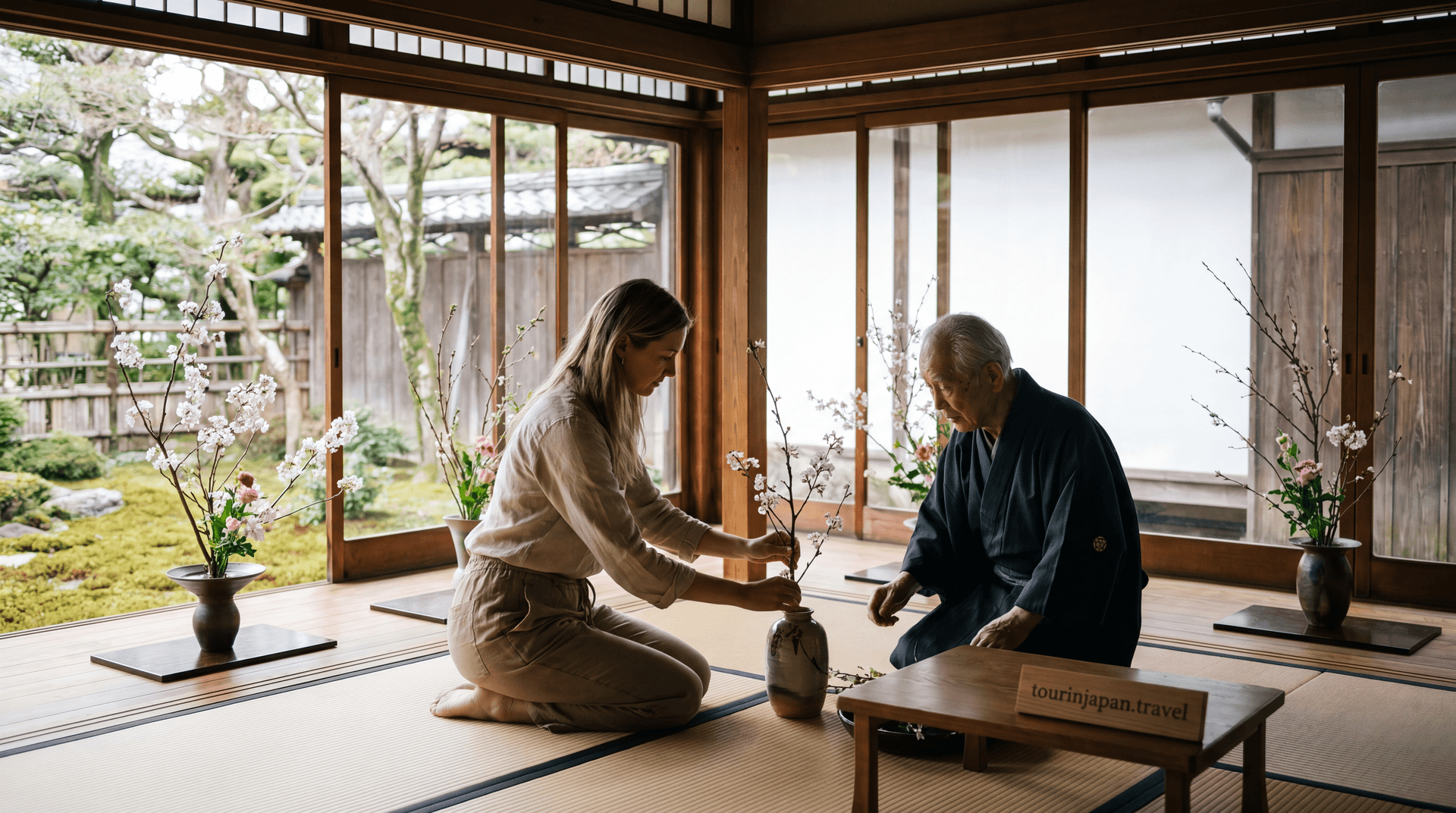
Ikebana Flower Arranging: Workshops and Schools for Visitors
By Tour in Japan editors · Updated
Ikebana is Japan's art of flower arranging — minimalist, asymmetrical, and deeply philosophical. Workshops for visitors are available across Japan. Here is how to find the best ones.
Ikebana — Japanese flower arrangement — looks nothing like Western floristry, and this gap is the key to understanding what makes it extraordinary. Where Western flower arranging tends toward abundance, symmetry, and decorative fullness, ikebana embraces emptiness, asymmetry, and the expressive power of a single stem. The negative space around the arranged materials is as important as the flowers themselves. Ikebana has roots in the Buddhist practice of offering flowers to the altar, evolving over 600 years into multiple schools with sophisticated philosophical and aesthetic systems. Learning even the basics of ikebana shifts how you see flowers, gardens, and natural forms — which is why the best ikebana workshops in Japan are genuinely transformative experiences rather than simple craft activities.
The Major Ikebana Schools
Ikenobo, founded in Kyoto in the 15th century, is the oldest and most formal ikebana school. Its classical style (rikka) features elaborate arrangements of seven or more elements symbolizing mountains, waterfalls, and the natural landscape. The Ikenobo headquarters at Rokkakudo Temple in Kyoto runs regular workshops for visitors — an exceptional location that combines the history of the school with one of Kyoto's most beautiful small temples.
Sogetsu, founded in Tokyo in 1927 by Sofu Teshigahara, is the most contemporary school — its philosophy that anyone can arrange anything anywhere makes it the most accessible for beginners. Sogetsu accepts non-floral materials, emphasizes personal expression over formula, and has produced some of the most striking avant-garde ikebana. The Sogetsu headquarters in Akasaka, Tokyo runs regular English-language workshops and is the single best place in Japan to learn ikebana for visitors with limited time.
Workshop Options for Visitors
- Sogetsu School (Akasaka, Tokyo): Weekly English-language beginner workshops. 3-hour sessions around 5,000-7,000 yen including materials. One of the best structured visitor experiences in Japan.
- Ikenobo Rokkakudo workshops (Kyoto): In-temple arrangements in a 6th-century temple that doubles as the school's historical headquarters. Advance booking required.
- Oh-hara School (Tokyo and Kyoto): Second-largest school, known for moribana (shallow-container) style. Multiple branches run visitor-accessible workshops.
- Tea ceremony ryokan programs: Several Kyoto ryokan offer ikebana alongside tea ceremony and calligraphy as cultural morning programs for guests.
- Community centers (kominkan): These local facilities sometimes run low-cost ikebana lessons open to anyone. Budget around 500-1,000 yen — very local, very authentic.
What You Will Arrange and Take Home
In a beginner ikebana workshop you will work with seasonal cut flowers and branches provided by the school, inserting them into a kenzan (spiked flower frog embedded in a container) according to the basic principles of the school's foundational form. The three main lines of an ikebana arrangement represent heaven (ten), earth (chi), and humanity (jin) — their relative heights and angles determine the composition's structure. Your instructor will demonstrate the principles with their own arrangement first, then guide you through creating your own.
Most visitors take their finished arrangement home (or back to their hotel room) wrapped in washi paper. The arrangement will last 3 to 5 days with fresh water. The most important thing to bring home is the principle of negative space — the insight that removing material can make a composition stronger is one that applies far beyond flower arranging to cooking, interior design, photography, and daily life. Many visitors find this single lesson in Japanese aesthetics one of the most lasting influences from their entire Japan trip.
Stay Connected in Japan
Yesim eSIMs work on arrival — no physical SIM needed. Japan data plans from $5.