
Harajuku Beyond Takeshita Street: Omotesando, Meiji Shrine, Yoyogi Park
By Tour in Japan editors · Updated
Harajuku is far more than Takeshita Street's candy colours. Omotesando's architecture, Meiji Shrine's forest, and Yoyogi Park's weekends make this Tokyo's most layered neighbourhood.
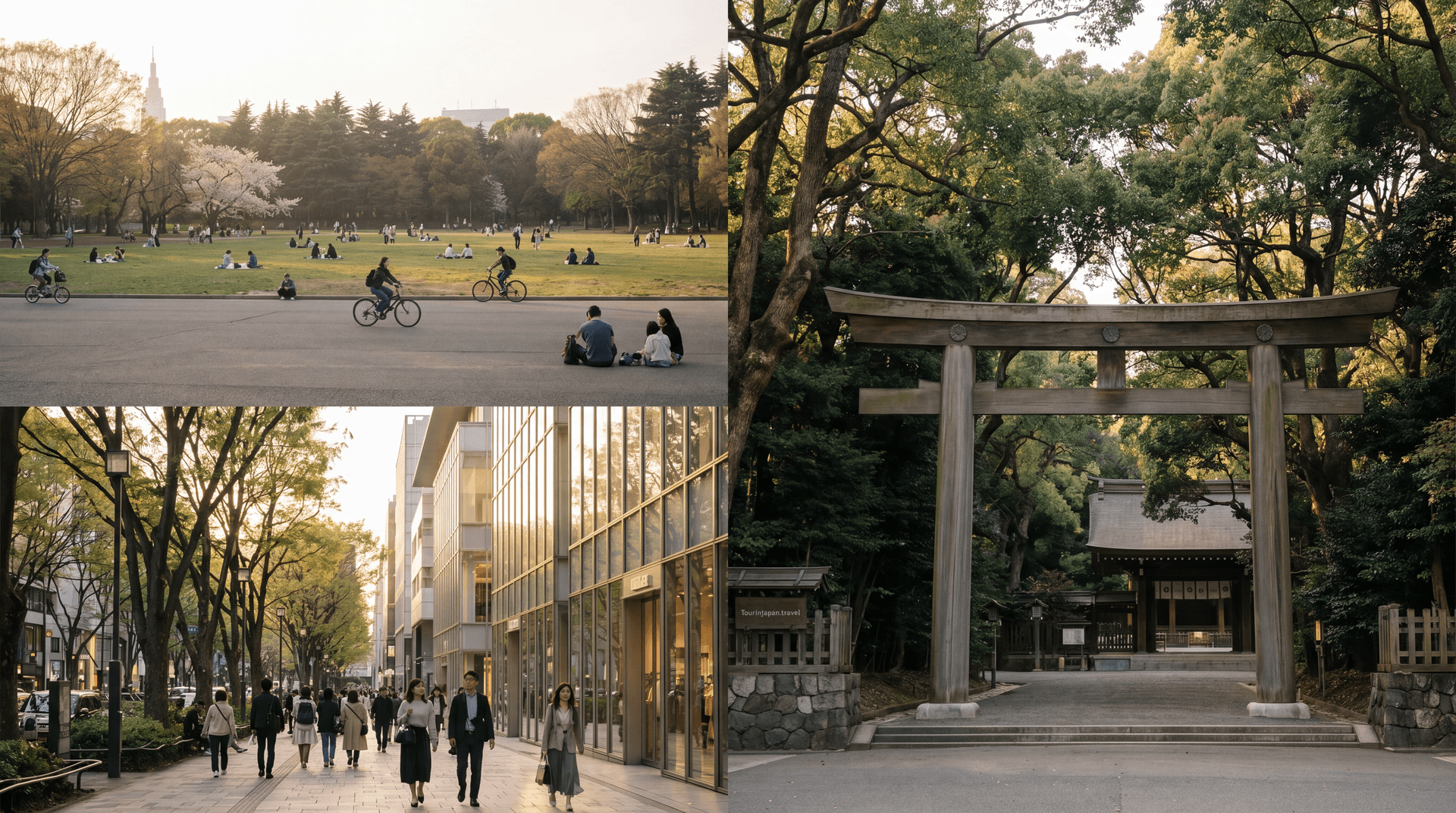
Harajuku has two reputations that contradict each other and are both accurate. The first is Takeshita Street, 350 meters of concentrated youth fashion chaos where crepe shops, candy-coloured accessories, and trend-chasing brands generate enormous crowds in a space barely five meters wide. The second is Omotesando, the avenue that runs parallel to it lined with prize-winning architecture, luxury flagships, and the most photographed zelkova trees in Tokyo. Harajuku Omotesando guide territory also includes Meiji Shrine's 70-hectare forest sanctuary, which exists in impossible proximity to Shibuya's commercial intensity, and Yoyogi Park, where Tokyo performs itself on Sunday afternoons.
Meiji Shrine: Forest in the City
Meiji Shrine was completed in 1920 to enshrine Emperor Meiji, whose reign (1868 to 1912) oversaw Japan's transformation from feudal isolationism to industrial world power. The shrine complex occupies 70 hectares of woodland created by planting 100,000 trees donated from across Japan, a forest that now feels ancient despite being just over a century old. The approach along the wide gravel path flanked by towering trees is one of Tokyo's most meditative urban experiences. Entry is free.
The inner precinct, accessible through the enormous cypress torii gate, opens at sunrise and closes at sunset. Sunday mornings often see traditional Shinto wedding processions pass through the main courtyard. The iris garden within the grounds (open May to June, 500 yen) was Emperor Meiji's favorite spot and contains 150 species. Visit the inner precinct first before Takeshita Street, as the contrast of leaving the forest calm and entering the street's noise is unforgettable.
Omotesando: The Architecture Walk
Omotesando is often called Tokyo's Champs-Elysees but the architecture is more interesting. The boulevard is lined with buildings by some of Japan's and the world's most celebrated architects. Prada's building by Herzog and de Meuron is a crystal lattice that changes character in every light condition. The Omotesando Hills complex by Tadao Ando spirals down into the earth around a central atrium. Dior by SANAA uses a translucent facade that glows at night. Walking the full length of Omotesando, about 800 meters, and examining each building takes an architecture enthusiast ninety minutes.
Yoyogi Park on a Sunday
Yoyogi Park on a Sunday afternoon is a performance without a stage. Rockabilly dancers in full 1950s American gear occupy one corner. African drum circles gather near the central fountain. Families fly kites. Yoga groups stretch in communal silence. The park was the site of the 1964 Tokyo Olympic Games village and covers 54 hectares of lawns, open woodland, and formal gardens. Entry is free.
- Meiji Shrine: free, open sunrise to sunset, allow 45 minutes to 1 hour including the approach
- Takeshita Street: best weekday morning or after 4 PM to avoid peak crowds; crepes from 600 yen
- Omotesando Hills: Tadao Ando-designed mall, basement food hall has excellent Japanese deli
- Tokyu Plaza Omotesando: rooftop terrace with views over the boulevard, free access
- Yoyogi Park: free, open always, Sunday afternoon for maximum local atmosphere
- Urahara backstreets: the lanes between Omotesando and Meiji Shrine have the best independent fashion boutiques
- Getting there: Harajuku Station (JR Yamanote Line) or Meiji-Jingumae Station (Tokyo Metro)
A full day covers the neighborhood well: Meiji Shrine in the morning, Omotesando walk and lunch, Takeshita Street in the afternoon, Yoyogi Park if it is Sunday. Combine with Shibuya, a five-minute walk south from the park, or Daikanyama, fifteen minutes on foot along residential lanes, to build a complete south-west Tokyo day.
Stay Connected in Japan
Yesim eSIMs work on arrival — no physical SIM needed. Japan data plans from $5.