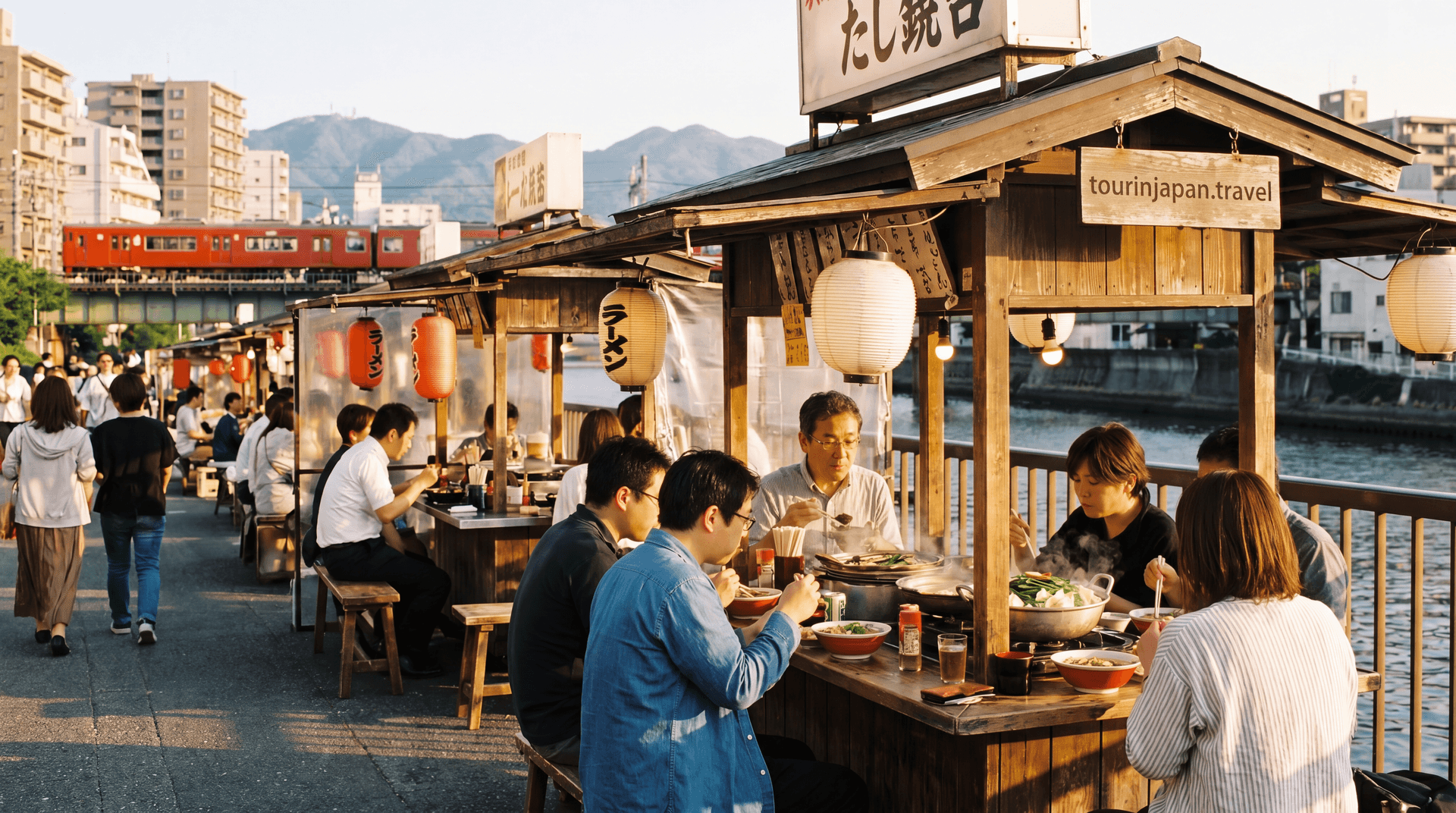
Fukuoka Food Guide: Ramen, Motsu Nabe and Yatai
A guide to Fukuoka's food scene, covering tonkotsu ramen, motsu nabe, mentaiko, yatai stalls in Tenjin and Nakasu, and local dishes such as gyoza and yakitori.
Affiliate link — we may earn a commission at no extra cost to you. Affiliate disclosure
Budget ¥2,000–3,500 (~$13–22) per person for a night at one Fukuoka yatai stall, or ¥4,000–7,000 (~$25–45) for a two- or three-stall crawl. There are about 100 licensed stalls in Nakasu, Tenjin and Nagahama, open from roughly 6 pm to 2 am.
Key facts
- Cost: ¥1,500–3,000 per stall with one drink; a crawl of two or three stalls is ¥4,000–7,000 per person.
- Time needed: Two to three hours for a crawl; 45 minutes for a single bowl of ramen.
- Best season: October to April. Summer stalls are hot and rain closes many of them.
- Book ahead: No reservations at yatai. Restaurants with more than ten seats generally take walk-ins; the famous ones queue.
- Watch out for: Cash. Roughly nine in ten stalls do not take cards.
Why Fukuoka eats differently
Fukuoka is a working port city that never developed the formal dining culture of Kyoto or Tokyo. Hakata, its central district, is built around small counters: ramen shops that serve one bowl and nothing else, standing bars, and the yatai — wheeled food stalls that set up on the pavement after dark and pack away before dawn.
That gives the city a food scene you can walk. Almost everything worth eating in Fukuoka sits within 2 km of Hakata Station or the Nakasu riverbank, and most of it costs less than ¥1,500 a head.
See the Fukuoka destination guide for the non-food half of the trip.
What it costs
Item | Typical price | In USD | Note |
|---|---|---|---|
Hakata ramen, one bowl | ¥800–1,200 | ~$5–8 | Nagahama is the cheapest end, Nakasu the priciest |
Kaedama (noodle refill) | ¥150–200 | ~$1–1.30 | Ordered by saying "kaedama" |
Yakitori skewer | ¥150–300 | ~$1–2 | Two to three bites per skewer |
Hitokuchi gyoza, one plate | ¥500–600 | ~$3–4 | Five to six small dumplings |
Mentaiko tamagoyaki | ¥500–800 | ~$3–5 | Spicy cod roe rolled in omelette |
Oden, per item | ¥100–200 | ~$0.65–1.30 | Daikon, egg, konnyaku |
Draft beer at a yatai | ¥500–600 | ~$3–4 | Most stalls apply a one-drink minimum |
Yatai prices are posted by city rule, so you can read the board before you sit down. Prices above come from current stall and city tourism listings; confirm on the stall's board, which is the version that applies to you.
Where to eat, district by district
Nakasu is the postcard version: 20-odd stalls along the Naka River, the most foreigner-friendly menus, and the highest prices — ¥2,000–3,500 a head. Come here first if it is your first yatai night.
Tenjin is where locals go. Stalls are scattered rather than lined up, prices run ¥1,500–2,500, and the ramen is just as good. It is the easiest district to reach from the subway.
Nagahama is the ramen district. The stalls and shops here invented the thin, fast-cooked noodle style that the rest of Japan now calls Hakata ramen. Expect ¥700–900 a bowl and a queue at peak times.
For a sit-down alternative, look for motsu nabe — a hotpot of beef offal, cabbage and garlic broth, finished with noodles. It is a full meal served by the pot, priced per person on the menu, and it is the dish most Fukuoka residents name first when you ask what to eat.
How a yatai night works
- Pick one district and walk it. Stalls in Nakasu sit shoulder to shoulder; in Tenjin you will walk between them. Look at the posted menu before you commit.
- Sit where there is a free stool. Seating is six to ten people at a counter, shared with strangers. Nobody minds; that is the point.
- Order one drink and one or two dishes. Most stalls enforce a one-drink minimum, and the food is meant to be ordered in rounds, not all at once.
- Pay as you go, in cash. Bring ¥3,000–5,000 in small notes. Very few stalls take cards, and none take foreign-issued cards reliably.
- Finish by midnight. Many stalls close around then even though the official window runs to 2 am, and heavy rain closes them entirely.
Ordering ramen without a menu
A Hakata ramen shop is a machine with three inputs. You order by ticket machine at the door or by pointing at the wall; you choose hardness; you eat in under fifteen minutes.
The noodle hardness question is real. Most shops offer a scale from "barikata" (very firm) to "yawa" (soft), and the default is firm. First-timers should ask for "futsu" — normal — and then try barikata on the second visit.
The kaedama refill is the local move. You finish the noodles but leave the broth, say "kaedama" and hand over ¥150–200. A second portion arrives in a few minutes. It is not a larger bowl; it is a second serving, which is why the broth is designed to survive it.
Slurping is normal and is how you cool the noodle. Tipping is not a thing anywhere in Japan, and a queue at the door is the only review that matters.
One warning for the ticket-machine shops: the machine takes coins and small notes only, and it is usually just inside the door. Have ¥1,000 in coins or a ¥1,000 note before you walk in, or you will be holding up the queue while you dig through a bag.
A one-day food plan for Fukuoka
Start with breakfast at a Nagahama ramen shop, which opens far earlier than the yatai do and serves the same city to a different crowd. Mid-morning, walk the Kawabata shotengai arcade for pickles and mentaiko to take home. Lunch is a bowl of udon or a set meal near Gion station.
Afternoon is the gap. Fukuoka's museums and the Ohori Park area fill it, and the Fukuoka destination guide lists the options. Dinner starts late: eat something small at 6 pm, then take a yatai from 8 pm and stay for two rounds.
The whole day at this pace costs roughly ¥5,000–8,000 (~$32–51) per person on food, excluding drink.
When to go
October to April is the comfortable stretch. Spring and autumn evenings sit between 10°C and 20°C, which is exactly what an open-air counter with a beer wants. July and August are humid enough that the stalls feel like a kitchen, and the rainy season in June closes stalls on many nights.
Check the stall's own social account on the day. Yatai keep irregular days off, and a stall that is lit on Tuesday may be gone on Wednesday.
Where to stay
Base yourself within walking distance of Nakasu or Tenjin if food is the reason for the trip. Hakata Station is the better base if you are also taking day trips — the shinkansen to Kumamoto, Nagasaki and Kagoshima all leave from there. The Kyushu guide covers where those trains take you.
Common mistakes
- Treating a yatai as a restaurant. It is a counter with a cook and a dozen seats. You eat, you talk, you leave. Two hours is a long visit.
- Turning up with a large group. Stalls seat six to ten. Parties of more than four will be split across stools or refused.
- Ordering everything at once. The cook works one or two dishes at a time. Order in rounds and you get hot food.
- Skipping the ramen because you already ate. Hakata ramen is small by design — a bowl is a snack, not a meal, and the kaedama refill exists for exactly that reason.
Sources
- JNTO — Fukuoka destination guide
- Fukuoka City tourism — yatai information
- JR Kyushu — rail access to Hakata
Verified 2026-10-26. Prices are current as of that date; yatai change theirs with the season.
Ready to explore Japan?
Browse tours and activities, or tell us what you're looking for and we'll suggest the best options.
Stay Connected in Japan
Airalo eSIMs work on arrival — no physical SIM needed. Data plans from $5 for 7 days.
Travel Insurance for Japan
Medical, trip cancellation, and adventure sports covered. Plans from $1.5/day.