
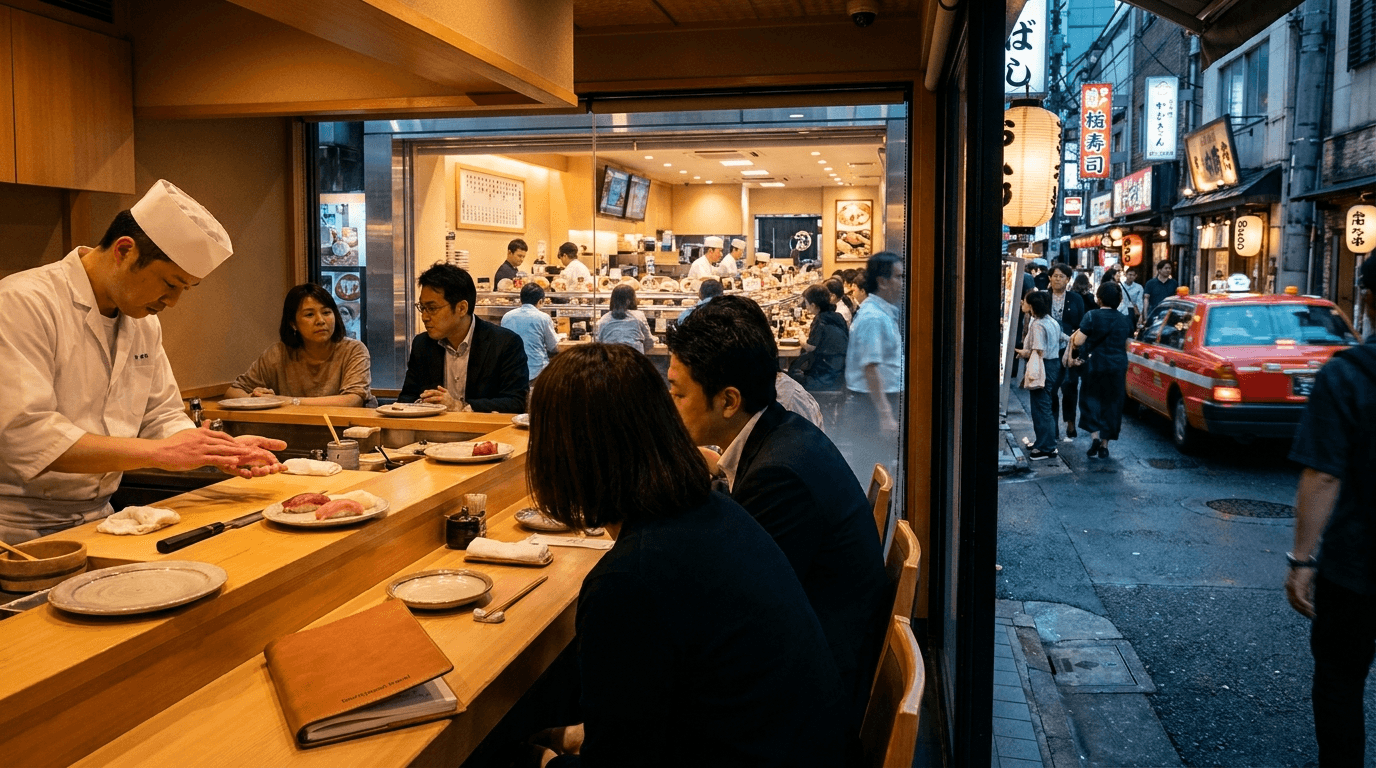
Best Sushi in Tokyo 2026: Top 20 Sushi Restaurants
By Tour in Japan editors · Updated
best sushi tokyo
Tokyo has the world's best sushi — from ¥100 plates at conveyor belt restaurants to ¥30,000 omakase experiences. Here are the top 20 spots.
Sushi Styles in Tokyo
| Style | Description | Price Range |
|---|---|---|
| Kaitenzushi | Conveyor belt, grab plates | ¥100–300/plate |
| Sushi-ya | Traditional counter, chef's choice | ¥3,000–15,000 |
| Omakase | Chef's choice, premium | ¥10,000–50,000 |
| Sushi set | Fixed menu, good value | ¥2,000–5,000 |
| Standing sushi | Quick, cheap, no frills | ¥500–1,500 |
| Takeout | From konbini or market | ¥300–2,000 |
Top 20 Sushi Restaurants
Kaitenzushi (Conveyor Belt) — Budget Friendly
| Restaurant | Location | Price | Rating | Notes |
|---|---|---|---|---|
| Sushiro | Various | ¥1,000–2,000 | ★★★★★ | Best value chain |
| Kura Sushi | Various | ¥1,000–2,000 | ★★★★☆ | All-you-can-eat option |
| Hamazushi | Various | ¥800–1,500 | ★★★★☆ | Budget-friendly |
| Genki Sushi | Various | ¥1,000–2,000 | ★★★★☆ | Fast, fun delivery system |
| Uobei Shibuya | Shibuya | ¥100/plate | ★★★★☆ | £1 per plate, order by screen |
Mid-Range Sushi-ya — Best Value
| Restaurant | Location | Price | Rating | Notes |
|---|---|---|---|---|
| Sushi Dai | Toyosu Market | ¥4,000–6,000 | ★★★★★ | Famous, 2-hour wait |
| Daiwa Sushi | Toyosu Market | ¥3,000–5,000 | ★★★★★ | Less wait, same quality |
| Sushi Saito | Roppongi | ¥20,000–30,000 | ★★★★★ | 3 Michelin stars |
| Sushi Yoshitake | Ginza | ¥15,000–25,000 | ★★★★★ | 3 Michelin stars |
| Masa | Midtown | ¥10,000–20,000 | ★★★★★ | 2 Michelin stars |
Omakase (Premium) — Once in a Lifetime
| Restaurant | Location | Price | Rating | Notes |
|---|---|---|---|---|
| Sukiyabashi Jiro | Ginza | ¥30,000–50,000 | ★★★★★ | Documentary fame, 3 stars |
| Sushi Saito | Roppongi | ¥20,000–30,000 | ★★★★★ | Reservation 3+ months ahead |
| Masa | Midtown | ¥10,000–20,000 | ★★★★★ | NYC transplant, 2 stars |
| Sushi Iwa | Ginza | ¥15,000–25,000 | ★★★★★ | 3 stars, intimate counter |
| Kohaku | Kagurazaka | ¥15,000–25,000 | ★★★★★ | 3 stars, innovative |
| Ishikawa | Kagurazaka | ¥10,000–20,000 | ★★★★★ | 3 stars, seasonal focus |
| Kanda | Minato | ¥15,000–25,000 | ★★★★★ | 3 stars, traditional |
Standing Sushi — Quick & Cheap
| Restaurant | Location | Price | Rating | Notes |
|---|---|---|---|---|
| Standing Sushi Bar | Various | ¥500–1,500 | ★★★★☆ | Quick, fresh, cheap |
| Sushi Zanmai | Various | ¥1,000–2,000 | ★★★★☆ | 24-hour, reliable |
| Haruki | Various | ¥800–1,500 | ★★★☆☆ | Budget option |
How to Order Sushi
At Kaitenzushi
| Step | What to Do |
|---|---|
| 1. Sit down | Take a seat at the counter or table |
| 2. Order via screen | Touch screen menu, select items |
| 3. Wait | Sushi arrives on conveyor belt or special lane |
| 4. Eat | Take plates from the belt |
| 5. Stack plates | Keep used plates for billing |
| 6. Pay | Count plates at the register |
| 7. Say "gochisousama" | Thank the staff |
At Traditional Sushi-ya
| Step | What to Do |
|---|---|
| 1. Sit at counter | Best experience — watch the chef |
| 2. Trust the chef | Order omakase for the best experience |
| 3. Eat in order | Start with lighter fish, end with richer |
| 4. Eat immediately | Sushi is best fresh |
| 5. Use fingers | It's perfectly acceptable |
| 6. Dip lightly | Fish side only, not the rice |
| 7. Finish everything | It's polite to eat all pieces |
Sushi Etiquette
Do
- ✅ Eat sushi in one bite (if possible)
- ✅ Use fingers for nigiri (it's traditional)
- ✅ Dip fish side only in soy sauce
- ✅ Eat ginger between pieces (palate cleanser)
- ✅ Say "gochisousama" when finished
- ✅ Thank the chef ("oishi desu" / it's delicious)
- ✅ Sit at the counter for the best experience
Don't
- ❌ Mix wasabi into soy sauce (chef already placed it)
- ❌ Dunk the rice in soy sauce (it falls apart)
- ❌ Eat ginger with the sushi (it's a palate cleanser)
- ❌ Put chopsticks standing up in rice (funeral association)
- ❌ Point at sushi with chopsticks
- ❌ Take too long — sushi is meant to be eaten fresh
Best Sushi by Budget
| Budget | What to Expect | Where to Go |
|---|---|---|
| ¥500–1,000 | Standing sushi, basic nigiri | Standing Sushi Bar, konbini |
| ¥1,000–2,000 | Kaitenzushi, good variety | Sushiro, Kura Sushi |
| ¥2,000–5,000 | Set menu, good quality | Mid-range sushi-ya |
| ¥5,000–10,000 | Omakase (entry level) | Various Ginza shops |
| ¥10,000–20,000 | Premium omakase | Michelin-starred shops |
| ¥20,000–50,000 | World-class omakase | Sukiyabashi Jiro, Sushi Saito |
Sushi at Toyosu Market
The successor to Tsukiji Outer Market:
| Restaurant | Type | Price | Wait Time |
|---|---|---|---|
| Sushi Dai | Omakase | ¥4,000–6,000 | 2–3 hours |
| Daiwa Sushi | Omakase | ¥3,000–5,000 | 1–2 hours |
| Sushi Zanmai | Various | ¥2,000–4,000 | 30–60 min |
| Iwasa Sushi | Kaitenzushi | ¥2,000–3,000 | 30–60 min |
Tip: Arrive at 5 AM to avoid the worst lines. Weekdays are much better than weekends.
Reservation Tips
| Restaurant Type | How to Book | Lead Time |
|---|---|---|
| Kaitenzushi | Walk-in | None |
| Mid-range | Phone or online | 1–2 days |
| Premium omakase | Concierge or reservation service | 1–3 months |
| Michelin-starred | Hotel concierge or Japanese friends | 3–6 months |
| Tourist-friendly | Online booking (Tabelog, Omakase) | 1–4 weeks |
Pro tip: Have your hotel concierge book for you — they have connections and speak Japanese.
FAQ
Q: How much does sushi cost in Tokyo? A: ¥500–50,000 depending on the restaurant. Kaitenzushi is ¥1,000–2,000, mid-range ¥3,000–5,000, omakase ¥10,000–50,000.
Q: What's the best kaitenzushi chain? A: Sushiro is widely considered the best value — good quality, reasonable prices, fun atmosphere.
Q: Do I need reservations for sushi in Tokyo? A: For kaitenzushi, no. For mid-range and above, yes — especially for omakase. Book 1–3 months ahead for popular spots.
Q: Can I eat sushi with my hands? A: Yes — it's traditional and perfectly acceptable. Many sushi chefs prefer it.
Q: What's the difference between nigiri and sashimi? A: Nigiri is rice topped with fish. Sashimi is just fish (no rice).
Useful Japanese Phrases
| Japanese | Romaji | English |
|---|---|---|
| おすすめは何ですか? | Osusume wa nan desu ka? | What do you recommend? |
| おまかせでお願いします | Omakase de onegai shimasu | Chef's choice, please |
| おいしいです | Oishii desu | It's delicious |
| ごちそうさまでした | Gochisōsama deshita | Thank you for the meal |
| お会計お願いします | Okaikei onegai shimasu | Check, please |
| もう一つお願いします | Mō hitotsu onegai shimasu | One more, please |
Internal Links
- Tokyo Street Food Guide
- Best Ramen in Osaka
- Japan Food Guide
- Budget Japan Travel Guide
- Cheapest Places to Eat in Japan
FAQ Schema
<script type="application/ld+json"> { "@context": "https://schema.org", "@type": "FAQPage", "mainEntity": [ { "@type": "Question", "name": "How much does sushi cost in Tokyo?", "acceptedAnswer": { "@type": "Answer", "text": "Kaitenzushi costs ¥1,000-2,000, mid-range ¥3,000-5,000, and premium omakase ¥10,000-50,000." } }, { "@type": "Question", "name": "What is the best kaitenzushi in Tokyo?", "acceptedAnswer": { "@type": "Answer", "text": "Sushiro is widely considered the best value kaitenzushi chain in Tokyo, offering good quality at reasonable prices." } } ] } </script>
Stay Connected in Japan
Yesim eSIMs work on arrival — no physical SIM needed. Japan data plans from $5.